


• A Literary Magazine | Honest Reflections on Life's Leisurely Diversions

Monthly Archives :

June 2025

One for the books

150 150 bjj-sportliterate

One for the Books

A Review of Stephen Lane’s Long Run to Glory

by Scott F. Parker

Was the 1984 women’s race “the greatest marathon in Olympic history,” as Stephen Lane’s subtitle claims? I don’t know. There have been some great ones in history — without even mentioning Sifan Hassan’s 2024 win, which occurred after the publication of Long Run to Glory. But having read the book I am persuaded that Lane has reported the race, the first women’s Olympic marathon, with the greatest narrative intrigue.
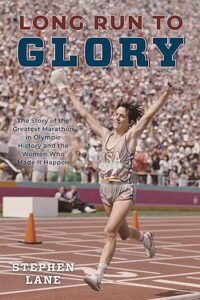
If you’re a track fan you are likely familiar with the story’s major plot points: after almost a century of men’s marathoning at the Olympics, women were finally given the opportunity to race 26.2 miles; the race, held in Los Angeles, was won by Joan Benoit, an American; no uteruses were found to have fallen out on the racecourse (as had been feared).

What Lane contributes to the story is an impressive depth of reporting that contextualizes the race in terms of the history of women’s distance running, the women’s movement broadly, and the lives of its leading athletes. He demonstrates a wonderful sensitivity to his primary subjects — Grete Waitz, Rosa Mota, and Ingrid Kristiansen, as well as Benoit.

What’s more, he does so without sacrificing narrative momentum, some feat when you consider that the race results have been in for four decades. For an allegedly boring sport to watch, marathoning, in Lane’s hands, is riveting to read about. His play-by-play of the marathon is scrupulous and informed, his enthusiasm contagious. And when it comes time for the runners to make their moves and respond to one another (or not), Lane’s psychological and performance background has prepared the reader to appreciate the implications of their decisions.

Whether or not it was the greatest Olympic marathon, it was the most significant. And Lane has given us a book worthy of its subject. This is a short review but it could be shorter: if you like sports books, you’ll want to read this one.

Scott F. Parker is the author of Run for Your Life: A Manifesto and The Joy of Running qua Running, among other books. His writing has appeared in Runner’s WorldRunning TimesTin HousePhilosophy NowThe Believerand other publications. He teaches at Montana State University and is the nonfiction editor for Kelson Books.
A HIGHER STANDARD

150 150 bjj-sportliterate

A Higher Standard

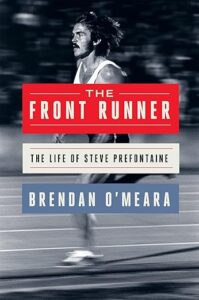
A Review of Brendan O’Meara’s The Front Runner: The Life of Steve Prefontaine

by Scott F. Parker

A substantial biography of Steve Prefontaine has been a long time coming. In the 50 years following Prefontaine’s death, Tom Jordan’s Pre was the only book devoted to the life of America’s most iconic distance runner. As serviceable an introduction to Prefontaine as Jordan’s book is, it lacks the depth an athlete of Prefontaine’s stature deserves. And so on the very month of the semicentennial of the car crash that took Prefontaine’s life, Brendan O’Meara’s The Front Runner becomes the first full biographical testament to one of the remarkable lives in track and field.

It’s no simple task to write about Prefontaine. Despite the relative paucity of biographical attention he’s received, his memory has taken hold in the running world like few others’, thanks largely to the films (two biopics, two documentaries) that both treat and establish his legacy. O’Meara is exactly right that Prefontaine, “a runner who never won an Olympic medal or broke a world record, remains, to this day, an avatar of self-belief, hard work, and determination, a philosopher runner who, as [Bill] Bowerman noted, sought a higher purpose than winning. Above all, a legend that superseded the man at the heart of the myth.” The challenge to the biographer of such a subject, then, is plain: to locate the man behind the myth, to puncture the legend with reality. And to a moderate degree, O’Meara succeeds.

One thing that has previously been intimated but that O’Meara lays bare is the physical abuse Prefontaine suffered as a boy at the hands of both parents. O’Meara details regular beatings that surpassed what was considered acceptable in 1950s lumberjack-tough Coos Bay enough that Prefontaine’s older half-sister and protector, Neta, sought interventions from neighbors. After presenting this history, O’Meara shows careful restraint interpreting it: “While it is a stretch to connect a straight line from being beaten as a child to Steve wanting to then ‘abuse’ his competition, the pain he endured at the hand of his father was, without question, a condition of his upbringing, in the same way that the pervasive culture of masculinity endemic to Coos Bay also was an ingredient to the roundness of Steve’s character and burgeoning sense of self.”

A lot goes into making anyone who they are, and the consequences of impacts are impossible to predict. If the abuse Prefontaine underwent influenced his tenacious approach to running, did it also influence his tenacious approach to beer drinking? To the casual reader, that impression is hard to avoid. Among other prodigious feats of binge drinking, O’Meara describes Prefontaine downing multiple pitchers on his way to winning drinking competitions, holding open his esophagus to allow himself to poor beer straight into his stomach, projectile vomiting at practice, and installing a kegerator at his house. Such dedicated drinking would be impressive even if Prefontaine were not simultaneously competing as one of the world’s great runners.

As dispiriting as the physical abuse and alcohol abuse are to read about, neither challenges the legend of Prefontaine as someone uniquely capable of transcending suffering through the expression of his indomitable will. Seen through the narrative we mostly know him by, the greater the suffering overcome, the greater the conquest. But such heroism is complicated, in O’Meara’s telling, at the nexus of Prefontaine’s self-doubt.

The inspiration Prefontaine’s fans take from his example often leads them toward liberation from their own doubts. How, then, to reconcile the image of the liberated Prefontaine with the runner thinking to himself “that running wasn’t everything. It cut into his personal life, or was so demanding that he had no real personal life at all. He wanted to do and try different things. There had to be more to life than running in circles.” The burnout O’Meara is describing here is from the summer of 1970, when Prefontaine is only a year removed from high school. While the dream of the 1972 Olympics would be enough to keep Prefontaine committed to running, the pattern of disillusion would recur for him, especially following the disappointment of those 1972 Games.

What’s so compelling about this theme in The Front Runner is that it gives us a perfectly average Prefontaine, one who keeps asking himself, “Is it worth it? Is it worth it? Is it worth it? The age-old question long-distance runners have always asked themselves.” For once, Prefontaine is made vulnerable. On this point more than on any other, O’Meara achieves his goal of humanizing his icon.

But even in this depiction, we read about Prefontaine’s psyche only as it bears on his running. Readers who wonder what might have interested Prefontaine off the track (besides opening a sports bar) will be left wondering. This is understandable to a degree. There is only so much to a life at twenty-four when so much of that life has been dedicated to such a demanding enterprise as elite distance running. And yet, there are plenty of answerable questions that O’Meara neglects. Prefontaine joined a frat. Which one? Did he live there? If not, where? And, prior to Pat Tyson, with whom? Of his many girlfriends, Mary Marckz and Nancy Allman are named. Were these relationships serious? Long lasting? What did they mean to him? What about school? He was a communications major (yet he could not spell). What kind of student was he? Did he like classes? Did he go to them? What did he learn? Those are things I wish I knew about someone whose life has fascinated me for decades.

Prefontaine’s accomplishments are the stuff of lore, as are his disappointments. As moving as it is to revisit them in O’Meara’s renderings — and for fans of Prefontaine it’s very moving indeed — he doesn’t have a lot to say about the human being whose accomplishments and disappointments they were. In its attention to Prefontaine the runner, The Front Runner solidifies the familiar narrative arc of his career; in its neglect of Prefontaine the man behind the runner, it leaves the legend to live on.

Scott F. Parker is the author of Run for Your Life: A Manifesto and The Joy of Running qua Running, among other books. His writing has appeared in Runner’s WorldRunning TimesTin HousePhilosophy NowThe Believerand other publications. He teaches at Montana State University and is the nonfiction editor for Kelson Books.

Planes, El Trains, and Ubers in Chicago

150 150 bjj-sportliterate

Planes, El Trains, and Ubers in Chicago

by Nancy Luana

In the South, where I come from, we are sweet — iced-tea sweet like my Aunt Mary used to make — one part tea, three parts sugar. And sometimes, oftentimes, that sweet is genuine. Other times it can leave a little bitter aftertaste, like maybe it wasn’t real sugar after all.

Not Chicago where I just visited for the first time. Y’all are something else, something I don’t quite have a name for because I’ve simply never experienced it before.

I was visiting just overnight to help the journal, Sport Literate, celebrate its 30th anniversary and to celebrate one of my essays being published in the same celebration issue. (You’ll want to read it, of course. “Forever Stamp.” Heck. Just go ahead and subscribe to the journal. It’s a pretty great journal boasting all kinds of awards and featuring the work of many more award-winning writers.)

My trip began at the O’Hare Airport where, when I went down the escalator to the platform where I was supposed to meet my hotel shuttle, the platform appeared to be above me. When I went up the escalator, the platform where I was supposed to be was below me? Well, anyway, a pilot who I am sure just wanted to go home observed my perplexed expression. Let me take you, he said. I have time.

Two hours later I attempted to take the CTA to my venue, Midwest Coast Brewing on West Walnut. I had studied my trains ahead of time. The green line and the blue line. It was the pink and purple and orange lines, as I recall, that got me in trouble — that combined with the fact that that I twice ignored the instructions given me by the good folks at Midwest Coast Brewing. I somehow reasoned that I, who had been in your town for two hours, knew more about how to navigate the CTA than folks who had lived in Chicago their whole lives.

It didn’t start out so bad. I got off the train the first time at the right stop but then couldn’t figure out how to get to the pink line. A woman mopping the platform who looked tired enough to drop and who probably would have rather been doing anything other than giving this poor tourist directions said, Come with me. I’ll show you.

There are two Damen stops, as I’m sure you know, one south, way south of where I was trying to go. Y’all do that to goof with first time tourist like myself, I figure, which seems sort of fair.  When I’d gone about as far south as I could go, some little voice said You have messed this up. Get off of this train. I did, and I explained to the lady in the plexiglass booth that I was on the verge of a panic attack. Because I was. I just need to get over there, I explained, pointing to the other side and almost seriously considering traversing the tracks. She began speaking to me in a voice not unlike the voice preschool teachers use to calm children who have missed both their nap and their snack. It’s easy, she said. See that sign? You just go up those stairs and get on the green line, and it will take you right to Damen. You can do it. 

It did. And I did.

And then West Walnut Street hid from me and from Google maps both. But it could not hide from the three separate total strangers all determined to get me to the Midwest Coast Brewing Company.  One by one, 10 minutes apart, they pointed. See the rail road overpass? Turn left there. Then turn left again. And when I goofed that up, there was some other Chicagoan, See the railroad overpass? Go under it. Go right . . .

I’d arrived hours early for my event, but before I’d finished my first beer, a group of people who’d just come from a fundraiser to raise money for an intergenerational housing project for gay persons joined me at the bar and bought me a beer and invited me to join them rather than be alone, and by the time they left an hour later I knew that I’d met people who were going to change the world and whose paths I would always be wanting to cross mine again in the future.

But what about the Sport Literate event, you ask? I’ll let the picture speak for itself.

Chicago Party People (left to right): Lora Keller, Nancy Luana, William Meiners, Joellen Lewsader, Nick Reading, and Justin Staley.

Oh, God. How did this woman get back to her hotel, you want to know. Consistent with how I got to Midwest Coast Brewing. With great difficulty. And with Chicago help. Do you know that you have three Hyatts near the airport? I’ve been to them all. After my Uber driver delivered me to the first wrong Hyatt (not his fault), he turned off Uber and determined to get me to the correct Hyatt. When I tried to explain to him that he would not get paid if we did not use Uber because I had credit and debit cards only, his only reply was, “I want to help you” — something he said four times over the next 20 minutes –—  I want to help you. (Ultimately I did figure out that I could compensate him for all of the fares when I tipped him for the first fare.) When we arrived at the second incorrect Hyatt, the Uber driver said I’ll wait for you. The young man at the concierge desk, after being told how ridiculously lost I was, looked up my reservation and wrote the address down and then pushed the piece of paper calmly, slowly towards me and then in the same preschool teacher voice that the CTA worker had used, he said, You okay? You’re very close.

 When I arrived at my Hyatt Regency O’Hare, I bolted quickly from my Uber car, fatigue and emotions all getting an upper hand, but I did not bolt quickly enough to keep my Uber driver from reaching back towards me with a fist pump of sorts. You’re so kind, I said.

 I just want to help you, he said.

Back home and preparing to board my own transit system, a woman who I am guessing was from the Middle East was studying the ticket-dispensing machine, her finger poised just above the screen with too many selections. Her eyes when she looked at me were that kind of moist that eyes get when they are trying very hard not to cry. Can you help me? she asked.  As we purchased her ticket and got her on the right train, she alternated over and over again between, You are so kind and You are so helpful.

Yeah, I told her.  I just got back from Chicago.

I learned it there.


Nancy Luana grew up in Decatur, Georgia, where she lives today and where many of her essays, like this one, are set. She is a graduate of the Naslund-Mann Graduate School of Writing at Spalding University in Louisville, Kentucky. Her writing has appeared in the Atlanta Journal Constitution and the Appalachian Review. When she is not working or writing, she is actively planning her escape from the big city. She is studying sailing and hopes one day to be writing from her boat on the Georgia coast. Her cat, Charlie Wilkes, is reportedly not onboard with these plans.