


A Higher Standard
A Review of Brendan O’Meara’s The Front Runner: The Life of Steve Prefontaine
by Scott F. Parker
A substantial biography of Steve Prefontaine has been a long time coming. In the 50 years following Prefontaine’s death, Tom Jordan’s Pre was the only book devoted to the life of America’s most iconic distance runner. As serviceable an introduction to Prefontaine as Jordan’s book is, it lacks the depth an athlete of Prefontaine’s stature deserves. And so on the very month of the semicentennial of the car crash that took Prefontaine’s life, Brendan O’Meara’s The Front Runner becomes the first full biographical testament to one of the remarkable lives in track and field.
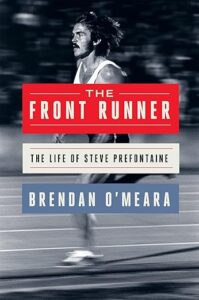 It’s no simple task to write about Prefontaine. Despite the relative paucity of biographical attention he’s received, his memory has taken hold in the running world like few others’, thanks largely to the films (two biopics, two documentaries) that both treat and establish his legacy. O’Meara is exactly right that Prefontaine, “a runner who never won an Olympic medal or broke a world record, remains, to this day, an avatar of self-belief, hard work, and determination, a philosopher runner who, as [Bill] Bowerman noted, sought a higher purpose than winning. Above all, a legend that superseded the man at the heart of the myth.” The challenge to the biographer of such a subject, then, is plain: to locate the man behind the myth, to puncture the legend with reality. And to a moderate degree, O’Meara succeeds.
One thing that has previously been intimated but that O’Meara lays bare is the physical abuse Prefontaine suffered as a boy at the hands of both parents. O’Meara details regular beatings that surpassed what was considered acceptable in 1950s lumberjack-tough Coos Bay enough that Prefontaine’s older half-sister and protector, Neta, sought interventions from neighbors. After presenting this history, O’Meara shows careful restraint interpreting it: “While it is a stretch to connect a straight line from being beaten as a child to Steve wanting to then ‘abuse’ his competition, the pain he endured at the hand of his father was, without question, a condition of his upbringing, in the same way that the pervasive culture of masculinity endemic to Coos Bay also was an ingredient to the roundness of Steve’s character and burgeoning sense of self.”
A lot goes into making anyone who they are, and the consequences of impacts are impossible to predict. If the abuse Prefontaine underwent influenced his tenacious approach to running, did it also influence his tenacious approach to beer drinking? To the casual reader, that impression is hard to avoid. Among other prodigious feats of binge drinking, O’Meara describes Prefontaine downing multiple pitchers on his way to winning drinking competitions, holding open his esophagus to allow himself to poor beer straight into his stomach, projectile vomiting at practice, and installing a kegerator at his house. Such dedicated drinking would be impressive even if Prefontaine were not simultaneously competing as one of the world’s great runners.
As dispiriting as the physical abuse and alcohol abuse are to read about, neither challenges the legend of Prefontaine as someone uniquely capable of transcending suffering through the expression of his indomitable will. Seen through the narrative we mostly know him by, the greater the suffering overcome, the greater the conquest. But such heroism is complicated, in O’Meara’s telling, at the nexus of Prefontaine’s self-doubt.
The inspiration Prefontaine’s fans take from his example often leads them toward liberation from their own doubts. How, then, to reconcile the image of the liberated Prefontaine with the runner thinking to himself “that running wasn’t everything. It cut into his personal life, or was so demanding that he had no real personal life at all. He wanted to do and try different things. There had to be more to life than running in circles.” The burnout O’Meara is describing here is from the summer of 1970, when Prefontaine is only a year removed from high school. While the dream of the 1972 Olympics would be enough to keep Prefontaine committed to running, the pattern of disillusion would recur for him, especially following the disappointment of those 1972 Games.
What’s so compelling about this theme in The Front Runner is that it gives us a perfectly average Prefontaine, one who keeps asking himself, “Is it worth it? Is it worth it? Is it worth it? The age-old question long-distance runners have always asked themselves.” For once, Prefontaine is made vulnerable. On this point more than on any other, O’Meara achieves his goal of humanizing his icon.
But even in this depiction, we read about Prefontaine’s psyche only as it bears on his running. Readers who wonder what might have interested Prefontaine off the track (besides opening a sports bar) will be left wondering. This is understandable to a degree. There is only so much to a life at twenty-four when so much of that life has been dedicated to such a demanding enterprise as elite distance running. And yet, there are plenty of answerable questions that O’Meara neglects. Prefontaine joined a frat. Which one? Did he live there? If not, where? And, prior to Pat Tyson, with whom? Of his many girlfriends, Mary Marckz and Nancy Allman are named. Were these relationships serious? Long lasting? What did they mean to him? What about school? He was a communications major (yet he could not spell). What kind of student was he? Did he like classes? Did he go to them? What did he learn? Those are things I wish I knew about someone whose life has fascinated me for decades.
Prefontaine’s accomplishments are the stuff of lore, as are his disappointments. As moving as it is to revisit them in O’Meara’s renderings — and for fans of Prefontaine it’s very moving indeed — he doesn’t have a lot to say about the human being whose accomplishments and disappointments they were. In its attention to Prefontaine the runner, The Front Runner solidifies the familiar narrative arc of his career; in its neglect of Prefontaine the man behind the runner, it leaves the legend to live on.
Scott F. Parker is the author of Run for Your Life: A Manifesto and The Joy of Running qua Running, among other books. His writing has appeared in Runner’s World, Running Times, Tin House, Philosophy Now, The Believer, and other publications. He teaches at Montana State University and is the nonfiction editor for Kelson Books.