


Running and Writing the Self:
A Review of Nicholas Thompson’s Running Ground
It hardly matters whether you approach running competitively, recreationally, or as a responsible form of aerobic exercise, eventually you will confront the kind of metaphysical conundrum with which the sport abounds. Who am I? What kind of thing? In what relation to the world? Capable of what?
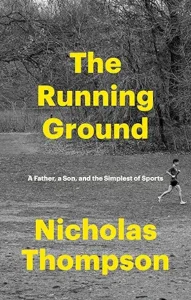 In his memoir, Running Ground, Nicholas Thompson describes one possible route to such philosophical territory. A competitive runner, Thompson is ever on the lookout for opportunities to shave time from his results, one of these being to learn how to ignore the desire to slow by overruling what are in effect the brain’s warnings to preserve energy, something Tim Noakes calls “the Central Governor Model.” As Thompson explains, “The Central Governor Model suggests a mind-body dilemma. We all can go faster. We just need to persuade our brains not to start the subconscious shutdown process right away. But the only thing we can use to trick our brains is our brains. Training becomes a game of hide-and-seek with oneself.”
Right, but bootstrapping problems aside, what is the self? For Thompson it’s a multitude. “I realize now,” he reflects from the vantage of middle-age, “that I’ve sought distinct and different compound goals from the sport as I’ve gone through life: self-confidence, self-awareness, and self-transcendence.”
The mature runner, if anything like Thompson, balances these three goals, identifying now as unlimited will, now as a bounded and contingent being, and now as being itself (perhaps). But the memoirist pursues a singular goal, one that relies on a narrower sense of self: how, he asks, can I understand the past that has made me into the person now looking back at that past? In Thompson’s case, the story he’s after is the one that explains how he became a world-class masters runner after years of good but not great racing. If that scans as standard inspirational stuff, be advised that The Running Ground is an outlier among running books. In addition to being an elite runner, Thompson is an enormously gifted writer, capable of being competitive in major marathons and then reflecting on them with the sensitivity and precision of someone who has dedicated himself to a life of letters. (In his day job, he is a prominent journalist.)
The story of Thompson’s running begins with his father, a competitive runner himself, who introduced Nicholas to the sport. After finding success in high school, Thompson is good enough to run for Stanford but not good enough to stand out there. He leaves the team and takes a break from running before taking up marathoning a few years later and going on to earn the nickname “Mister 243” for his uncanny ability to run this time and only this time (plus or minus). It is only after surviving thyroid cancer at 30 that Thompson is able to break through and improve significantly on his two hours and 43 minutes. Looking back on this period of his life, Thompson writes, “Multiple studies have shown that survivors of cancer often experience what is known as post-traumatic growth. Standing on the edge of mortality gives them clarity about what matters.” It’s another one of those oddities of the human psyche. We all know that we will die, indeed are all the time approaching death. Yet this insight alone isn’t enough to propel us toward the growth that we know is available. And pretty soon those possible selves become unavailable to us.
Even after running his personal marathon best of 2:29 at age 44, Thompson must confront the reality of his unrealized potential: “I wondered then, as I wonder now, what other versions of me exist that there may no longer be time to find.”
There would be worse ways to read The Running Ground than as a reckoning with aging. As Thompson finds new ways to excel past his running prime, his father’s life undergoes a fairly spectacular decline that serves as a cautionary example, among other cautionary examples, that “people stop running because they get old; they also get old because they stop running.” Thompson’s response to his father’s eventual death is to push himself to run faster, a way of processing his loss by means of accepting his father’s “gift of running” and refusing to squander it.
But just as there is something noble about doing one’s best, no level of success forestalls death or decline. And while the rewards of running certainly include accomplishment, they are not equivalent to it. For all the ways Thompson sacrifices at the altar of speed, he understands that speed and the pursuit of speed is itself but a means toward the end of experience.
The telos of running, if it can be put so seriously, is a way of being in the world that, for the runner, is indistinguishable from play. Even the hard work of training and vigorous effort are but forms through which play expresses itself. Thompson quotes Charlie Parker to this effect: “Learn all the theory you can, but forget it when you play.” When you’re running, just run. Just trust yourself to play.
Of course it’s a gift to run, and it’s one the runner wants to pass along to his children when the time comes: “I hope, though, that one day in the future, in whatever cities they live, they stand on the sidelines of a major race, watching the runners flow by, remembering cold November mornings from a generation ago when their father, then strong and quick, ran by on Atlantic Avenue.”
Scott F. Parker is the author of Run for Your Life: A Manifesto and The Joy of Running qua Running, among other books. His writing has appeared in Runner’s World, Running Times, Tin House, Philosophy Now, The Believer, and other publications. He teaches at Montana State University and is the nonfiction editor for Kelson Books.