


The Sustaining Power of Myth
A Review of Matt Love’s Never Stop Pre
by Scott F. Parker
For the past quarter century, Matt Love has been one of the more prominent, and perhaps the most prolific, members of the Oregon literary community. Through his Nestucca Spit Press, he’s published more than two dozen books exploring the history, geography, and culture of his home state. It’s only fitting that on the 50th anniversary of Steve Prefontaine’s death Love has turned his attention to Oregon’s foremost athletic icon with his new book Never Stop Pre: The Enduring Inspiration of America’s Greatest Sports Legend.
As Love rightly assumes, there is no need to establish Prefontaine’s bona fides either as a runner or as a legend of the sport. The legacy speaks for itself to anyone with even the least interest in track. And yet for those versed in the mythology of Prefontaine there is deep pleasure to be taken in celebrating his feats in the company of other fans or — let me call them what they are, let me call us what we are — disciples. Through half a century of communal worship we have established not just the legend of Prefontaine but also its power. And the more we go on honoring him, the more deserving of honor he becomes. The man becomes a symbol.
At its core, Never Stop Pre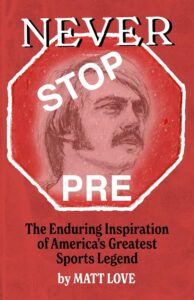 is a compendium of 28 scenes attesting to Prefontaine’s lasting impact, a book-length collage of poems, song lyrics, newspaper articles, official testimonies, oral histories, folk tales, and the inspired efforts of everyday runners. Love has dug deep into the archives and emerged with gems, like Senator Mark Hatfield referring to Pre as “an Oregon tiger” in the Senate Congressional Record and Governor Tom McCall writing in a letter to Prefontaine’s parents that “Oregon has never been struck such a tragic blow.”
Alongside these historical artifacts, Love relates his own personal relationship to Pre’s influence, the power of which he attests to early in the book, writing, “Indeed, his legend had a significant influence in staying my hand against suicide.”
Several years ago, after pleading guilty to luring a minor for sex, Love was sentenced to 30 days in jail, two years of probation, and forced to pay restitution and register as a sex offender, making him persona non grata in the community he had been so instrumental in creating. Writing in the third person, he describes the saga this way in the book, “He had made a mistake in two sentences of written social media communication (no images at all) with a 17-year-old female he was mentoring (not his student) and lost everything. The State annihilated his past and present; he had no future. The mob had stoned him to death on social media and newspaper comment boards. He had considered suicide by jumping into Hart’s Cove on Cascade Head; he was encouraged to commit suicide by total strangers. His closest friend vanished without a word.”
Fortuitously, at this time, he pulled his truck off Highway 101 to wait out a storm in Coos Bay. There, he walked into the Coos Art Museum and “took the stairs to the Prefontaine Memorial Gallery. No one was there. He examined the memorabilia and then sat down and started reading the register.” An hour later, after soaking up the appreciation others have expressed for Pre, Love persuaded himself that he must run “like Pre raced, although there was no known finish line. It was the only way he would ever survive.”
Love’s psychodrama can be read as indulgent, a distraction from the tribute he otherwise pays his hero. But it’s easy to judge, and Love’s story can just as well be read as a testament to the power and utility of Prefontaine lore. The beauty of the myth of Prefontaine is its vast applicability. Pre “knew he had to keep running to see who had the most guts.” The metaphor is there for the taking: it’s possible for anyone to live with the kind of guts Pre ran with — possible at least to aspire to. Whatever anyone thinks of Love’s crime, it took guts for him to draw from Pre’s example the courage he needed to go on, it took guts to write this book as he wrote it.
Never Stop Pre is a book a certain kind of Oregonian and a certain kind of runner will have been waiting for. It’s a book that asks us to take Prefontaine seriously. Even more, it asks us — whether we make a pilgrimage to his holy sites (Hayward Field, Pre’s Rock, his gravesite in Coos Bay, etc.) or just read about them — to study Pre’s example and from it learn how to take ourselves seriously as well.
Scott F. Parker is the author of Run for Your Life: A Manifesto and The Joy of Running qua Running, among other books. His writing has appeared in Runner’s World, Running Times, Tin House, Philosophy Now, The Believer, and other publications. He teaches at Montana State University and is the nonfiction editor for Kelson Books.