

• A Literary Magazine | Honest Reflections on Life's Leisurely Diversions

Uncategorized

Reds Take Two in the City of Brotherly Love

150 150 bjj-sportliterate

Reds Take Two in the City of Brotherly Love

Baseball is a funny game. Not the bent over, cackle-out-loud funny induced from your favorite cocaine-fueled comedians from the 1970s and ’80s. More like a dry wit observational humor as told by predatory funnymen from the 1980s and ’90s.

The Reds and Phillies had similar records when they met for a Mid-May midweek showdown. Yet the Phillies were rising, playing their best ball. The Reds, though not in the freefall of the first nine days of the month, were still scuffling.

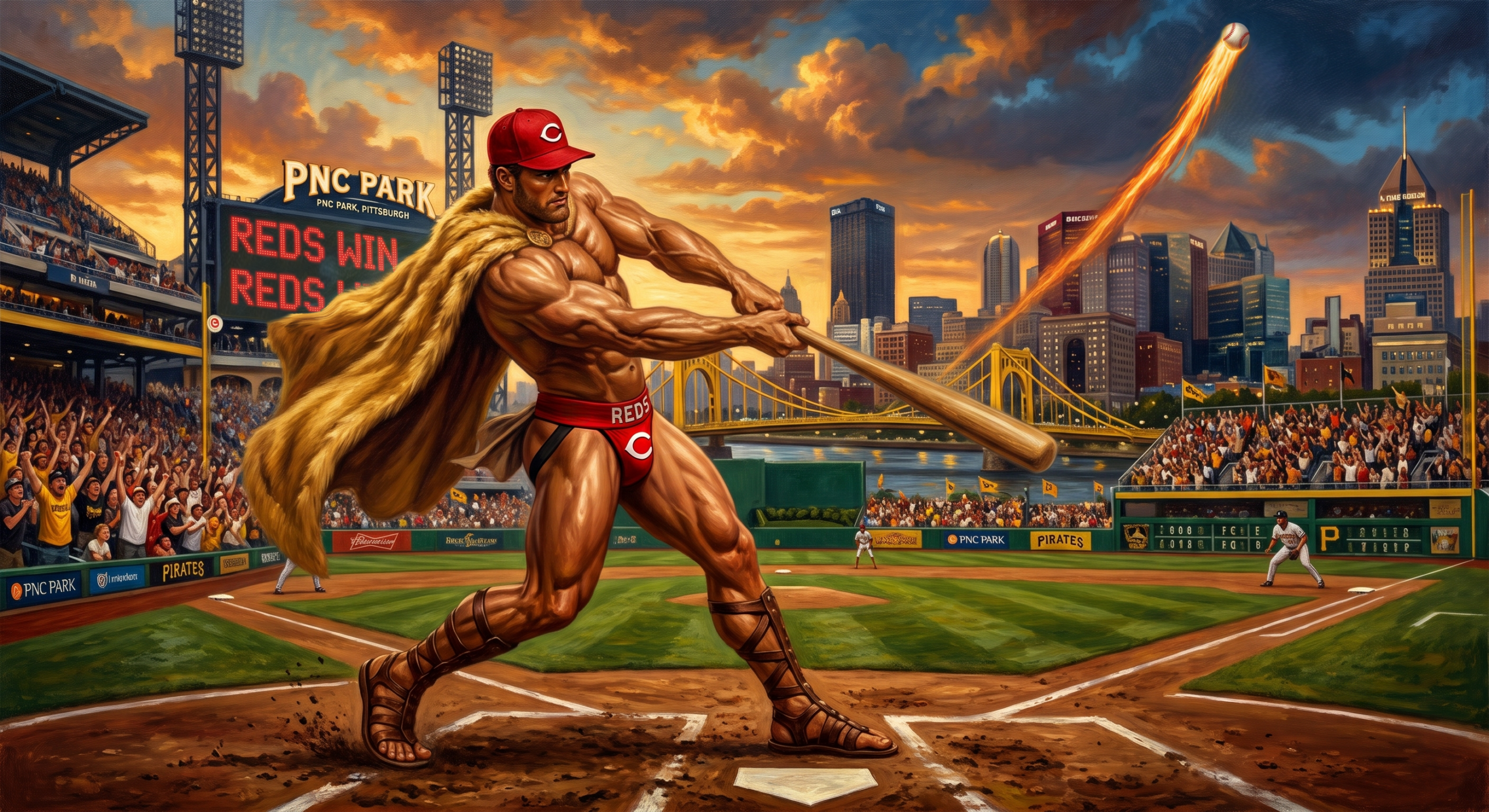
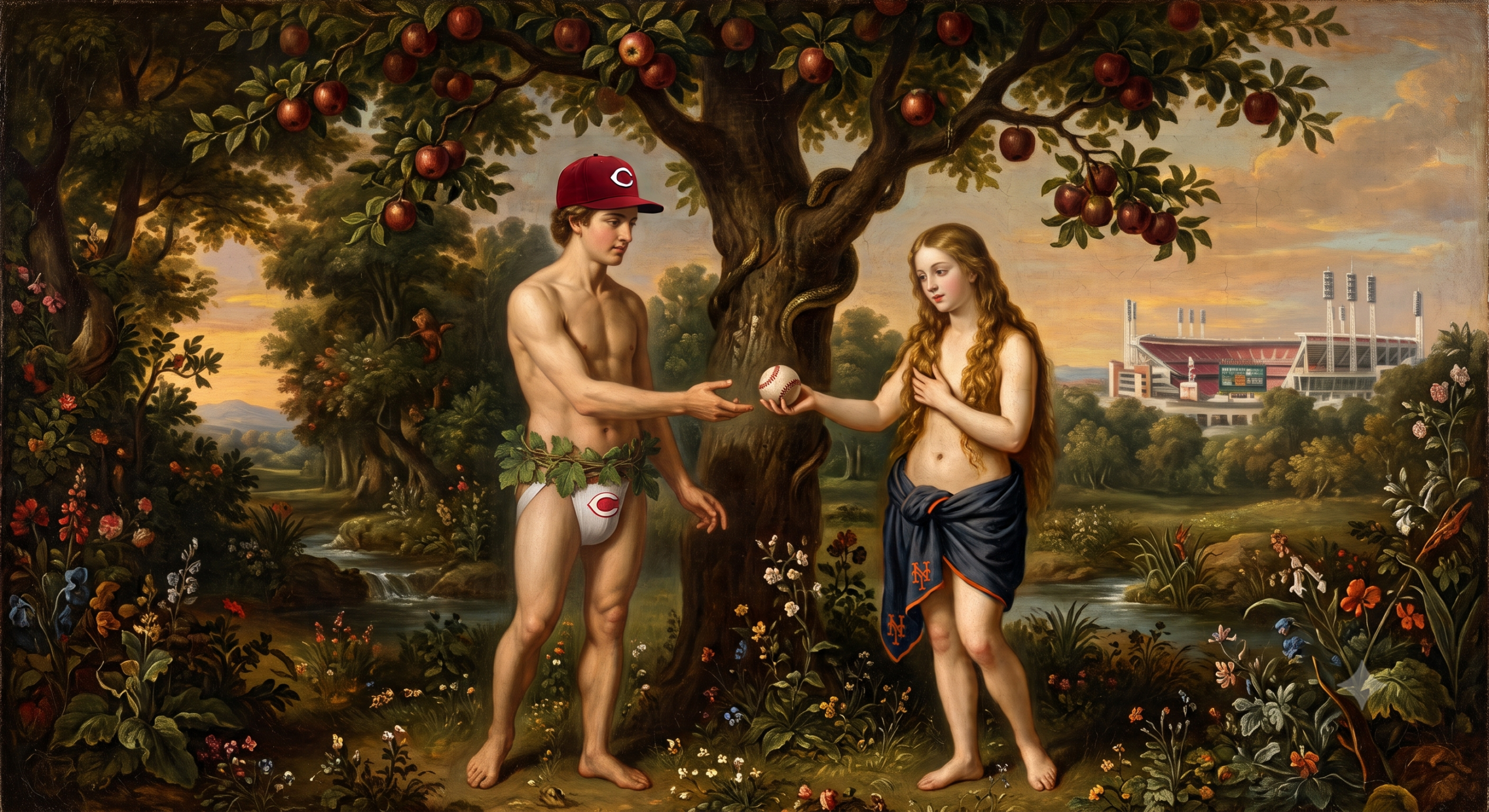
On Monday night in the city of Brotherly Love, Nick Lodolo was kind enough to give up two runs in the home team’s first. But the Reds evened it immediately in the top of the second. Lodolo settled down until giving up a solo shot in the sixth. Again the visitors responded with Sal Stewart launching an 0-2 curveball into the right-field seats. For the slumping rookie, it must have felt like a bell ringer, a Liberty Bell knock to get him healthy again after his heroic April. Then, Spencer Steer’s two-out double in the eighth gave the Reds a 4-3 lead. Say hey, could the Reds win this one?

Stop me if you’ve heard this before. Graham Ashcraft gives up a leadoff single in the bottom of the eighth inning. He manages two outs but then surrenders a two-run homer to Bryson Stott. There was some radio-booth discussion about whether or not to leave Ashcraft in to pitch to the lefthanded hitter. Francona leaves him in, Bryson goes yard, and the Reds lose 5-4.

Tuesday, Chase Burns again showed his early-season dominance. He gave up three hits over six full innings. One hit, however, was a longshot from Trea Turner. The Redleg offense scratched out two runs in the fourth and two more in the seventh. And three guys from the bullpen held it down for a 4-1 victory.

The Wednesday matinee featured a Reds hit parade (15 in all, four from Stewart alone, including a left field upper decker that wowed the Phillie TV guys). Andrew Abbott pitched well for five-plus innings. A shaky bullpen in the sixth gave up three runs. But the Reds added on late for the 9-4 final and a series win.

I was on a Philadelphia rooftop to see Veterans Stadium demolished on March 21, 2004. We had champagne on what I think was a Sunday and the final day of spring break from Purdue. Seems like a million years ago given the differences in my life between now and then. But if my math is right it was just over 22 years ago.

Stewart, who surely would have been Joe Nuxhall’s “Star of the Game” on Wednesday, was only about 15 months old when I was in Philly. Born in Miami, he probably wouldn’t have been thinking about cheese steaks, or founding fathers, or even the sorry ass Slyvester Stallone (in spite of having the same initials). You never know. As I saw one stadium imploded almost his whole lifetime ago, perhaps something from Sal’s toddler days forecasted the reality of him breaking out of an offensive funk with multiple hits and two homers more than two decades later. Life, like baseball, can be a funny game.

William Meiners is the editor of Sport Literate. Among his summer 2026 plans are the documentation of 33 Reds’ series. That should be about 600 to 700 words every few days. If you don’t expect too much breakdown or analysis, outside of his own troubled head, you may not be disappointed. From losing streaks through high-water marks, he’ll follow the club, sometimes literally, from the reluctant spring of early May through the dog days of August. Then he’s off to something else.

“Hello, Cleveland!”: WTF, Bullpen?

150 150 bjj-sportliterate

“Hello, Cleveland!”: WTF, Bullpen?

by William Meiners

I feel for Terry Francona. The Reds manager seems like a nice enough guy, a player’s coach, if you will, and I don’t know if he ever gets too riled up. Though he’s never lived in an apartment above me and I’ve spent more than a few years in basement apartments.

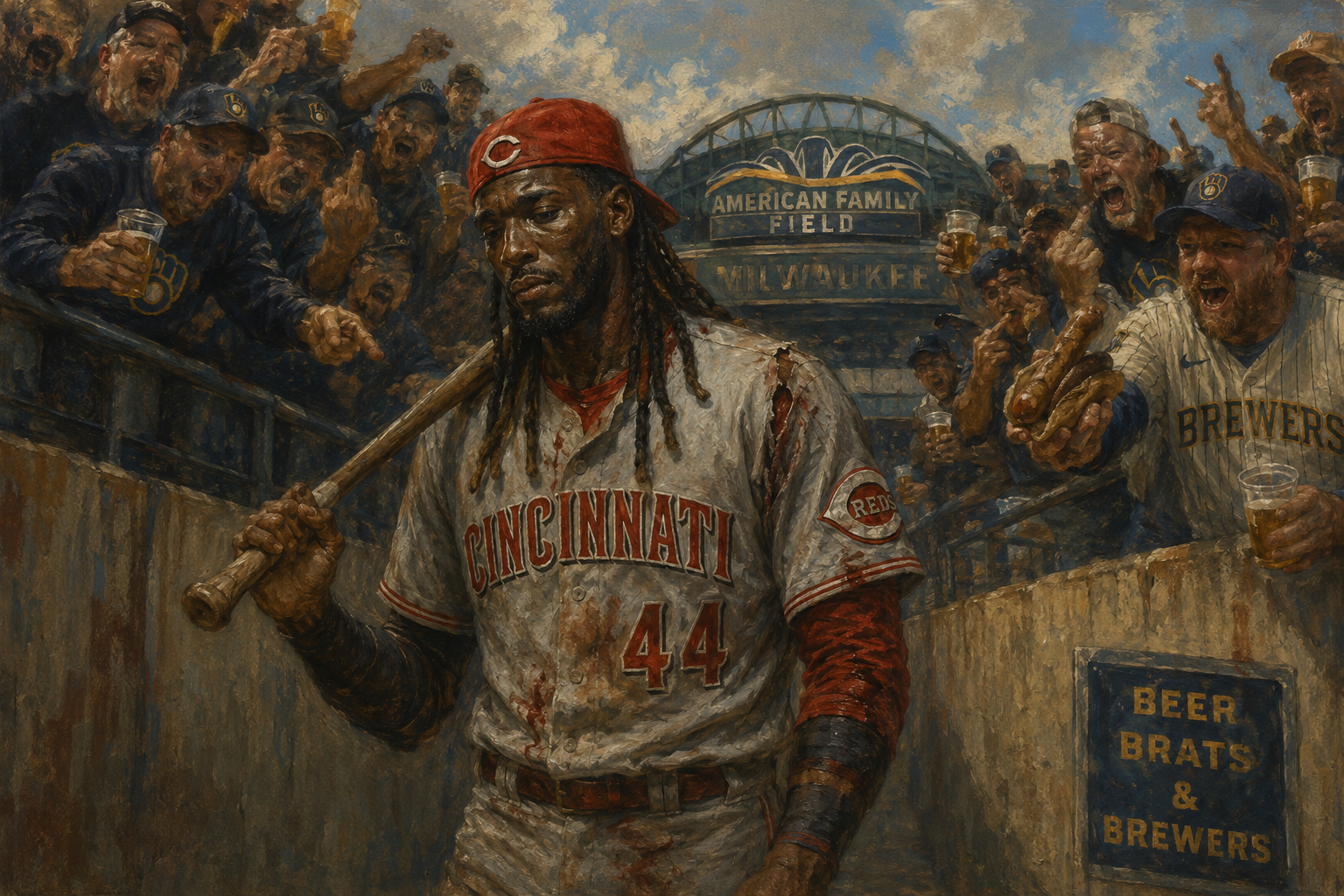
With the Reds elevator drop from the Central’s top to basement in less than three weeks of May, the team rolled into Cleveland for round one in the Battle of Ohio. Rivalry games are happening all over this weekend with Cubs vs. White Sox, Yankees vs. Mets, Phils vs. Pirates, etc.

Francona managed the Indians/Guardians for a decade. Maybe his young players might win one (or two or three) for the Tito. But like the absence of crying in baseball, there may be no bulletin board material either. There’s a saying about momentum being as good as the next day’s starter.

Coming off a 15-run awakening in the getaway game against the Nationals, the Reds put a good starter on the mound on Friday night. Andrew Abbott, feeling his old self as young as he is (born June 1, 1999), pitched well and got three runs of support from his teammates. Tito hands it over to the bullpen after Abbott surrenders a homer in the sixth. In the top of the eighth, the Reds pitch in with three runs, including a two-run homer from Matt McClain, who seems to be getting on track. Up 7-1, this should be a Friday night laugher.

I wonder if Francona sees patterns in the nature of 26 young men. Generally equally divided by pitchers and fielders, the lineups are rolled out like chess pieces, hoping for a winning combination. Among the throwers, you’ve got starters and relievers, including long men, stoppers, and closers. Of a baker’s dozen position players, too many to date still ain’t hitting their weight, including a Gold Glove third baseman. JJ Bleday, who did not make the club out of spring training, is providing solid offensive output from the outfield. Sal Stewart, who can play first or third, has slumped a bit in May after a fantastic April. Elly de la Cruz is a superstar, go ahead and trademark EDLC (and I think he’s already got an ice cream named after him).

In the bottom of the eighth, Graham Ashcraft threw 12 straight balls. If he’d been my Little Leaguer, I might have threatened to murder him. Enter the game with a three-run lead, and it’s like the Guardians are on a speed loop, racing around the bases without once swinging the bat. After loading the bases, Travis Bazzana, born long after “Bonanza” left the airways, singled home a run. Then the next pitcher, Brock Burke, walks in two runners and gives up a sacrifice fly. Tejay Antone gives up one more in the bottom of the ninth but earns the save. Reds squeak out a one-run win. But Jesus Christ, it’s enough to give Francona ulcers. And I think he had some health problems in his Cleveland days. Beyond the general discontent of living in Cleveland.

Saturday was a glorious day for yard work in Michigan. The Reds had a chance to win the late-afternoon start, but the relievers (with a bullpen like this, who needs victories?), give up 2, 2, and 1 in innings six, seven, and eight to secure the loss from a game the Reds led 4-2 going to the sixth. Four relievers, all generous with at least one free pass, made the final score (7-4) look a little more lopsided than it was.

Sunday went “ugly early,” same advice they put on Harry’s t-shirts at Purdue. Brady Singer, in a second straight start, gave up three homers in four innings. Three relievers in red stockings gave up one each in another blowout loss (10-3). Cincinnati dropped back to just one game over .500. And it’s starting to look like a long season.

William Meiners is the editor of Sport Literate. Among his summer 2026 plans are the documentation of 33 Reds’ series. That should be about 600 to 700 words every few days. If you don’t expect too much breakdown or analysis, outside of his own troubled head, you may not be disappointed. From losing streaks through high-water marks, he’ll follow the club, sometimes literally, from the reluctant spring of early May through the dog days of August. Then he’s off to something else.

Ramblin’ Man

150 150 bjj-sportliterate

Ramblin’ Man

by Justin C. Staley

We learn to walk anywhere between 11-13 months, and if we’re lucky, we spend the rest of our lives doing it. We walk for exercise. To cool off. To think. Because the dog has the zoomies. Because Uber is doing surge pricing.

Say the average person walks 7,500 steps per day. That’s 2,737,500 steps in a year. The average life expectancy is 79 years. That means that average person walks 216, 262,500 steps in their life. If it takes about 2,000 steps to walk a mile, we’ll walk about 108,000 miles in our lives. One foot in front of the next, step after step, nearly four and a half times around the Earth.

Once we decide to walk it’s almost as involuntary as a heartbeat. Maybe we think. Maybe we try not to think. Maybe we observe or try to solve a problem. Walking can be meditative, philosophical, spiritual, even. Aristotle walked around teaching philosophy for his Peripatetic School. Nietzsche ambled. Kierkegaard wandered. So did Socrates, Kant, Heidegger. Rosseau wrote a book called Reveries of the Solitary Walker. Henry David Thoreau was a walker, of course. So were Elizabeth Carter and Virgina Woolf. Einstein. Keats. Beethoven. Samuel Coleridge and Williams Wordsworth and Wordsworth’s sister Dorothy who might’ve outwalked them both. Dickens. Nan Shepherd. De Quincy. One foot in front of the next, step after step, every one of them.

Michael McColly, author of the book, Walking Chicago’s Coast: A 63 Mile Journey to the Indiana Dunes, has no shortage of reasons he walks: anxiety, curiosity, to break loose, to discover, to get to know places, to stay in touch with them.

He first began walking when he was in the Peace Corps in Senegal in the early 1980s. Walking was an escape, something therapeutic. It turned into a way to inhabit the world. He writes, “to assuage a physical hunger if not a psychological need to feel [his] body over open landscapes.”

McColly, freshly home in Chicago from a walking trip in the UK in 2016, felt the need to move again. He couldn’t stop walking. He decided — practically out of nowhere — to walk along the lakefront. To where? He wasn’t sure. Then he envisioned walking clear to the Indiana Dunes, a few hours from where he grew up in Marion, Indiana. Within a couple days he was walking. It was only 63 short miles away on foot.

Michael McColly revisits his lakeshore walk. Photos by Justin Staley.

His book is an intriguing blend of travelogue, personal essay, historical and environmental reportage, and phenomenological exploration. McColly is curious about how we interact with our surroundings, what places mean to us, what meanings we give them. He explores time, memories, alienation, and more, taking us from his home in Rogers Park, alongside DuSable Lakeshore Drive, through the Loop, then the “other half” of Chicago, this “polyglot metropolis of ever-widening social, economic, and environmental divides”: through the South Side, South Chicago, the Calumet River, then into Indiana and through its forgotten neighborhoods and cities, including the most famous forgotten city of all: Gary. Along the way McColly wrestles with his memories, with the winners and losers of history, and the relationship between urban landscapes and the natural world. There are victories against development but failures to protect the most vulnerable; there is isolation and community; beautiful beaches and shorelines filled with smokestacks and oil refineries and toxic waste leeching into communities literally and spiritually; there are ancient lakes and abandoned casinos; the ethos of labor and its graveyards; there are lost cities ravaged by racial, economic, and environmental injustices, and there are vibrant communities and hopes for a future.

I meet McColly on a chilly, ludicrously windy morning in early March at the Montrose Point Bird Sanctuary on Chicago’s North Side. We walk the path and discuss birds. Once you’re in your 40s you’re required to download the Merlin bird app and buy a pair of binoculars to start identifying birds in your neighborhood. Everyone can agree on birds; birds could heal the world. As McColly writes in his book: “I have found in birds what my dog once was for me — a reconnection to the living world around me. In them I recognize the ephemeral nature of life, in their vulnerability I feel my own. For what is fate to the kingbird or the robin? They weather the winter storms with resilience. They survive despite our stupidity, possessing a will to make do with the world as they find it.”

I hear the cardinal’s perfect metronomic whistles, the angry, twirling calls of red-winged blackbirds, the abrupt squeaks of grackles, the ceaseless chirping of sparrows, and plenty more I can’t recognize. I ask McColly about his mental preparation to make his journey. “The idea of setting an intention was really interesting psychologically. Because I knew I was doing something different,” he said. “I was traveling in the city, and my perception changed. Because I’m saying I’m doing this, everything is changing.”

I’m reminded of quantum physicists, philosophers, neuroscientists, and self-help authors alike, who, for varying (yet cohesive) reasons, insist that the nature of the attention we give to the world changes the way we see it. McColly finds individual histories on painted rocks, truths under white-washed histories of heroes, personal and collective memories embedded into an entire coast. On a 63-mile walk, you have no choice but to pay attention.

Along his two-day summer sojourn, when McColly removes his shoes and checks for blisters or rubs his swelling feet, you can practically feel the aches, but you also feel the relief when he walks on grass, or finds an air-conditioned building, or goes for a swim in the lake and dries in the sun.

We emerge from the sanctuary and walk the fishing pier, the wind nearing violence. Fishermen with their buckets and tackle boxes line the path. The smell of cigarettes appears and disappears just as quickly. To the south is that famous skyline. Beyond that, the rest of McColly’s journey along the Third Coast all the way to the Dunes.

“I wish I would’ve had the time to talk to people,” McColly declares as we double back along the pier. We get glimpses of plenty of people, though, even if he doesn’t talk to them: fishermen, beachcombers, swimmers, gleaners; kayakers, preachers, cab drivers, gamblers, chess players; landscape painters, joggers, cyclists, street vendors, shop owners. There’s a loneliness to this book, as there is in all good stories, but there’s recognition, and recognition tells us we belong.

In the book the lake looms like the sun itself, both place and living thing. McColly reminisces about being in complete awe of it the first time he saw it as a kid growing up in Indiana and goes for a swim in it multiple times to cool down. The lake is baptism, ablution, rejuvenation.

Then there’s the destination: the Indiana Dunes. “That was a story I wanted people to know,” he tells me. With his arrival at the Dunes, there’s no giant revelation, but in this refuge where he feels home, he understands that for all the shaping of the world we do, the places we visit and call home shape us, too, only in much more subtle ways. The Dunes, with its mosaic of ecosystems shaped for thousands of years by the lake and the wind and the seasons, its history just another chapter in the fight to preserve natural spaces, is the perfect place for the collision between the past and the present, between the certainty of a natural order and the uncertainty of our short lives. It’s a place for memory and imagination. In the book’s last few pages, McColly goes for a swim in the lake. And then he starts walking again.

McColly and I double back along the outer edge of the bird sanctuary and Montrose Beach Natural Dunes Area. The Chicago Park District stopped tending to the area in 2001 and it’s since become a protected area for native and endangered plants, and an important natural area for foraging, nesting, and migrating birds.

When we get to the border between the Dunes and Montrose Beach a woman stops us. “Hi. Walk all the way down and turn around.” We’re quiet. “Are you here for the owl?” she asks.

Apparently there’s a snowy owl who’s taken refuge in the dunes. “Okay, let’s go,” McColly says, and I nod.

We trek along the sand and push against the wind. There are several groups of people watching. The wind is something fierce and McColly and I stop talking. We take turns snapping photos and looking at the snowy owl through his binoculars. The owl sits imperturbable, stoically bearing it all.

After some time we head back to the sanctuary and sit on a fence at one of its entrances and wind down our talk. For the first time all morning the wind calms. We walk back through the sanctuary, and after we emerge we shake hands and walk in opposite directions, he back to his apartment, me to my car. I climb in and wish I hadn’t driven.

Justin C. Staley is a burger aficionado who teaches at DePaul University in Chicago and enjoys freelance writing when he can find the time. His stories and essays have been published in HeliconCrack the SpineBig MuddyCola, and Sports Illustrated’s “The Cauldron.” His essay, “A Giants Fan Walks into a Bar,” was published in Sport Literate‘s 30th Anniversary” issue in 2025. He lives in Evanston, Illinois with his wife, twin sons, dog Odin, and cats Bilbo and Frodo.


The Douchebags of Skylands Finding Connection, One Throw at a Time

150 150 bjj-sportliterate


A band of misfits, a forest full of chains, and a lesson in how to be human.

by Scott Bandremer

Bzzzzz. Bzzz Bzzz.
I peeled open my eyes, slowly turning towards my phone. Six-thirty a.m. A Sunday morning my wife and I had sworn to sleep in after a long, chaotic week, to pretend adulthood occasionally came with rest.
I could feel it. She was already awake, peering at me over the satin berm like an artillery scout awaiting bombardment.
Bzzzzz. Bzzz Bzzz.
“It’s the Douchebags again,” she muttered with resignation.
Of course, she was right. It was always the Douchebags.

The Secret Society of Throwers

The author (front) and some douchebags.

I’m part of a club — part sport, part therapy, part traveling circus — called disc golf.

And yes, I know what you’re thinking. It’s that thing hippies do in public parks, right? The poor man’s golf. The stoner’s excuse to loiter. The weird cousin of ultimate frisbee.

Fine. You’re not wrong. But you’re not right either.

Disc golf is a bona fide sport — legit, growing fast, and quietly taking over the world’s green spaces. Nearly four million players. Sixteen thousand courses. There’s a pro tour with true international championships; sponsorships; even million-dollar endorsement deals — like Paul McBeth’s ten-year, ten-million-dollar pact with Discraft.

Watch a PDGA event on YouTube — perhaps featuring Calvin Heimburg, Paige Pierce or Kristin Lätt — and tell me it’s not beautiful. Those discs cut through the air like poetry. It’s golf without the pretense, yoga with a scoreboard.

The world can be a painful, difficult place at times. Not on the course. Here, it’s about your next perfect throw. Here, the world drops away, and you’re along for the ride.

Enter the Douchebags

The Douchebags of Skylands. That’s our club.

About 20 of us scattered through New York and New Jersey — a mix of lifers, rookies, philosophers, and degenerates who’ve somehow turned irony into identity. It began innocently enough, a couple of old timers hurling typical R-rated ribs in all directions as we played. When — POP — it struck us together, a lightning bolt of stupidity – we’d stumbled on a name for our growing band of players.

It took on a life of its own from there. People wanted in, wanted to be counted amongst the Douchebags of Skylands. There’s a group chat that never sleeps, a library of inside jokes, and a Sunday ritual that borders on religion.

By the third hole, something happens. The game envelops you as the noise of the week fades. The trees become cathedral columns. The fairway turns sacred. It all fuses into a kind of moving meditation. We become a roving band of Douchebags, synchronized and serene, navigating trees, ponds, and the ever-looming threat of OB – out of bounds.

The outside world fades. The course becomes sanctuary, an oasis for us all (and in fact, one of our favorite courses in Warwick goes by the name of Oasis).

You aim, you throw, you breathe. You curse. You laugh. Someone yells “nice!” while someone else’s disc ricochets deep into the woods. And just like that, the world makes sense again.

When the round ends, we linger in the parking lot – dusty, happy, slightly sunburned, ready to exchange our club tags with each other based on our scores. The stress has evaporated. For a few hours, we’ve been exactly where we belong.

The Cast of Douchebags

Every Douchebag member is unique, with quirks we’ve come to roast and to love.

There’s Roach, a beer-guzzling, seventy-something legend of ball busting, who’s been playing longer than some of our members have been alive. A club co-founder, he swears he’ll someday die mid-putt, right there on the green, and no one doubts it.

JByrd, a co-founder, once steered a corporate ship at a Big Four firm before sailing off for calmer waters. Known for his “aarghs” and “ayes,” this patchless-pirate maneuvers through our courses with reckless abandon. You’ll know him by his baby jogger disc carrier rolling down the fairways.

Donnie Douchebag, a rural mountain-man rebel philosopher who teaches the rest of us (especially city folk like your author) about camping, venison, and the Zen of hitting trees. His least expected special gift is remembering everyone’s birthday as my Aunt Annette was known for, which makes him both terrifying and indispensable.

Then there’s Big Mike, RAK, Sings, MJB, Rev, a couple of Jeffs, and Alicia the Champ, a former world champion who still throws like she’s chasing the crown. The roster is long, and the stories longer.

We play everywhere – Orange, Sussex, Morris, and Westchester counties. Forests, ridges, lakesides. No greens fees, no dress code, no starter telling you to tuck in your shirt.

Just trees, chains, and the faint smell of bug spray and coffee.

Not Your Typical Douchebags

Despite the name, we’re not actual douchebags. (Except maybe Brian, but that’s another story.) Our moniker is satire — a badge of ironic honor.

We are, in truth, a microcosm of inclusivity — a melting pot of age, gender, and background — teachers, welders, deli guys, entrepreneurs, retirees, a cannabis grower or two. Seventies playing alongside twenties. Trump voters and Bernie bros sharing the same beer cooler.

And the miracle? None of it matters.

Politics, religion, whatever — gone. It’s just about the game, and the flight of the disc.

When’s the last time you saw that? People who’d normally clash online laughing together in the woods? That’s what this is about. The game’s the excuse. The connection is the point. Genuine, hard-earned, and human. Beyond the throws and the laughs, the club has become something sacred: a refuge where we can share what brings us joy and what weighs us down.

There’s safety in Douchebags.

Some of us are nursing heartbreaks or layoffs or health scares. Some just need to be outside. But every week throughout the year we show up – in 95 degrees of heat, or ten below in a foot of snow. We throw. We roast each other mercilessly. We listen. And somehow, that’s enough. I live for it. I’ve been playing for decades and have no plans to stop. Screw old age.

The course is the confessional. The Douchebags are the congregation.

The Theology of Throwing Plastic

Discs and shrooms

So what does a bunch of multi-aged weirdos flinging frisbees have to do with anything larger?

In an era when “community” means arguing in the comments section, this is the antidote. The Douchebags of Skylands are proof of what’s possible when we choose connection over conflict.

For a few hours, we share one goal: make the disc fly true.

And that simple focus — 20people watching a piece of plastic spin toward a metal basket — becomes its own quiet life lesson.

You throw, you miss, you adjust. You try again. Someone laughs, someone swears, someone hits the chains. You high-five, you move on.

It’s life distilled to its cleanest form: failure, recovery, grace.

If enough of us practiced that, maybe the rest of the world would start to level out too.

Toward a Kinder Brand of Douchebaggery

I’m not saying the United Nations should settle disputes over a doubles round – though I’d pay to watch Putin miss a 10-footer — but the Douchebags of Skylands have tapped into something the world’s forgotten.

D-bag at sunset.

Connection — it’s real and at times, it’s spectacular.

No algorithms. No talking points. Just the shared pursuit of a stubborn little disc that refuses to go straight.

And when the last putt drops, the world feels a little less broken. Not perfect. Just better.

So when you hear that early-morning bzzzz — your phone lighting up with a text from friends who refuse to let you sleep in — don’t roll over. Answer it.

It might not be a summons to play, but rather, a call to action to be a little better to each other today. Will disc golf save the planet? Probably not, but it’s rocking the world of my knucklehead friends, and that’s a good starting point.

And if nothing else, a reminder that real human connection still exists. That joy can be small, round, and airborne. And that somewhere, in a forest at sunrise, a group of Douchebags is already throwing.

Because deep down, we all have a little Douchebag waiting to get out — and the truth is, the world could use a few more of us.

Scott Bandremer is a writer and lifelong disc golfer based in the New York/New Jersey metro area. He’s still trying to make par on hole 18.

The Ball Dreams of the Sky

150 150 bjj-sportliterate

A Baseball Life: Henry Schipper’s The Ball Dreams of the Sky

by William Meiners

Henry Schipper can trace his life through baseball. Like mapping the long arc of an upper-deck shot, he sailed from Little League in Detroit through a teenage stint as Babe Ruth phenom in Wisconsin to the senior softball leagues of the Golden State. Along the way, he sold beer at Wrigley Field for a couple of seasons in the mid-1970s while attending the University of Chicago. In Los Angeles, making a living as a journalist and documentarian, he followed the Angels, not the Dodgers (and the Clippers, not the Lakers) — choices he confessed to suffer for.

His first love came naturally, as Schipper had been the kid with a golden arm. A hurler of consecutive no-hitters in Wisconsin, he bicycled to and from his suburban play, mostly victorious but occasionally crestfallen, unaccompanied by any family members. And he shared no news of what transpired on the diamond with parents or sister. His book of poems, The Ball Dreams of the Sky, shortlisted for the Casey Award as Spitball Magazine’s “best baseball book” of 2025, would bring him back to his summer days in Detroit.

The collection, Schipper told me just days after the Dodgers squeaked by the Blue Jays in a heart-pounding World Series, had been on his mind for about a decade. “Then out of the blue, I had to have double bypass heart surgery,” he said. “I remember thinking, ‘Shit, I never wrote that baseball book.’”

Upon recovery, Schipper said he went about writing and rewriting the poems that could “translate life into baseball,” noting the framing that would take the reader from birth through death in a baseball context. The nuance of the language alone, like the old possibility of an endless extra-inning game, seemed limitless.

With some 50 gathered poems, a few of which follow, Schipper’s debut poetry collection is arranged under the sections of Early Innings, Middle Game, and Late Life. Of course revisiting what he first thought might be the “halcyon days” of his baseball youth, Schipper was surprised just how much trauma he drummed up.

Body and soul

The bat is physical,
inches and ounces,
swollen at the head,
all about the grip,
and hitting.

The glove like the brain,
a complex web with separate lobes,
layers of stitching,
organically poised
to catch a thought.

The ball comes to life in flight;
its essence is its potential,
like spirit it soars.

Both bat and glove dream of the ball;
the ball dreams of the sky.


If God played ball

If God played ball,
would He hit home runs
and catch them all?

would He steal signs,
or just Know?

would He prefer power
or speed, the blast
or the blur, the big bang,
or the burning whoosh?

would He take the mound against Himself?
and foul off pitch after pitch,
forever?

is that what He’s doing now?

He made the game;
it’s possible this is how
He spends His time.

would He quietly one day
turn to small ball —
advance the runner,
find the holes, express perfection
in sacrifice and team play?

would He ever slump, or pretend to,
strike out, flub one in the field,
come up short in the clutch?

of course He would,
feeling our pain, our loss,
our longing, letting the fans down.

He’d have to;
without imperfection
there is no game.

or need for Him
to wait at the gates,
and sign autographs
one at a time.

Schipper noted that the book’s title, also that last line from the “Body and soul” poem, had not been the original. “Translating the Game” had been an early challenger. Then he considered “There’s No Holocaust in Baseball” as the collection’s title poem. Though that particular label, he reasoned, would put a significant weight on the book.

His mother, from Vienna, and his father, from a Polish border town, had narrowly escaped the holocaust. They met in Palestine in 1939, huddling in the horror of nearly entire families lost to murder. Soon after, they made their way to America and Detroit.

“Because my parents were immigrants, they didn’t know anything about baseball,” said Schipper, the star of his neighborhood living in a “complicated house” where his parents, both European intellectuals, shared affection without understanding of their son’s game. “Little did they know that I was channeling all the ghosts in the house.”

But there was a catch

The stadium was packed
and I was rapt as I watched
my first game, a boy
among Gods, astonished
to see that it really existed,
this larger-than-life, this radio dream,
and I could be here, I could sit
in the heart of the diamond,
the shimmering world,
and see myself in it,
shining one day.

But there was a catch —
as I followed each play
the ball disappeared, again and again,
through the gates of a geist haus,
a spirit home, full of those
I never knew, bubbes and zeydes
from Vienna and Przemysl — eight aunts,
seven uncles, eleven cousins — Ephraim,
Siddy, Lev, Naftali. Salomea who
fell with her husband in Warsaw.
Jenta, Leah, Rivka, Chaim. Max
who made it to Shanghai where
he starved to death, along
with his kids. Erika, Arnold,
Rafat, Regina, Moses, Ida, Dobra,
Zvi, shot, gassed, burned, all of them
gazing right through me, stunned
at the lost horizon of their field of dreams.

The field I raced to every day
was just beyond the cherry tree
that I picked clean before I played,
edging out to the furthest limb,
risking all to get my share, to taste
the best, and in this delicate measure
of weight and balance and stretch
and slip, I honed the skills that would serve
in the dirt, as I measured the pitch,
measured the hit, measured the dive
and the slide and the distance between
where my story began and I now stood,
in the shifting sand of memories
I never had.

Perhaps in spite of historical family trauma, Schipper found his own lifelong love in baseball. Something beyond the escape of throwing the horsehide around the backyard. Through all that simile and metaphor his book explores romance, creativity, how so much depends on the weather (for everyone from infielders to farmers), and simply loving a game that’s rife with heartbreak.

Indeed, “Senior Softball” begins, “After all these years/do we still have to keep score? The game/is fun in so many ways/that have nothing to do with win/or lose. I used to come to be a star./Now I come to feel a star/the warm one, and to move/and mingle with others who shine,/basking in the field of play.”

With pitchers and catchers reporting for spring training in the not-so-distant future, and fans dreaming of hot stove turnarounds, The Ball Dreams of the Sky could be a hopeful St. Valentine’s Day gift for the baseball lover in your life.

Playing with words

Pen in hand, he lofted a fungo to right;
the words gathered underneath,
each one crying “mine!”

his spikes dug into syllables
of dirt, spewing letters, dollar signs,
quotation marks and exclamation points,
as he rounded the bag

he turned the pages of his wind-up,
and let the delivery write itself

the webbing of the rhyme
was old and scarred,
like fingers broken many times

in china they have a language of codes,
of blinks and bluffs that catchers
and coaches understand

the rain came down in hyperbole
and booze, and sheets of nostalgia
that rewrote the night

the poet yawned between every pitch,
foregoing perfection in uniforms of verse
don’t lose me in the sun, she cried,
and he swore he would not,
but he did

flirting with a game of words
in a field of lines, he pressed his face
inside his glove, the glove that holds
the gloves that hides — he caught himself —
and said goodbye


Managers & farmers

The faces of managers
when the season goes bad, befuddled but stoic,
like farmers with weather
they can’t understand.

They pulled the right strings the part that was theirs,
and July stood high
with the harvest to come.

When out of the blue
the Gods came to play,
with bloops, and hops,
and swinging bunts, freakish
breaks that blighted the game.

And they counted the losses
and gauged the time,
squinting, puzzled
at the edge of reproach,
but always within the code
of no blame, that’s baseball
you take whatever you get.

Like Job they bent
but did not break.
The utopian game
was thus maintained,
with the helpless gaze
of unfathoming faith.

William Meiners is the founding editor of Sport Literate.

Henry Schipper, an award-winning filmmaker in Los Angeles, has written and produced more than 125 primetime documentaries. He once held the Babe Ruth League record for consecutive no-hitters in Wisconsin. The Ball Dreams of the Sky is his first book of poems.


Running and Writing the Self

150 150 bjj-sportliterate

Running and Writing the Self:

A Review of Nicholas Thompson’s Running Ground

It hardly matters whether you approach running competitively, recreationally, or as a responsible form of aerobic exercise, eventually you will confront the kind of metaphysical conundrum with which the sport abounds. Who am I? What kind of thing? In what relation to the world? Capable of what?

In his memoir, Running Ground, Nicholas Thompson describes one possible route to such philosophical territory. A competitive runner, Thompson is ever on the lookout for opportunities to shave time from his results, one of these being to learn how to ignore the desire to slow by overruling what are in effect the brain’s warnings to preserve energy, something Tim Noakes calls “the Central Governor Model.” As Thompson explains, “The Central Governor Model suggests a mind-body dilemma. We all can go faster. We just need to persuade our brains not to start the subconscious shutdown process right away. But the only thing we can use to trick our brains is our brains. Training becomes a game of hide-and-seek with oneself.”

Right, but bootstrapping problems aside, what is the self? For Thompson it’s a multitude. “I realize now,” he reflects from the vantage of middle-age, “that I’ve sought distinct and different compound goals from the sport as I’ve gone through life: self-confidence, self-awareness, and self-transcendence.”

The mature runner, if anything like Thompson, balances these three goals, identifying now as unlimited will, now as a bounded and contingent being, and now as being itself (perhaps). But the memoirist pursues a singular goal, one that relies on a narrower sense of self: how, he asks, can I understand the past that has made me into the person now looking back at that past? In Thompson’s case, the story he’s after is the one that explains how he became a world-class masters runner after years of good but not great racing. If that scans as standard inspirational stuff, be advised that The Running Ground is an outlier among running books. In addition to being an elite runner, Thompson is an enormously gifted writer, capable of being competitive in major marathons and then reflecting on them with the sensitivity and precision of someone who has dedicated himself to a life of letters. (In his day job, he is a prominent journalist.)

The story of Thompson’s running begins with his father, a competitive runner himself, who introduced Nicholas to the sport. After finding success in high school, Thompson is good enough to run for Stanford but not good enough to stand out there. He leaves the team and takes a break from running before taking up marathoning a few years later and going on to earn the nickname “Mister 243” for his uncanny ability to run this time and only this time (plus or minus). It is only after surviving thyroid cancer at 30 that Thompson is able to break through and improve significantly on his two hours and 43 minutes. Looking back on this period of his life, Thompson writes, “Multiple studies have shown that survivors of cancer often experience what is known as post-traumatic growth. Standing on the edge of mortality gives them clarity about what matters.” It’s another one of those oddities of the human psyche. We all know that we will die, indeed are all the time approaching death. Yet this insight alone isn’t enough to propel us toward the growth that we know is available. And pretty soon those possible selves become unavailable to us.

Even after running his personal marathon best of 2:29 at age 44, Thompson must confront the reality of his unrealized potential: “I wondered then, as I wonder now, what other versions of me exist that there may no longer be time to find.”

There would be worse ways to read The Running Ground than as a reckoning with aging. As Thompson finds new ways to excel past his running prime, his father’s life undergoes a fairly spectacular decline that serves as a cautionary example, among other cautionary examples, that “people stop running because they get old; they also get old because they stop running.” Thompson’s response to his father’s eventual death is to push himself to run faster, a way of processing his loss by means of accepting his father’s “gift of running” and refusing to squander it.

But just as there is something noble about doing one’s best, no level of success forestalls death or decline. And while the rewards of running certainly include accomplishment, they are not equivalent to it. For all the ways Thompson sacrifices at the altar of speed, he understands that speed and the pursuit of speed is itself but a means toward the end of experience.

The telos of running, if it can be put so seriously, is a way of being in the world that, for the runner, is indistinguishable from play. Even the hard work of training and vigorous effort are but forms through which play expresses itself. Thompson quotes Charlie Parker to this effect: “Learn all the theory you can, but forget it when you play.” When you’re running, just run. Just trust yourself to play.

Of course it’s a gift to run, and it’s one the runner wants to pass along to his children when the time comes: “I hope, though, that one day in the future, in whatever cities they live, they stand on the sidelines of a major race, watching the runners flow by, remembering cold November mornings from a generation ago when their father, then strong and quick, ran by on Atlantic Avenue.”

Scott F. Parker is the author of Run for Your Life: A Manifesto and The Joy of Running qua Running, among other books. His writing has appeared in Runner’s WorldRunning TimesTin HousePhilosophy NowThe Believerand other publications. He teaches at Montana State University and is the nonfiction editor for Kelson Books.

The Sustaining Power of Myth

150 150 bjj-sportliterate

The Sustaining Power of Myth

A Review of Matt Love’s Never Stop Pre

by Scott F. Parker

For the past quarter century, Matt Love has been one of the more prominent, and perhaps the most prolific, members of the Oregon literary community. Through his Nestucca Spit Press, he’s published more than two dozen books exploring the history, geography, and culture of his home state. It’s only fitting that on the 50th anniversary of Steve Prefontaine’s death Love has turned his attention to Oregon’s foremost athletic icon with his new book Never Stop Pre: The Enduring Inspiration of America’s Greatest Sports Legend.

As Love rightly assumes, there is no need to establish Prefontaine’s bona fides either as a runner or as a legend of the sport. The legacy speaks for itself to anyone with even the least interest in track. And yet for those versed in the mythology of Prefontaine there is deep pleasure to be taken in celebrating his feats in the company of other fans or — let me call them what they are, let me call us what we are — disciples. Through half a century of communal worship we have established not just the legend of Prefontaine but also its power. And the more we go on honoring him, the more deserving of honor he becomes. The man becomes a symbol.

At its core, Never Stop Pre is a compendium of 28 scenes attesting to Prefontaine’s lasting impact, a book-length collage of poems, song lyrics, newspaper articles, official testimonies, oral histories, folk tales, and the inspired efforts of everyday runners. Love has dug deep into the archives and emerged with gems, like Senator Mark Hatfield referring to Pre as “an Oregon tiger” in the Senate Congressional Record and Governor Tom McCall writing in a letter to Prefontaine’s parents that “Oregon has never been struck such a tragic blow.”

Alongside these historical artifacts, Love relates his own personal relationship to Pre’s influence, the power of which he attests to early in the book, writing, “Indeed, his legend had a significant influence in staying my hand against suicide.”

Several years ago, after pleading guilty to luring a minor for sex, Love was sentenced to 30 days in jail, two years of probation, and forced to pay restitution and register as a sex offender, making him persona non grata in the community he had been so instrumental in creating. Writing in the third person, he describes the saga this way in the book, “He had made a mistake in two sentences of written social media communication (no images at all) with a 17-year-old female he was mentoring (not his student) and lost everything. The State annihilated his past and present; he had no future. The mob had stoned him to death on social media and newspaper comment boards. He had considered suicide by jumping into Hart’s Cove on Cascade Head; he was encouraged to commit suicide by total strangers. His closest friend vanished without a word.”

Fortuitously, at this time, he pulled his truck off Highway 101 to wait out a storm in Coos Bay. There, he walked into the Coos Art Museum and “took the stairs to the Prefontaine Memorial Gallery. No one was there. He examined the memorabilia and then sat down and started reading the register.” An hour later, after soaking up the appreciation others have expressed for Pre, Love persuaded himself that he must run “like Pre raced, although there was no known finish line. It was the only way he would ever survive.”

Love’s psychodrama can be read as indulgent, a distraction from the tribute he otherwise pays his hero. But it’s easy to judge, and Love’s story can just as well be read as a testament to the power and utility of Prefontaine lore. The beauty of the myth of Prefontaine is its vast applicability. Pre “knew he had to keep running to see who had the most guts.” The metaphor is there for the taking: it’s possible for anyone to live with the kind of guts Pre ran with — possible at least to aspire to. Whatever anyone thinks of Love’s crime, it took guts for him to draw from Pre’s example the courage he needed to go on, it took guts to write this book as he wrote it.

Never Stop Pre is a book a certain kind of Oregonian and a certain kind of runner will have been waiting for. It’s a book that asks us to take Prefontaine seriously. Even more, it asks us — whether we make a pilgrimage to his holy sites (Hayward Field, Pre’s Rock, his gravesite in Coos Bay, etc.) or just read about them — to study Pre’s example and from it learn how to take ourselves seriously as well.

Scott F. Parker is the author of Run for Your Life: A Manifesto and The Joy of Running qua Running, among other books. His writing has appeared in Runner’s WorldRunning TimesTin HousePhilosophy NowThe Believerand other publications. He teaches at Montana State University and is the nonfiction editor for Kelson Books.

Memoir of a Yankee Fan of a Certain Age

150 150 bjj-sportliterate

Memoir of a Yankee Fan of a Certain Age

by Howard Wach

I turned 70 last February, a scary number that pushed me deeper into the practice of looking backward in decade-long chunks, a survey of love, joy, fear — the works. The New York Yankees occupy 60-plus years’ worth of that retrospective space, and their fortunes, I have discovered, uncannily aligned with my own.

Every baseball fan knows the quasi-religious drill. The annual worship cycle begins in February and ends in late October if things go well; or sometime in August if not. We attend nine-inning revival meetings and tie our emotions to a stubborn communal faith. We indulge in a respite from the real world and feel a superstitious jolt when tuning in the game causes our team to collapse. It’s powerful stuff.

To extend the religious metaphor, these are the revealed truths I’ve found behind the memory door. Yankee destinies matched my first act: a happy childhood, miserable adolescence, and rocky passage to adulthood. Further down the road, midway through the second act, my team and I shared a perfectly timed renewal. A homecoming, a redemption that sweetened my passage through the middle-aged householder years.

First let’s set the context. After winning 14 pennants and nine World Series titles in 16 years, the Yankees wandered through the American League wilderness from 1965 to 1976. That 11-year blip of mediocrity ended 49 years ago, footnote to a century of winning and stretches of utter dominance. I hear the objections already. Eleven years? Nothing. A nanosecond in so many baseball chronologies of dashed hopes and broken dreams. Met fans will reflexively flip me the bird. Even after their 21st century resurrections, Wrigley Bleacher Bums and Red Sox Nation will snicker and jeer. Fair enough. I know everybody hates the Yankees. They hated the Boss (so did I, sometimes), they hated Reggie, they hated A-Rod, they hate entitlement, arrogance, and the money, money, money. I get all that. Still, it’s been 16 years since the last Yankee championship in 2009, a full generation since Joe Torre’s team ruled the baseball universe. The 2024 World Series debacle will live in infamy (or schadenfreude) for a long time. But I’m getting ahead of myself.

Damn Yankees
One freezing February morning in 1955, I entered this world in Dr. Morris Leff’s Central Maternity Hospital, a minor Bronx institution on the Grand Concourse a mile or so north of Yankee Stadium. I was screaming, I’m told. Maybe unhappy I’d have to wait for baseball season to begin. Three months later “Damn Yankees” opened on Broadway, a perfect cultural signifier just when the old mob comedian Joe E. Lewis supposedly said, “Rooting for the Yankees is like rooting for U.S. Steel.”

My father Danny and his brother Morty grew up nearby, weaned on prewar Yankee supremacy: Lou Gehrig’s screaming line drives crashing into the bleachers, Joe D.’s elegant all-around excellence, eighth-inning explosions — the legendary “five-o’clock lightning” — that doomed visiting teams. As a kid I soaked up my dad and uncle’s old Bronx tales.

Two team pictures of Yankee championship squads — 1951 and 1961 — hang above my desk. The players wear clean home uniforms; arms folded in the classic team-photo pose. Centered above them I’ve placed a photo portrait of a maskless, crouching Yogi, cap turned backward, shin guards and chest protector in place, a ball tucked into the round catcher’s mitt on his raised left hand, his sharp-eyed mug slightly squinting. I pulled the team pictures from a “wall of fame” in our parents’ Florida garage when my brother and I cleaned out their apartment. Danny got them from Morty, who always carried a glove and bat in the trunk of his car and once played with Whitey and Mickey in a fantasy camp. My son Ben, whose greatest childhood pleasure may have been receiving a Derek Jeter jersey for his eighth birthday, found the Yogi picture for one of my birthdays. Yankee fealty runs broad and deep in my line.

Hitting .350
Danny and Grandpa Charlie took me to my first game in 1962. I sat between them behind home plate, the protective netting above us. Charlie made me laugh, as he often did, when he brought his hands up to pretend-catch foul balls. I looked around in awe at the scale of things. Three huge tiers of banked wooden seats, supported by steel and concrete pillars, stretched past the baselines and curved into the gigantic outfield. High above us, flags billowed over the famous scalloped rooftop frieze. A tobacco-smoke haze swirled through the stands. Action on the field raised the constant thrum of voices to a low roar, and white-shirted fans filled the bleachers beyond impossibly distant outfield walls. The massive stadium filled my little boy’s senses. Tucked between my father and grandfather, I grasped the enormity of it yet felt completely safe.

Even then I knew all the names, learned as I watched Danny watch televised games. The next winter the Yanks traded away Bill “Moose” Skowron, their hard-hitting first baseman. The trade puzzled me. I felt betrayed, as if something rightfully mine had been snatched away. “Why, Daddy?” I asked. “Don’t worry, Howie,” he replied, “the Yanks know what they’re doing.” That satisfied me, since Dad knew everything. My allegiances were firming up nicely.

I was a really sharp grade-school student too. My eight-year-old brain sponged it all up. School was a breeze. School was fun. I was hitting .350, belting long balls in language and arithmetic all over the classroom. I was so sharp that the school authorities, in their Long Island wisdom, pushed me through second and third grade in one year.

Pretty Mrs. Furst eased my mid-year passage into third grade with plenty of extra attention. One day, she stood behind me and gently cupped my face in her hands. I melted into a puddle of pre-sexual pleasure that evaporated into jealousy when I learned she was pregnant. I didn’t understand the mechanics but grasped that I was not her one and only love. A disappointment, true, but the world still spun on its proper axis since the Yankees were perennial champions. That October the Dodgers dispatched them in four games, a crack in the armor, and a premonition. In 1965 — after one more dynastic pennant and another World Series loss — age and diminished skills sent them plunging to a sixth-place finish. Whitey was 36, Mickey a depleted 33, Maris was hurt most of the year. The axis had shifted. Terrible timing for a kid like me.

Sinking Toward Oblivion
We found another artifact in the Florida garage. A 1966 game program, the lineups penciled on the scorecard in my careful block letters. The little book cost a quarter then and sets you back 10 bucks today. I can buy a 1966 specimen on eBay — good condition, slightly creased — for $39.99.

I’m a historian and this was a bona fide primary source, so I went to work. What do we have here? White Sox vs. Yankees, rosters printed above the scoring box. Ads for manly products rimmed the page: Old Spice, Rise Shave Cream, Cutty Sark Scotch, and Old Gold ciggies. I stopped scoring after the fifth inning. Did I lose interest? Not likely. A little sleuthing via the online Baseball Reference got me to May 28, 1966.  Then I dug out the May 29 New York Times game story. Rain had descended and the game was called after the fifth with the score tied at 2-2.

I parsed the lineups in my primary source: Richardson, Tresh, Boyer, Howard, Pepitone — heroes of the last triumphal flare before the 1965 fall. Maris was injured that day, and Mantle hit third. I surrounded that magical name with short Keith Haring-style emphasis lines. But the shocking collapse of ‘65 was descending into tragedy. They were a barely middling 17-20 on May 28 and finished the season dead last (back when last was last, as in 10th place), sinking toward oblivion like the figure falling through space in the opening sequence of “Mad Men.” Seventy wins, 89 losses, and that 2-2 tie. The mighty had fallen, good and hard.

I Hate the Mets
In 1966, my 11-year-old soul loved baseball as much as DC Comics and Mad Magazine. Possibly more. Saturday mornings I pedaled my bike to the candy store and blew my 25-cent allowance on five fresh packs of Topps Cards, unless the spinning comic book rack held a new 12-cent Action or Superman. Middle-school confusions and Beth Goldberg’s short shorts hadn’t yet divided my attention, but Freudian latency was slipping away. Angela Donofrio’s big black eyes and wavy hair sent faint tremors through me when our fifth-grade desks faced each other. But what was that smudge on her forehead one late winter Wednesday? Nothing a Jewish kid could suss out. And why did lessons in fractions fail to click through to instant comprehension?

I was a pretty good Little League first baseman, a tall lefty. I loved the feel and smell of my glove and sweet crack of the bat — no vibration, no stinging hands — when you barreled it just right, which I could do on occasion. My biggest problem? Yankee loyalty is in my blood, and I’m an outlier in my Long Island neighborhood among yammering Met fans cheering for their kooky, lovable losers. They captured hearts and minds all around me, ruled New York, and ruined my summers. Outraged by the unfairness of it all, I wrote a peevish letter to Steve Jacobson, a sportswriter for Newsday, the Long Island daily, whining about lopsided coverage that grossly favored the Mets and reduced my team to one wire service paragraph. “When the Yankees are more interesting,” he wrote back, “we’ll pay more attention to them.” That really stung. Then the fucking Mets won everything in ‘69.

 I Love You, Joe
I loved Joe Pepitone. He was my anti-hero role model, like Jack Nicholson’s wayward pianist in Five Easy Pieces. His talent and potential had prompted the Moose Skowron trade. And Danny was right. Sure enough, Pepi helped the Yanks win their last two pennants in ‘63 and ‘64 and led the team with 31 homers in ‘66. I tried to copy his smooth lefty glovework and quick swing and absorbed his seductive bad-boy vibe. The long hair, the swagger, the cool Italian good looks. Food for my blooming rebellious instincts. I didn’t know he played an active late-night game at the Copa and the Peppermint Lounge. I learned all that later, after he pissed away his career and fessed up in a wistful 1975 autobiography called Joe, You Coulda Made Us Proud, still available on Amazon.

A television memory flashed past as I pondered that old scorecard. Riding a hot streak, Pepitone bangs a double to right field. Phil Rizzuto’s high tenor, the soundtrack of two Yankee generations, exclaims “Holy Cow!! This is what American League pitchers have been afraid of for years.” But those productive bursts never lasted long. The Yanks gave up on Pepi after ’69 and traded him to Houston for Curt Blefary, a journeyman outfielder who hit .212 in one Bronx season.

Tumbling Down
Yankee baseball crumbled into annual disappointment. So did my baseball dreams when I saw the massive ninth grader who played first base on the middle-school team. Suddenly, everything went south. An advanced math class and its teacher knocked me sideways. He knew I was struggling and did nothing. Red lines slashed across my test papers meant academic failure, a lousy new feeling. New anxieties crept in too: the unnerving sight of boys and girls entwined, like pretty, blonde Diane Callahan wrapped up with big, tough Joey Falciano outside the school gym.

Intimidated and reeling, I fell away from the smart kids and gravitated to losers like crazy, troubled Mitchell Rose, who ran through the halls shouting nonsense and lived in a ramshackle house with his divorced mom. I found him hilarious. Or Steve Rockfeld, who never saw a shortcut he wouldn’t take. A couple of years later his delinquent cousin procured our first “nickel bag” of pot. One fall day in 1970, as we walked home from school, Rockfeld spied a VW Beetle, ignition keys dangling. He jumped in the driver’s side, and I rode shotgun. We cruised around for two days before cops clocked our stolen plates, pulled us over, and slapped handcuffs on us. That did not go well at home.

The Yankees wallowed in futility and decrepitude while I floundered in school and frightened my parents. I bumbled through diagrammed sentences, chemistry, and Spanish grammar while braless girls in tiny miniskirts terrified, inflamed, and ignored me. Picture me ditching school and creeping through the weedy scrub that bordered the six-lane expressway behind our house to smoke cigarettes and wait out the day. Picture a hungover Mantle striking out, flinging away his helmet, and hobbling back to the dugout on ruined legs. Jake Gibbs, Jerry Kenney, and Horace Clarke hit .230 and flubbed easy chances. Poor Horace. Not an awful player, really, but somehow the poster boy, the sad face of those downtrodden teams. Mediocre, like me.

Oh, there were bright spots, or at least mixed reviews. A 10th grade history teacher introduced ways of thinking I wanted to learn. “How credible was Tacitus?” he asked, and somehow the question penetrated my foggy brain and stayed there. I made the JV basketball squad, a temporary win until a badly sprained ankle killed my fragile confidence and I spiraled off the team. The intrepid Mel Stottlemyre won 20 games three times between ‘65 and ‘69. He lost twenty in ‘66, a perverse sign of quality. In a late season 1969 cameo, young Thurman Munson injected a pugnacious spark of talent and toughness. “The Yankees got a catcher who’s gonna be great,” my friend Jeff’s dad predicted while driving us home from a Saturday bowling session one September day. And Ron Blomberg, the “Designated Hebrew”, brought hope and joy to bar mitzvah boys and punished right-handed pitchers but flailed hopelessly against lefties and had a giant hole in his glove.

Up in the Grandstand
Attendance on May 28, 1966 was 14,622. Unthinkably meager now, but about average during the lean years. By ‘70 and ‘71 a trip to the Stadium with friends meant a day-long escape from suburban tedium. We’d smoke a joint, take the LIRR to Woodside, and change for the long subway ride into Manhattan and up to the Bronx. Sometimes we stopped at a corner grocery and used our fake IDs to score a six-pack. In those innocent days you could breeze past the grizzled ticket takers and carry your package into the ballpark. We’d climb the ramps to our $1.50 grandstand seats, inhale the aroma of stale beer and cigar smoke baked into the walls, and settle in wherever we wanted.

I relished my time in the old grandstand, happy to commune with fellow believers for a little while and remember (or imagine) the glory days. You heard strong opinions up there. Beefy, raspy-voiced guys sat alone sipping beer, scattering peanut shells, and bellowing across rows of vacant seats about Mantle or why Munson would never be as good as Berra. Eyes remained fixed on the action; they never looked at each other. “Can o’ corn,” one of them would sneer as a harmless fly ball rose to the height of our seats before falling into a waiting outfielder’s glove to kill a Yankee rally.

It was oddly placid in that cavernous stadium. Bob Sheppard’s elegant tones dignified each player’s name and echoed across the vast spaces; the stadium organist played the “Star Spangled Banner” and bouncy, show-tune interludes between innings. No sensory assault kept the crowd entertained — or distracted — every minute. No pounding techno-rock blitzed your brain; no roving cameras projected delirious fans on a giant centerfield screen; no flashing lights constantly urged you to “MAKE SOME NOISE.” The third baseman who booted a grounder heard the epithet you screamed at him. Or you could have a conversation.

Free at Last
I felt free and unburdened when I walked across the Westbury Music Fair stage to collect my high school exit ticket in June of ‘72. It’s about fucking time, I thought to myself. I won’t miss any of these people. I had no close friends, no prom to remember, no clubs or activities or “school spirit” (a phrase that made no sense to me). I skipped the yearbook. I didn’t want to memorialize any of it or any of them.

That fall I found myself in Boston, of all places, attending a college which kindly accepted my mixed bag of grades. I liked exploring that old, faded city, but I was aimless and flailing, not remotely ready to manage myself. I played a lot of pinball, drank lots of beer, and hid my insecurities in a haze of pungent smoke. I arrived with two ounces, needless insurance against running dry. I didn’t anticipate moving into a dormitory saturated with pot, hash, quaaludes and acid, heartily enjoyed by just about everyone.

It never occurred to me to visit Fenway Park, since sex, drugs, and rock and roll now mattered far more than a team going nowhere. Besides, “the rivalry” didn’t truly ignite until one hot August day in ‘73. Stubby, grimy Munson and tall, chiseled Carlton Fisk (a genuine New Hampshire Yankee) squared off and pummeled each other after Stick Michael whiffed on a suicide squeeze bunt attempt as Munson rumbled home from third base. He body-slammed Pudge, they went at it, the benches emptied, and a 40-year feud was born. The Yanks started well that season — the first in the Steinbrenner era — but finished a dreary 80-82, disintegrating after that catchers’ brawl. It was the last hurrah in the House that Ruth Built. Like the Bronx neighborhoods around it, the big old barn had seriously decayed.

Modes of Recovery
Here’s how you rebuild a baseball legacy. The city buys and condemns your old rundown stadium, rebuilds it with tax money at four times the estimated cost, then leases it back to you. You pay the rent and keep most of the mountains of dough that roll in. You inaugurate your refurbished home with expensive imported talent (first Catfish, then Reggie) and grow richer than ever as the crowds return, hungry for a renaissance. You obscure the whole deal with curveball accounting while the city teeters near bankruptcy. The Bronx is burning, a summer blackout brings looting and chaos, Son of Sam spreads terror, but your team is back, big time. Three American League pennants and two World Series wins in succession follow.

Here’s how you rebuild yourself. You drop out of the college you had no business attending (relieving the guilt of wasted parental tuition payments), drive a Boston taxi for a few months, find a girl who will fuck you and love you, and then take off for San Francisco anyway with your best pal in a driveaway Mustang convertible. You love Kerouac and the Grateful Dead though you’ve missed the party out there. You start seriously examining yourself while dipping into esoteric wisdom (who didn’t in 1974 California?), keep yourself housed and fed with crappy jobs, and wander back east the next year a little bit smarter. You hook up with the girl again and commit yourself to answering that 10th grade history question. You move back home, take classes during the day, and wait tables at night. You win the GPA pennant, summa cum laude.

Scenes From the Second Act
My team and I blundered through a decade of ineptitude and mistakes. They stunk up the American League for years while I stumbled through the weeds, pimply and awkward, unsure and vaguely ashamed. We busted out of our funk together. The Yanks beat George Brett and the Royals to win the 1976 pennant. The Big Red Machine then clobbered us, but the next two years Reggie and Munson and Guidry carried us home, just when my adolescent misery turned into young adult dilemmas of love, sex, work, and money.

I watched the decisive ‘76 playoff game on a balky old television in my Albany College apartment, banging on the set and twisting the rabbit ears. I coaxed just enough reception to see Chris Chambliss blast the pennant-winning home run and happily crazed fans rush the field. Chambliss got as far as second base, then charged ahead, like Jim Brown looking for daylight, flattening one guy on his zig zag route across the infield to safety in the dugout. Eleven years of frustration exploded in a pot-fueled, beer-soaked frenzy. The whole astonishing thing, with priceless Rizzuto commentary, is on YouTube.

I left Albany, returned to Boston, and stayed there 10 semi-bohemian years gathering postgraduate credentials. Then I landed in a faraway upstate New York college town and got more mixed reviews. They booted my ass instead of granting me tenure. It crushed me, that episode. (I got the news the day after my 40th birthday.) It ground me to dust and left me depressed and homicidally angry. It took years to rebalance myself. But before I left that goddamn place, I met my wife Janet (a Bronx girl her entire life until I swept her away on a fateful research trip), and we produced two new Yankee fans. We packed up, fastened our three-year old son and infant daughter into car seats, and moved to a Westchester County suburb, solidly Yankee territory, where Janet had a high school teaching job she loved.

I scuffled through a two-year career reboot and renewed my acquaintance with metropolitan life. The best part of that, hands down, happened in the Bronx. I spent an excellent 15 years at Bronx Community College. Students liked me (unlike the upstate kid who advised me to “dress like an American”). Colleagues respected me. I succeeded wildly. I was finally hitting .350 again, a few short blocks from the site of Dr. Leff’s long-shuttered clinic. Meanwhile Derek Jeter hovered over our child-raising years in pictures, cards, posters, and a holographic refrigerator magnet. Ben wore his birthday jersey to tattered threads. His sister Susanna learned the game and the players and rocked her Yankee gear when I took her to games. Now she smartly manages her engagement to a hard-core Met fan. He’s a good guy. I can forgive this flaw.

Perfect, miraculous timing! I returned with a Bronx wife and found a Bronx job exactly when the new Bronx golden age began: six pennants and four World Series wins in eight years between ‘96 and ‘03. Jeter, O’Neill, Williams, Pettitte, Posada, and the incomparable Rivera. An impossible act to follow.

The new-old stadium is gone now, replaced by $2.3 billion of public/private investment across 161st Street. I’ve attended 50-odd games in the new place. I hate the non-baseball noise, but the game is no less captivating; my wish for an upper-deck blast no less earnest than 60 years ago. Mantle then, Judge now.

The curtain is up on my third act. Here I am, imitating Pepi in the backyard, charging around the bases in my Little League jersey, hiding in the bushes to avoid a math test, sitting in a vanished stadium filled with shadows, ghosts, and clumps of stubborn, hard-luck fans cursing and slapping their foreheads at another error, another popup, another loss.

We carry our origins, our scenes and roles, everywhere and always. These selves never die. The wide-eyed child, the gawky, shy eighth-grader, the teenage loner angry at his failures, the almost-adult finding his way, the professor finally coming home. They’re all buried under the decades until (or unless) we dig them out.

Howard Wach is a semi-retired City University of New York academic. In his former life he wrote and published articles and essays about academic history and educational technology. He has now sworn off footnotes and bloated prose. His post-academic writing has appeared in the Palisades Review, the Jewish Writing Project, and Judith Magazine. He is currently mourning the Yankees’ most recent October failure and preparing to wait till next year. He also bangs on the piano when the spirit moves him.

One for the books

150 150 bjj-sportliterate

One for the Books

A Review of Stephen Lane’s Long Run to Glory

by Scott F. Parker

Was the 1984 women’s race “the greatest marathon in Olympic history,” as Stephen Lane’s subtitle claims? I don’t know. There have been some great ones in history — without even mentioning Sifan Hassan’s 2024 win, which occurred after the publication of Long Run to Glory. But having read the book I am persuaded that Lane has reported the race, the first women’s Olympic marathon, with the greatest narrative intrigue.

If you’re a track fan you are likely familiar with the story’s major plot points: after almost a century of men’s marathoning at the Olympics, women were finally given the opportunity to race 26.2 miles; the race, held in Los Angeles, was won by Joan Benoit, an American; no uteruses were found to have fallen out on the racecourse (as had been feared).

What Lane contributes to the story is an impressive depth of reporting that contextualizes the race in terms of the history of women’s distance running, the women’s movement broadly, and the lives of its leading athletes. He demonstrates a wonderful sensitivity to his primary subjects — Grete Waitz, Rosa Mota, and Ingrid Kristiansen, as well as Benoit.

What’s more, he does so without sacrificing narrative momentum, some feat when you consider that the race results have been in for four decades. For an allegedly boring sport to watch, marathoning, in Lane’s hands, is riveting to read about. His play-by-play of the marathon is scrupulous and informed, his enthusiasm contagious. And when it comes time for the runners to make their moves and respond to one another (or not), Lane’s psychological and performance background has prepared the reader to appreciate the implications of their decisions.

Whether or not it was the greatest Olympic marathon, it was the most significant. And Lane has given us a book worthy of its subject. This is a short review but it could be shorter: if you like sports books, you’ll want to read this one.

Scott F. Parker is the author of Run for Your Life: A Manifesto and The Joy of Running qua Running, among other books. His writing has appeared in Runner’s WorldRunning TimesTin HousePhilosophy NowThe Believerand other publications. He teaches at Montana State University and is the nonfiction editor for Kelson Books.

A HIGHER STANDARD

150 150 bjj-sportliterate

A Higher Standard

A Review of Brendan O’Meara’s The Front Runner: The Life of Steve Prefontaine

by Scott F. Parker

A substantial biography of Steve Prefontaine has been a long time coming. In the 50 years following Prefontaine’s death, Tom Jordan’s Pre was the only book devoted to the life of America’s most iconic distance runner. As serviceable an introduction to Prefontaine as Jordan’s book is, it lacks the depth an athlete of Prefontaine’s stature deserves. And so on the very month of the semicentennial of the car crash that took Prefontaine’s life, Brendan O’Meara’s The Front Runner becomes the first full biographical testament to one of the remarkable lives in track and field.

It’s no simple task to write about Prefontaine. Despite the relative paucity of biographical attention he’s received, his memory has taken hold in the running world like few others’, thanks largely to the films (two biopics, two documentaries) that both treat and establish his legacy. O’Meara is exactly right that Prefontaine, “a runner who never won an Olympic medal or broke a world record, remains, to this day, an avatar of self-belief, hard work, and determination, a philosopher runner who, as [Bill] Bowerman noted, sought a higher purpose than winning. Above all, a legend that superseded the man at the heart of the myth.” The challenge to the biographer of such a subject, then, is plain: to locate the man behind the myth, to puncture the legend with reality. And to a moderate degree, O’Meara succeeds.

One thing that has previously been intimated but that O’Meara lays bare is the physical abuse Prefontaine suffered as a boy at the hands of both parents. O’Meara details regular beatings that surpassed what was considered acceptable in 1950s lumberjack-tough Coos Bay enough that Prefontaine’s older half-sister and protector, Neta, sought interventions from neighbors. After presenting this history, O’Meara shows careful restraint interpreting it: “While it is a stretch to connect a straight line from being beaten as a child to Steve wanting to then ‘abuse’ his competition, the pain he endured at the hand of his father was, without question, a condition of his upbringing, in the same way that the pervasive culture of masculinity endemic to Coos Bay also was an ingredient to the roundness of Steve’s character and burgeoning sense of self.”

A lot goes into making anyone who they are, and the consequences of impacts are impossible to predict. If the abuse Prefontaine underwent influenced his tenacious approach to running, did it also influence his tenacious approach to beer drinking? To the casual reader, that impression is hard to avoid. Among other prodigious feats of binge drinking, O’Meara describes Prefontaine downing multiple pitchers on his way to winning drinking competitions, holding open his esophagus to allow himself to poor beer straight into his stomach, projectile vomiting at practice, and installing a kegerator at his house. Such dedicated drinking would be impressive even if Prefontaine were not simultaneously competing as one of the world’s great runners.

As dispiriting as the physical abuse and alcohol abuse are to read about, neither challenges the legend of Prefontaine as someone uniquely capable of transcending suffering through the expression of his indomitable will. Seen through the narrative we mostly know him by, the greater the suffering overcome, the greater the conquest. But such heroism is complicated, in O’Meara’s telling, at the nexus of Prefontaine’s self-doubt.

The inspiration Prefontaine’s fans take from his example often leads them toward liberation from their own doubts. How, then, to reconcile the image of the liberated Prefontaine with the runner thinking to himself “that running wasn’t everything. It cut into his personal life, or was so demanding that he had no real personal life at all. He wanted to do and try different things. There had to be more to life than running in circles.” The burnout O’Meara is describing here is from the summer of 1970, when Prefontaine is only a year removed from high school. While the dream of the 1972 Olympics would be enough to keep Prefontaine committed to running, the pattern of disillusion would recur for him, especially following the disappointment of those 1972 Games.

What’s so compelling about this theme in The Front Runner is that it gives us a perfectly average Prefontaine, one who keeps asking himself, “Is it worth it? Is it worth it? Is it worth it? The age-old question long-distance runners have always asked themselves.” For once, Prefontaine is made vulnerable. On this point more than on any other, O’Meara achieves his goal of humanizing his icon.

But even in this depiction, we read about Prefontaine’s psyche only as it bears on his running. Readers who wonder what might have interested Prefontaine off the track (besides opening a sports bar) will be left wondering. This is understandable to a degree. There is only so much to a life at twenty-four when so much of that life has been dedicated to such a demanding enterprise as elite distance running. And yet, there are plenty of answerable questions that O’Meara neglects. Prefontaine joined a frat. Which one? Did he live there? If not, where? And, prior to Pat Tyson, with whom? Of his many girlfriends, Mary Marckz and Nancy Allman are named. Were these relationships serious? Long lasting? What did they mean to him? What about school? He was a communications major (yet he could not spell). What kind of student was he? Did he like classes? Did he go to them? What did he learn? Those are things I wish I knew about someone whose life has fascinated me for decades.

Prefontaine’s accomplishments are the stuff of lore, as are his disappointments. As moving as it is to revisit them in O’Meara’s renderings — and for fans of Prefontaine it’s very moving indeed — he doesn’t have a lot to say about the human being whose accomplishments and disappointments they were. In its attention to Prefontaine the runner, The Front Runner solidifies the familiar narrative arc of his career; in its neglect of Prefontaine the man behind the runner, it leaves the legend to live on.

Scott F. Parker is the author of Run for Your Life: A Manifesto and The Joy of Running qua Running, among other books. His writing has appeared in Runner’s WorldRunning TimesTin HousePhilosophy NowThe Believerand other publications. He teaches at Montana State University and is the nonfiction editor for Kelson Books.