


Ramblin’ Man
by Justin C. Staley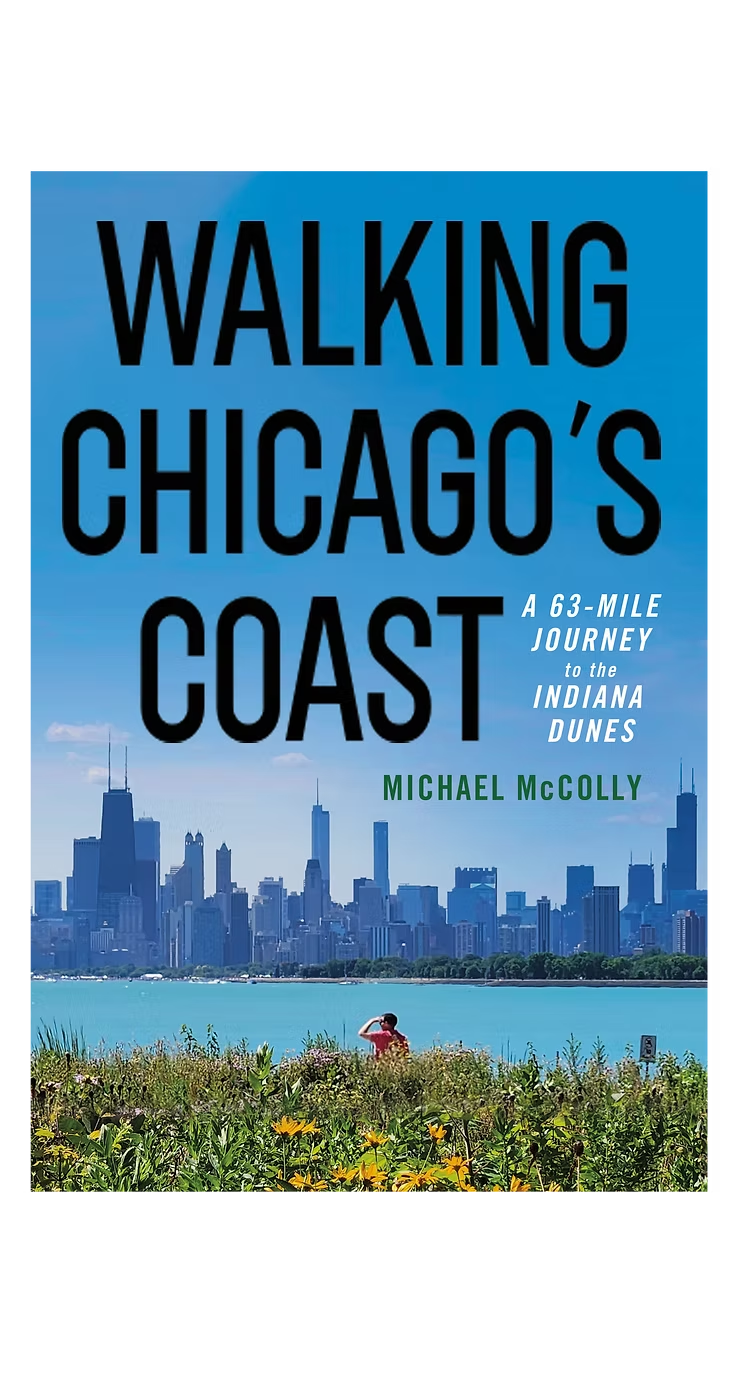
We learn to walk anywhere between 11-13 months, and if we’re lucky, we spend the rest of our lives doing it. We walk for exercise. To cool off. To think. Because the dog has the zoomies. Because Uber is doing surge pricing.
Say the average person walks 7,500 steps per day. That’s 2,737,500 steps in a year. The average life expectancy is 79 years. That means that average person walks 216, 262,500 steps in their life. If it takes about 2,000 steps to walk a mile, we’ll walk about 108,000 miles in our lives. One foot in front of the next, step after step, nearly four and a half times around the Earth.
Once we decide to walk it’s almost as involuntary as a heartbeat. Maybe we think. Maybe we try not to think. Maybe we observe or try to solve a problem. Walking can be meditative, philosophical, spiritual, even. Aristotle walked around teaching philosophy for his Peripatetic School. Nietzsche ambled. Kierkegaard wandered. So did Socrates, Kant, Heidegger. Rosseau wrote a book called Reveries of the Solitary Walker. Henry David Thoreau was a walker, of course. So were Elizabeth Carter and Virgina Woolf. Einstein. Keats. Beethoven. Samuel Coleridge and Williams Wordsworth and Wordsworth’s sister Dorothy who might’ve outwalked them both. Dickens. Nan Shepherd. De Quincy. One foot in front of the next, step after step, every one of them.
Michael McColly, author of the book, Walking Chicago’s Coast: A 63 Mile Journey to the Indiana Dunes, has no shortage of reasons he walks: anxiety, curiosity, to break loose, to discover, to get to know places, to stay in touch with them.
He first began walking when he was in the Peace Corps in Senegal in the early 1980s. Walking was an escape, something therapeutic. It turned into a way to inhabit the world. He writes, “to assuage a physical hunger if not a psychological need to feel [his] body over open landscapes.”
McColly, freshly home in Chicago from a walking trip in the UK in 2016, felt the need to move again. He couldn’t stop walking. He decided — practically out of nowhere — to walk along the lakefront. To where? He wasn’t sure. Then he envisioned walking clear to the Indiana Dunes, a few hours from where he grew up in Marion, Indiana. Within a couple days he was walking. It was only 63 short miles away on foot.
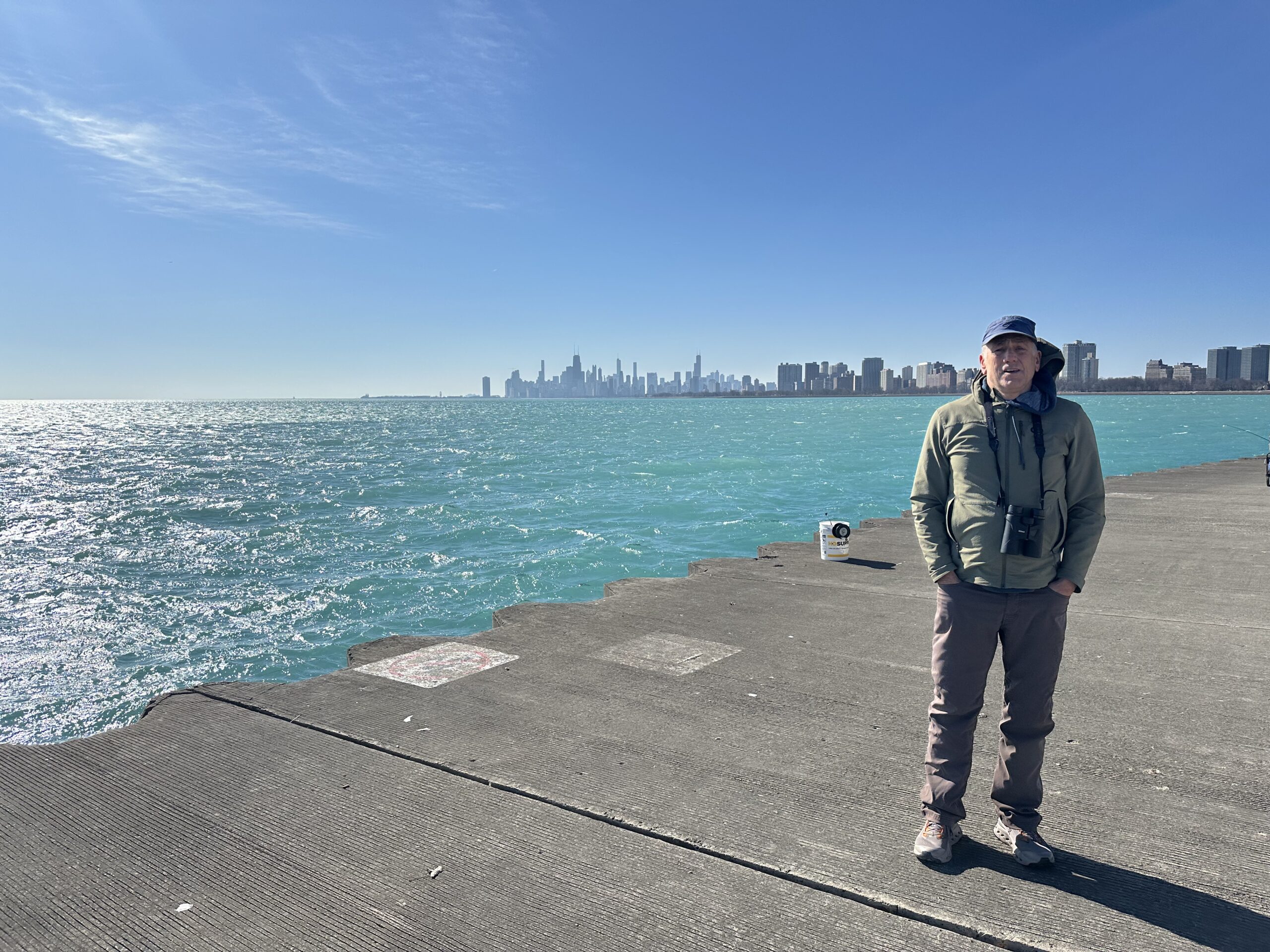
Michael McColly revisits his lakeshore walk. Photos by Justin Staley.
His book is an intriguing blend of travelogue, personal essay, historical and environmental reportage, and phenomenological exploration. McColly is curious about how we interact with our surroundings, what places mean to us, what meanings we give them. He explores time, memories, alienation, and more, taking us from his home in Rogers Park, alongside DuSable Lakeshore Drive, through the Loop, then the “other half” of Chicago, this “polyglot metropolis of ever-widening social, economic, and environmental divides”: through the South Side, South Chicago, the Calumet River, then into Indiana and through its forgotten neighborhoods and cities, including the most famous forgotten city of all: Gary. Along the way McColly wrestles with his memories, with the winners and losers of history, and the relationship between urban landscapes and the natural world. There are victories against development but failures to protect the most vulnerable; there is isolation and community; beautiful beaches and shorelines filled with smokestacks and oil refineries and toxic waste leeching into communities literally and spiritually; there are ancient lakes and abandoned casinos; the ethos of labor and its graveyards; there are lost cities ravaged by racial, economic, and environmental injustices, and there are vibrant communities and hopes for a future.
I meet McColly on a chilly, ludicrously windy morning in early March at the Montrose Point Bird Sanctuary on Chicago’s North Side. We walk the path and discuss birds. Once you’re in your 40s you’re required to download the Merlin bird app and buy a pair of binoculars to start identifying birds in your neighborhood. Everyone can agree on birds; birds could heal the world. As McColly writes in his book: “I have found in birds what my dog once was for me — a reconnection to the living world around me. In them I recognize the ephemeral nature of life, in their vulnerability I feel my own. For what is fate to the kingbird or the robin? They weather the winter storms with resilience. They survive despite our stupidity, possessing a will to make do with the world as they find it.”
I hear the cardinal’s perfect metronomic whistles, the angry, twirling calls of red-winged blackbirds, the abrupt squeaks of grackles, the ceaseless chirping of sparrows, and plenty more I can’t recognize. I ask McColly about his mental preparation to make his journey. “The idea of setting an intention was really interesting psychologically. Because I knew I was doing something different,” he said. “I was traveling in the city, and my perception changed. Because I’m saying I’m doing this, everything is changing.”
I’m remi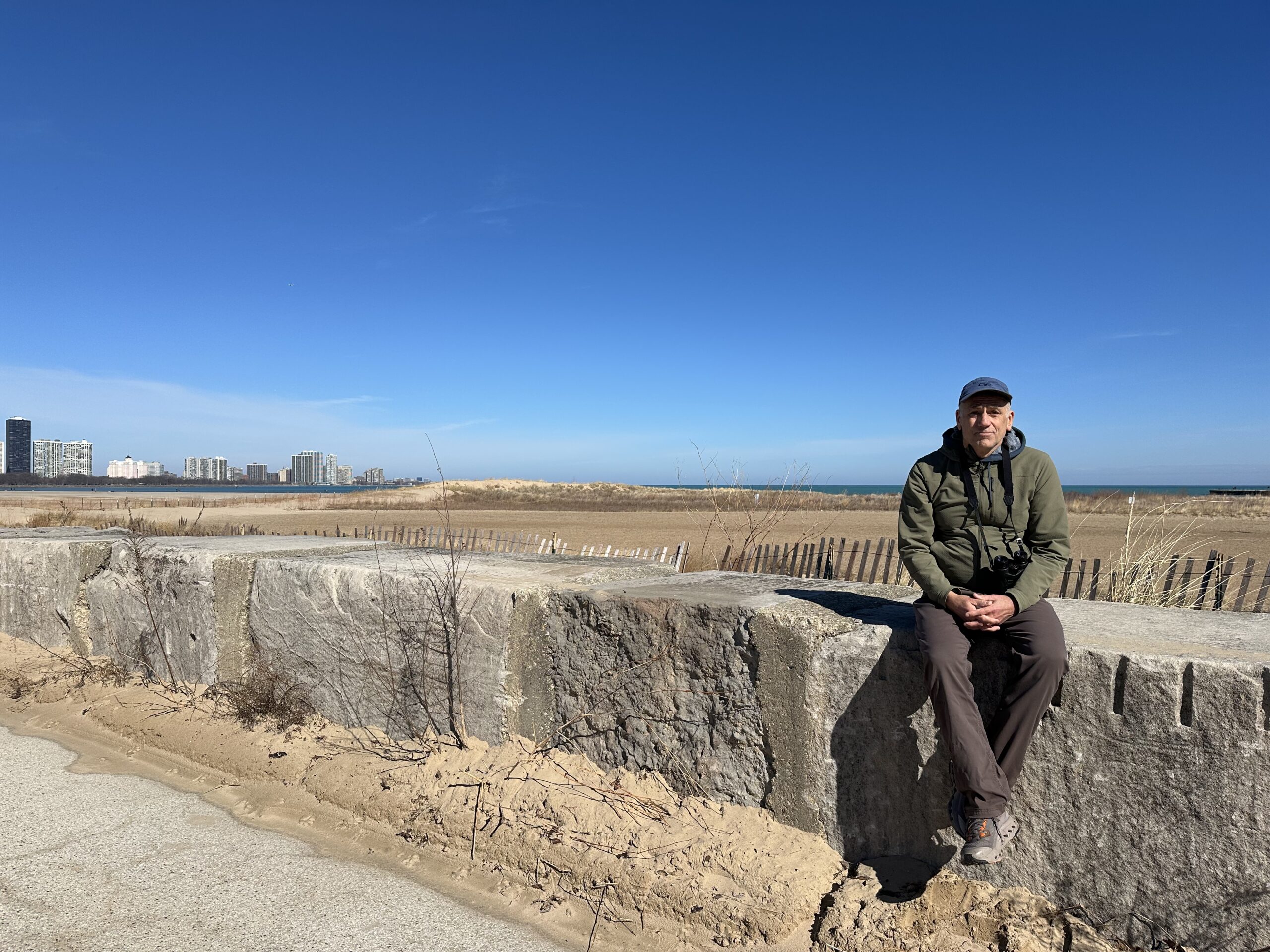 nded of quantum physicists, philosophers, neuroscientists, and self-help authors alike, who, for varying (yet cohesive) reasons, insist that the nature of the attention we give to the world changes the way we see it. McColly finds individual histories on painted rocks, truths under white-washed histories of heroes, personal and collective memories embedded into an entire coast. On a 63-mile walk, you have no choice but to pay attention.
Along his two-day summer sojourn, when McColly removes his shoes and checks for blisters or rubs his swelling feet, you can practically feel the aches, but you also feel the relief when he walks on grass, or finds an air-conditioned building, or goes for a swim in the lake and dries in the sun.
We emerge from the sanctuary and walk the fishing pier, the wind nearing violence. Fishermen with their buckets and tackle boxes line the path. The smell of cigarettes appears and disappears just as quickly. To the south is that famous skyline. Beyond that, the rest of McColly’s journey along the Third Coast all the way to the Dunes.
“I wish I would’ve had the time to talk to people,” McColly declares as we double back along the pier. We get glimpses of plenty of people, though, even if he doesn’t talk to them: fishermen, beachcombers, swimmers, gleaners; kayakers, preachers, cab drivers, gamblers, chess players; landscape painters, joggers, cyclists, street vendors, shop owners. There’s a loneliness to this book, as there is in all good stories, but there’s recognition, and recognition tells us we belong.
In the book the lake looms like the sun itself, both place and living thing. McColly reminisces about being in complete awe of it the first time he saw it as a kid growing up in Indiana and goes for a swim in it multiple times to cool down. The lake is baptism, ablution, rejuvenation.
Then there’s the destination: the Indiana Dunes. “That was a story I wanted people to know,” he tells me. With his arrival at the Dunes, there’s no giant revelation, but in this refuge where he feels home, he understands that for all the shaping of the world we do, the places we visit and call home shape us, too, only in much more subtle ways. The Dunes, with its mosaic of ecosystems shaped for thousands of years by the lake and the wind and the seasons, its history just another chapter in the fight to preserve natural spaces, is the perfect place for the collision between the past and the present, between the certainty of a natural order and the uncertainty of our short lives. It’s a place for memory and imagination. In the book’s last few pages, McColly goes for a swim in the lake. And then he starts walking again.
McColly and I double back along the outer edge of the bird sanctuary and Montrose Beach Natural Dunes Area. The Chicago Park District stopped tending to the area in 2001 and it’s since become a protected area for native and endangered plants, and an important natural area for foraging, nesting, and migrating birds.
When we get to the border between the Dunes and Montrose Beach a woman stops us. “Hi. Walk all the way down and turn around.” We’re quiet. “Are you here for the owl?” she asks.
Apparently there’s a snowy owl who’s taken refuge in the dunes. “Okay, let’s go,” McColly says, and I nod.
We trek along the sand and push against the wind. There are several groups of people watching. The wind is something fierce and McColly and I stop talking. We take turns snapping photos and looking at the snowy owl through his binoculars. The owl sits imperturbable, stoically bearing it all.
After some time we head back to the sanctuary and sit on a fence at one of its entrances and wind down our talk. For the first time all morning the wind calms. We walk back through the sanctuary, and after we emerge we shake hands and walk in opposite directions, he back to his apartment, me to my car. I climb in and wish I hadn’t driven.
Justin C. Staley is a burger aficionado who teaches at DePaul University in Chicago and enjoys freelance writing when he can find the time. His stories and essays have been published in Helicon, Crack the Spine, Big Muddy, Cola, and Sports Illustrated’s “The Cauldron.” His essay, “A Giants Fan Walks into a Bar,” was published in Sport Literate‘s “30th Anniversary” issue in 2025. He lives in Evanston, Illinois with his wife, twin sons, dog Odin, and cats Bilbo and Frodo.