


Thanks, Gil
by Scott Bandremer
Oh no.
Another Knicks video just landed in my feed.
Somebody’s showing Game 5 again. Somebody else is filming grown men weeping in the streets of Manhattan.
Another guy is hugging complete strangers like he’d just been rescued from a deserted island.
And now they’re playing Sinatra.
Stop. Please stop.
I have no more tissues.
My New York Knicks are NBA champions. World Champions!
Even now, typing those words feels vaguely illegal, like I should look over my shoulder before publishing them.
For 53 years I lived with a simple understanding of the universe: the Knicks were not going to win a championship again. Ever.
That wasn’t pessimism. That was data.
I had decades of evidence. Entire presidential administrations came and went. Technologies were invented, became obsolete, and disappeared.
I got older. My hair got thinner. Ticket prices became the GDP of a small nation.
And still, no championship.
Eventually, disappointment becomes part of your identity. Knicks fans don’t merely root for a basketball team. We major in hope while minoring in heartbreak.
Then the impossible happened.
The Knicks won.
And here’s the strange part: I knew exactly how to handle losing. I’d been practicing since Richard Nixon was president.
What I wasn’t prepared for was winning.
Now every video sends me spiraling.
Every highlight reel feels personal.
Every replay unlocks some forgotten room in my memory.
To quote Jackson Browne, “Here come those tears again.”
I find myself sitting in the middle of this beautiful emotional hurricane, dazed and grateful and more than a little confused.
Because somewhere beneath the celebration, another memory keeps tugging at me.
The last time New York sports made me feel this way was when I was a kid. Oh, the Mets championship in 1986 was very special, indeed.
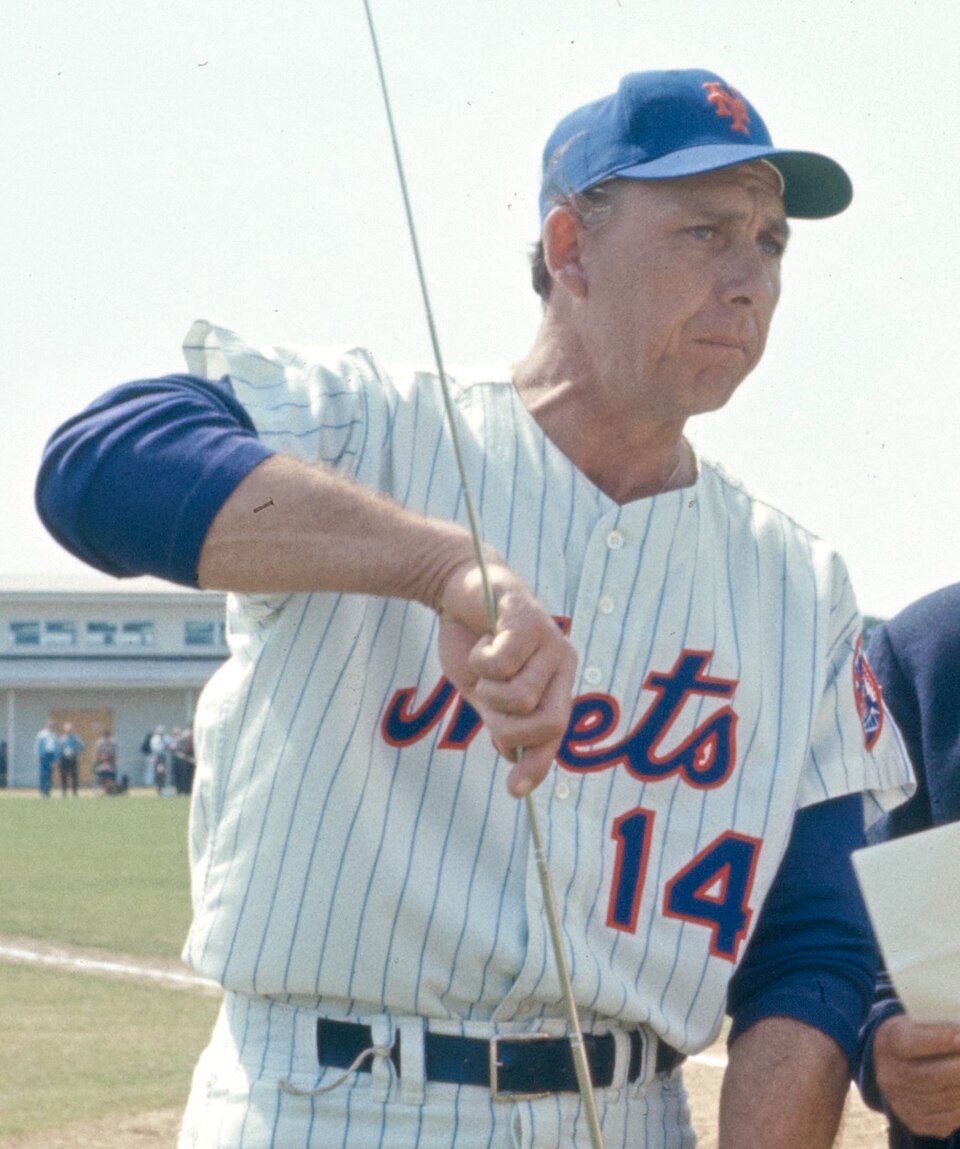
Hall of Famer Gil Hodges (Class of 2022) was a slugging first basemen for both the Brooklyn and Los Angeles Dodgers. After his playing days, he returned to New York, managing the “Miracle Mets” to the 1969 World Series title.
But this feeling I now have is something else.
Something that is drawing me back in time, as I close my eyes and begin to float away on a magic carpet ride deep into my past …
And suddenly I’m drifting backward through the decades. Back to a time of innocence. Back to the losing ways of the New York Jets, the New York Knicks and the New York Mets.
Back to a man named Gil Hodges who taught me something about heroes long before I understood the lesson.
Spring, 1969. I was almost 9 years old, living in the geographic center of my universe: Flatbush-Midwood, Brooklyn.
Our apartment building sat on Kenilworth Place directly across from Brooklyn College, surrounded by fraternity houses, single-family homes, and the sort of neighborhood characters that gave Brooklyn its PhD in personality.
From our kitchen window, I could watch history happen and then be home in time for dinner.
It was a different era, which is a polite way of saying our parents had a remarkably relaxed definition of child supervision.
At 5 years old, I walked three blocks alone to kindergarten at P.S. 152, passing Brooklyn College on one side and Midwood High School on the other. My educational future was basically laid out like a subway map.
My younger brother and I rode our bikes everywhere — through the college campus, down side streets, wherever curiosity pointed the handlebars.
Meanwhile, the late 1960s raged around us.
Anti-war protests regularly marched beneath our apartment windows. Thousands of demonstrators would flood Campus Road, chanting and carrying signs against the Vietnam War.
Even as a kid, I could feel the electricity in the air. Something important was happening. I wasn’t entirely sure what it was, but I knew it mattered.
Still, at the end of the day, I was nine.
And like many 9-year-olds, I had more pressing concerns.
Specifically, my terrible taste in sports teams.
I rooted passionately for the Mets, Jets, and Knicks — a trifecta of disappointment so reliable it should have come with a warranty. Somehow, probably through my father, who expressed most of his emotions through sports scores, I became hopelessly attached.
I watched every game on our black-and-white television. I memorized rosters. I collected trading cards with the intensity of a Wall Street investor building a portfolio.
For the record, I was once potentially worth millions (maybe).
My mother accidentally destroyed that possibility by throwing away roughly 2,000 football cards from 1968 while I was away at college.
Whenever people ask why I don’t own a yacht today, that’s the answer.
I knew every Met by heart: Tom Seaver, Cleon Jones, Tommie Agee, Jerry Koosman, Jerry Grote. I could probably have recited the batting order faster than I could complete long division.
Then, something miraculous happened.
Actually, three miraculous things.
Joe Namath guaranteed and delivered a Super Bowl for the Jets in 1969.
The Knicks won an unforgettable championship in 1970.
And amidst all of that, in the greatest sporting upset my young brain could comprehend, the Mets won the World Series in 1969.
The Miracle Mets.
For a kid who had invested emotionally in three chronic underachievers, this felt less like sports and more like proof that the universe occasionally rewarded loyalty.
I was living in fan paradise.
Then, two years later, reality showed up.
In April of 1972, Gil Hodges died suddenly of a heart attack.
I was almost 12 years old.
Until then, death had mostly existed as an abstract concept adults talked about. Suddenly it wasn’t abstract anymore.
One day Gil Hodges was managing the Mets. The next day he wasn’t.
Gone.
I remember being stunned. Not just sad but confused. How could someone be there one day and disappear the next?
My mother tried to comfort me, but I kept thinking about something else entirely:
Who was going to manage the Mets?
It’s amazing how childhood grief and childhood priorities can occupy the same space.
When I learned Gil’s funeral would be held at Our Lady Help of Christians Church on Avenue M, I made a decision.
Actually, my friend and I made a decision.
We were going.
This was no small undertaking.
Sure, kids had freedom back then.
We played stickball, punchball, basketball, and rode bikes until the streetlights came on — or until my mother’s voice, somehow capable of traveling several city blocks without technological assistance, summoned me home for dinner.
But Avenue M felt far away. Practically another borough.
Still, how could we not go?
So, without informing my parents of our expedition — which felt like a detail best shared afterward — we hopped on our bikes and headed off.
When we arrived, it looked like all of New York had the same idea.
The streets were packed.
The line stretched forever.
And there I was: a nice Jewish kid from Brooklyn about to enter a church for the first time in his life.
I had absolutely no idea what I was doing.
As the line moved forward and we entered the church, I stopped cold.
Standing only a few feet away were some of the biggest sports legends I’d ever seen.
There was Bud Harrelson. Tommie Agee. Tug McGraw.
Then I saw Pee Wee Reese. Jackie Robinson. Sandy Koufax.
These weren’t baseball players.
These were superheroes.
At least they had been in my mind.
Then I noticed something.
They were crying.
Not quietly.
Not hiding it.
Just openly grieving.
I stood there staring.
Because this wasn’t what superheroes were supposed to do.
These men were strong. Fearless. Larger than life.
And yet here they were, mourning a friend.
For the first time, I understood something that would take many adults years to learn:
Strength and vulnerability aren’t opposites. They’re teammates.
Before I knew it, I was crying too. I couldn’t have explained why.
I just knew that if these men loved Gil Hodges enough to cry, then somehow I did too.
That moment never left me.
Neither did what happened next.
Remember, this was my first church experience. Nobody had issued me a handbook.
As the line shuffled toward Gil’s open casket — the first deceased person I had ever seen — I watched carefully.
Everyone ahead of me paused.
Many knelt briefly.
So when my turn came, I did exactly what any loyal young Mets fan would do.
I got down on one knee. Closed my eyes. Stayed there for a few seconds.
And hoped I wasn’t violating any major church regulations.
Then I stood up and moved along. Mission accomplished.
When I finally got home and told my mother where I’d been, I braced for impact.
I expected punishment. Maybe grounding.
Possibly a lecture delivered at volumes rivaling her dinner-time summons.
Instead, she surprised me.
She hugged me.
Then she told me she was proud of me for making the effort to honor someone who had meant so much to me.
At 12 years old, that felt pretty good.
The next day, my friend and I retold the adventure to anyone willing to listen.
We described every detail: the crowd, the players, the church, the tears.
Our friends listened like we’d returned from Everest.
And in our own way, maybe we had.
Looking back now, I realize that day wasn’t really about baseball.
It was about growing up. It was about discovering that heroes are human.
It was about learning that grief is simply love with nowhere to go.
And it was about taking one small bike ride that somehow ended up lasting a lifetime.
Today, when I take my grandchildren to Citi Field, I point toward the retired number 14 hanging above the ballpark.
Gil Hodges.
Our manager.
I tell them his story.
Sometimes they listen. Sometimes they’re more interested in the giant scoreboard or whatever snack costs eighteen dollars these days.
But every now and then, I catch that familiar sparkle in their eyes.
The same one I had.
The same connection to a team, a player, a moment.
And I realize that’s really what survives.
Not championships. Not statistics. Not even miracles.
What survives are the memories. The stories.
The people who mattered.
So these days I spend my time loving my grandchildren, loving my Mets, and holding onto the moments that shaped me.
The Knicks have held up their end of the bargain. Now the remaining two thirds of this sports triad need to step up.
Hopefully, years from now, my grandkids will have a few stories of their own.
Let’s Go Mets. Let’s Go Jets. And God Bless the New York Knicks.
Life is short. But memories are forever. Hold on to them tight.
Thanks, Gil.
Scott Bandremer is a writer, photographer, and digital video producer who resides in the greater NYC market. A 50-plus year devoted fan of the Mets, Knicks, and Jets, he can currently be found residing on Cloud9 as he celebrates the awesomeness of a Knicks championship.