


First With No Second
A Review of Mark Remy’s The Running Dictionary
Since the publication of The Runner’s Rule Book in 2009, Mark Remy has been a genre unto himself and a veritable font of running humor. It might not be high praise to call him the premier running satirist, if he is literally one of a kind, but high praise is what he deserves. If you are a runner who hasn’t yet read Remy, chances are his several books and his website Dumb Runner are the treasures you didn’t know you were looking for.
Find it hard to believe there could be that much funny about running? Take a minute and click on the link in the previous paragraph. Or just consider the general ridiculousness of the modern runner’s life and habits, as seen through the eyes of one with above average (i.e., >0) self-awareness. He’s an insider (2:46 marathon PR ) with an outsider’s sense of irony. Holding his exaggerated mirror up to our obsessive faces, Remy gives us the chance to laugh at ourselves — a welcome opportunity for as self-serious a group as recreational runners.
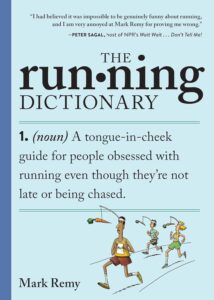 In his latest book, The Running Dictionary, Remy finds a new form in which to fit his wits: the definition. Non-running English speakers will know the automobile as “A powerful, motorized multiton steel vehicle that provides a comfortable place for its operator to watch online videos and check social media” but may not be aware that automobile operators will “occasionally [glance] up to tell runners that they should ‘get off the road.’” Unlike drivers, Remy sees us.
Less flattering to the runner’s ego, the excesses of the running-industrial complex are ripe for Remy’s teasing. Take carbon-plated shoes, which “can cost more than twice as much as a typical pair of running shoes, yet are less durable — a combination that few runners can resist.” Before we assign all blame to Nike (“Greek goddess of marketing”), consider how runners use social media: “to share details of their latest run and to ignore posts from other runners sharing details of their latest runs.” If you can’t laugh, truth hurts.
Behind Remy’s jabs lies a compassionate ethos, described on his website and honored in his books. The Dumb Runner Manifesto (in full):
1. Running should be simple. Period.
2. There is beauty in every run, if you take the time to look. Music, too, if you listen for it.
3. Laughter is good. So is pie. More of both, please.
Laughter indeed (you’re on your own for pie). Even the most circumspect reviewer is tempted to quote the book pretty much in whole or at random:
Beginner: Someone who is new enough to the sport to feel insecure about how fast and how far they run, because they haven’t yet learned that other runners are too busy worrying about their own pace and mileage to care about anyone else.
Boston qualifier (BQ): 1. A marathon time that’s fast enough to allow entry into the famously selective Boston Marathon. 2. Any word or phrase used to modify the meaning of Boston, usually by those who are unable to meet the marathon’s time standards — e.g., “the hugely overrated Boston Marathon.”
Running should be simple. But few things are simple where the ego is concerned. Thank the running gods we have Mark Remy to keep us honest.
Scott F. Parker is the author of Run for Your Life: A Manifesto and The Joy of Running qua Running, among other books. His writing has appeared in Runner’s World, Running Times, Tin House, Philosophy Now, The Believer, and other publications. He teaches at Montana State University and is the nonfiction editor for Kelson Books.