

• A Literary Magazine | Honest Reflections on Life's Leisurely Diversions

Posts By :

bjj-sportliterate

Reds Take Two in the City of Brotherly Love

150 150 bjj-sportliterate

Reds Take Two in the City of Brotherly Love

Baseball is a funny game. Not the bent over, cackle-out-loud funny induced from your favorite cocaine-fueled comedians from the 1970s and ’80s. More like a dry wit observational humor as told by predatory funnymen from the 1980s and ’90s.

The Reds and Phillies had similar records when they met for a Mid-May midweek showdown. Yet the Phillies were rising, playing their best ball. The Reds, though not in the freefall of the first nine days of the month, were still scuffling.

On Monday night in the city of Brotherly Love, Nick Lodolo was kind enough to give up two runs in the home team’s first. But the Reds evened it immediately in the top of the second. Lodolo settled down until giving up a solo shot in the sixth. Again the visitors responded with Sal Stewart launching an 0-2 curveball into the right-field seats. For the slumping rookie, it must have felt like a bell ringer, a Liberty Bell knock to get him healthy again after his heroic April. Then, Spencer Steer’s two-out double in the eighth gave the Reds a 4-3 lead. Say hey, could the Reds win this one?

Stop me if you’ve heard this before. Graham Ashcraft gives up a leadoff single in the bottom of the eighth inning. He manages two outs but then surrenders a two-run homer to Bryson Stott. There was some radio-booth discussion about whether or not to leave Ashcraft in to pitch to the lefthanded hitter. Francona leaves him in, Bryson goes yard, and the Reds lose 5-4.

Tuesday, Chase Burns again showed his early-season dominance. He gave up three hits over six full innings. One hit, however, was a longshot from Trea Turner. The Redleg offense scratched out two runs in the fourth and two more in the seventh. And three guys from the bullpen held it down for a 4-1 victory.

The Wednesday matinee featured a Reds hit parade (15 in all, four from Stewart alone, including a left field upper decker that wowed the Phillie TV guys). Andrew Abbott pitched well for five-plus innings. A shaky bullpen in the sixth gave up three runs. But the Reds added on late for the 9-4 final and a series win.

I was on a Philadelphia rooftop to see Veterans Stadium demolished on March 21, 2004. We had champagne on what I think was a Sunday and the final day of spring break from Purdue. Seems like a million years ago given the differences in my life between now and then. But if my math is right it was just over 22 years ago.

Stewart, who surely would have been Joe Nuxhall’s “Star of the Game” on Wednesday, was only about 15 months old when I was in Philly. Born in Miami, he probably wouldn’t have been thinking about cheese steaks, or founding fathers, or even the sorry ass Slyvester Stallone (in spite of having the same initials). You never know. As I saw one stadium imploded almost his whole lifetime ago, perhaps something from Sal’s toddler days forecasted the reality of him breaking out of an offensive funk with multiple hits and two homers more than two decades later. Life, like baseball, can be a funny game.

William Meiners is the editor of Sport Literate. Among his summer 2026 plans are the documentation of 33 Reds’ series. That should be about 600 to 700 words every few days. If you don’t expect too much breakdown or analysis, outside of his own troubled head, you may not be disappointed. From losing streaks through high-water marks, he’ll follow the club, sometimes literally, from the reluctant spring of early May through the dog days of August. Then he’s off to something else.

“Hello, Cleveland!”: WTF, Bullpen?

150 150 bjj-sportliterate

“Hello, Cleveland!”: WTF, Bullpen?

by William Meiners

I feel for Terry Francona. The Reds manager seems like a nice enough guy, a player’s coach, if you will, and I don’t know if he ever gets too riled up. Though he’s never lived in an apartment above me and I’ve spent more than a few years in basement apartments.

With the Reds elevator drop from the Central’s top to basement in less than three weeks of May, the team rolled into Cleveland for round one in the Battle of Ohio. Rivalry games are happening all over this weekend with Cubs vs. White Sox, Yankees vs. Mets, Phils vs. Pirates, etc.

Francona managed the Indians/Guardians for a decade. Maybe his young players might win one (or two or three) for the Tito. But like the absence of crying in baseball, there may be no bulletin board material either. There’s a saying about momentum being as good as the next day’s starter.

Coming off a 15-run awakening in the getaway game against the Nationals, the Reds put a good starter on the mound on Friday night. Andrew Abbott, feeling his old self as young as he is (born June 1, 1999), pitched well and got three runs of support from his teammates. Tito hands it over to the bullpen after Abbott surrenders a homer in the sixth. In the top of the eighth, the Reds pitch in with three runs, including a two-run homer from Matt McClain, who seems to be getting on track. Up 7-1, this should be a Friday night laugher.

I wonder if Francona sees patterns in the nature of 26 young men. Generally equally divided by pitchers and fielders, the lineups are rolled out like chess pieces, hoping for a winning combination. Among the throwers, you’ve got starters and relievers, including long men, stoppers, and closers. Of a baker’s dozen position players, too many to date still ain’t hitting their weight, including a Gold Glove third baseman. JJ Bleday, who did not make the club out of spring training, is providing solid offensive output from the outfield. Sal Stewart, who can play first or third, has slumped a bit in May after a fantastic April. Elly de la Cruz is a superstar, go ahead and trademark EDLC (and I think he’s already got an ice cream named after him).

In the bottom of the eighth, Graham Ashcraft threw 12 straight balls. If he’d been my Little Leaguer, I might have threatened to murder him. Enter the game with a three-run lead, and it’s like the Guardians are on a speed loop, racing around the bases without once swinging the bat. After loading the bases, Travis Bazzana, born long after “Bonanza” left the airways, singled home a run. Then the next pitcher, Brock Burke, walks in two runners and gives up a sacrifice fly. Tejay Antone gives up one more in the bottom of the ninth but earns the save. Reds squeak out a one-run win. But Jesus Christ, it’s enough to give Francona ulcers. And I think he had some health problems in his Cleveland days. Beyond the general discontent of living in Cleveland.

Saturday was a glorious day for yard work in Michigan. The Reds had a chance to win the late-afternoon start, but the relievers (with a bullpen like this, who needs victories?), give up 2, 2, and 1 in innings six, seven, and eight to secure the loss from a game the Reds led 4-2 going to the sixth. Four relievers, all generous with at least one free pass, made the final score (7-4) look a little more lopsided than it was.

Sunday went “ugly early,” same advice they put on Harry’s t-shirts at Purdue. Brady Singer, in a second straight start, gave up three homers in four innings. Three relievers in red stockings gave up one each in another blowout loss (10-3). Cincinnati dropped back to just one game over .500. And it’s starting to look like a long season.

William Meiners is the editor of Sport Literate. Among his summer 2026 plans are the documentation of 33 Reds’ series. That should be about 600 to 700 words every few days. If you don’t expect too much breakdown or analysis, outside of his own troubled head, you may not be disappointed. From losing streaks through high-water marks, he’ll follow the club, sometimes literally, from the reluctant spring of early May through the dog days of August. Then he’s off to something else.

Ramblin’ Man

150 150 bjj-sportliterate

Ramblin’ Man

by Justin C. Staley

We learn to walk anywhere between 11-13 months, and if we’re lucky, we spend the rest of our lives doing it. We walk for exercise. To cool off. To think. Because the dog has the zoomies. Because Uber is doing surge pricing.

Say the average person walks 7,500 steps per day. That’s 2,737,500 steps in a year. The average life expectancy is 79 years. That means that average person walks 216, 262,500 steps in their life. If it takes about 2,000 steps to walk a mile, we’ll walk about 108,000 miles in our lives. One foot in front of the next, step after step, nearly four and a half times around the Earth.

Once we decide to walk it’s almost as involuntary as a heartbeat. Maybe we think. Maybe we try not to think. Maybe we observe or try to solve a problem. Walking can be meditative, philosophical, spiritual, even. Aristotle walked around teaching philosophy for his Peripatetic School. Nietzsche ambled. Kierkegaard wandered. So did Socrates, Kant, Heidegger. Rosseau wrote a book called Reveries of the Solitary Walker. Henry David Thoreau was a walker, of course. So were Elizabeth Carter and Virgina Woolf. Einstein. Keats. Beethoven. Samuel Coleridge and Williams Wordsworth and Wordsworth’s sister Dorothy who might’ve outwalked them both. Dickens. Nan Shepherd. De Quincy. One foot in front of the next, step after step, every one of them.

Michael McColly, author of the book, Walking Chicago’s Coast: A 63 Mile Journey to the Indiana Dunes, has no shortage of reasons he walks: anxiety, curiosity, to break loose, to discover, to get to know places, to stay in touch with them.

He first began walking when he was in the Peace Corps in Senegal in the early 1980s. Walking was an escape, something therapeutic. It turned into a way to inhabit the world. He writes, “to assuage a physical hunger if not a psychological need to feel [his] body over open landscapes.”

McColly, freshly home in Chicago from a walking trip in the UK in 2016, felt the need to move again. He couldn’t stop walking. He decided — practically out of nowhere — to walk along the lakefront. To where? He wasn’t sure. Then he envisioned walking clear to the Indiana Dunes, a few hours from where he grew up in Marion, Indiana. Within a couple days he was walking. It was only 63 short miles away on foot.

Michael McColly revisits his lakeshore walk. Photos by Justin Staley.

His book is an intriguing blend of travelogue, personal essay, historical and environmental reportage, and phenomenological exploration. McColly is curious about how we interact with our surroundings, what places mean to us, what meanings we give them. He explores time, memories, alienation, and more, taking us from his home in Rogers Park, alongside DuSable Lakeshore Drive, through the Loop, then the “other half” of Chicago, this “polyglot metropolis of ever-widening social, economic, and environmental divides”: through the South Side, South Chicago, the Calumet River, then into Indiana and through its forgotten neighborhoods and cities, including the most famous forgotten city of all: Gary. Along the way McColly wrestles with his memories, with the winners and losers of history, and the relationship between urban landscapes and the natural world. There are victories against development but failures to protect the most vulnerable; there is isolation and community; beautiful beaches and shorelines filled with smokestacks and oil refineries and toxic waste leeching into communities literally and spiritually; there are ancient lakes and abandoned casinos; the ethos of labor and its graveyards; there are lost cities ravaged by racial, economic, and environmental injustices, and there are vibrant communities and hopes for a future.

I meet McColly on a chilly, ludicrously windy morning in early March at the Montrose Point Bird Sanctuary on Chicago’s North Side. We walk the path and discuss birds. Once you’re in your 40s you’re required to download the Merlin bird app and buy a pair of binoculars to start identifying birds in your neighborhood. Everyone can agree on birds; birds could heal the world. As McColly writes in his book: “I have found in birds what my dog once was for me — a reconnection to the living world around me. In them I recognize the ephemeral nature of life, in their vulnerability I feel my own. For what is fate to the kingbird or the robin? They weather the winter storms with resilience. They survive despite our stupidity, possessing a will to make do with the world as they find it.”

I hear the cardinal’s perfect metronomic whistles, the angry, twirling calls of red-winged blackbirds, the abrupt squeaks of grackles, the ceaseless chirping of sparrows, and plenty more I can’t recognize. I ask McColly about his mental preparation to make his journey. “The idea of setting an intention was really interesting psychologically. Because I knew I was doing something different,” he said. “I was traveling in the city, and my perception changed. Because I’m saying I’m doing this, everything is changing.”

I’m reminded of quantum physicists, philosophers, neuroscientists, and self-help authors alike, who, for varying (yet cohesive) reasons, insist that the nature of the attention we give to the world changes the way we see it. McColly finds individual histories on painted rocks, truths under white-washed histories of heroes, personal and collective memories embedded into an entire coast. On a 63-mile walk, you have no choice but to pay attention.

Along his two-day summer sojourn, when McColly removes his shoes and checks for blisters or rubs his swelling feet, you can practically feel the aches, but you also feel the relief when he walks on grass, or finds an air-conditioned building, or goes for a swim in the lake and dries in the sun.

We emerge from the sanctuary and walk the fishing pier, the wind nearing violence. Fishermen with their buckets and tackle boxes line the path. The smell of cigarettes appears and disappears just as quickly. To the south is that famous skyline. Beyond that, the rest of McColly’s journey along the Third Coast all the way to the Dunes.

“I wish I would’ve had the time to talk to people,” McColly declares as we double back along the pier. We get glimpses of plenty of people, though, even if he doesn’t talk to them: fishermen, beachcombers, swimmers, gleaners; kayakers, preachers, cab drivers, gamblers, chess players; landscape painters, joggers, cyclists, street vendors, shop owners. There’s a loneliness to this book, as there is in all good stories, but there’s recognition, and recognition tells us we belong.

In the book the lake looms like the sun itself, both place and living thing. McColly reminisces about being in complete awe of it the first time he saw it as a kid growing up in Indiana and goes for a swim in it multiple times to cool down. The lake is baptism, ablution, rejuvenation.

Then there’s the destination: the Indiana Dunes. “That was a story I wanted people to know,” he tells me. With his arrival at the Dunes, there’s no giant revelation, but in this refuge where he feels home, he understands that for all the shaping of the world we do, the places we visit and call home shape us, too, only in much more subtle ways. The Dunes, with its mosaic of ecosystems shaped for thousands of years by the lake and the wind and the seasons, its history just another chapter in the fight to preserve natural spaces, is the perfect place for the collision between the past and the present, between the certainty of a natural order and the uncertainty of our short lives. It’s a place for memory and imagination. In the book’s last few pages, McColly goes for a swim in the lake. And then he starts walking again.

McColly and I double back along the outer edge of the bird sanctuary and Montrose Beach Natural Dunes Area. The Chicago Park District stopped tending to the area in 2001 and it’s since become a protected area for native and endangered plants, and an important natural area for foraging, nesting, and migrating birds.

When we get to the border between the Dunes and Montrose Beach a woman stops us. “Hi. Walk all the way down and turn around.” We’re quiet. “Are you here for the owl?” she asks.

Apparently there’s a snowy owl who’s taken refuge in the dunes. “Okay, let’s go,” McColly says, and I nod.

We trek along the sand and push against the wind. There are several groups of people watching. The wind is something fierce and McColly and I stop talking. We take turns snapping photos and looking at the snowy owl through his binoculars. The owl sits imperturbable, stoically bearing it all.

After some time we head back to the sanctuary and sit on a fence at one of its entrances and wind down our talk. For the first time all morning the wind calms. We walk back through the sanctuary, and after we emerge we shake hands and walk in opposite directions, he back to his apartment, me to my car. I climb in and wish I hadn’t driven.

Justin C. Staley is a burger aficionado who teaches at DePaul University in Chicago and enjoys freelance writing when he can find the time. His stories and essays have been published in HeliconCrack the SpineBig MuddyCola, and Sports Illustrated’s “The Cauldron.” His essay, “A Giants Fan Walks into a Bar,” was published in Sport Literate‘s 30th Anniversary” issue in 2025. He lives in Evanston, Illinois with his wife, twin sons, dog Odin, and cats Bilbo and Frodo.


A Collapse Between Blowouts as Reds Drop Series to Nats

150 150 bjj-sportliterate

A Collapse Between Blowouts as Reds Drop Series to Nats

by William Meiners

Let’s go backwards for this series. Once called the businessman’s special (keep your women and children at home), the Reds flexed offensively on Thursday afternoon like never before in the young season, pounding the Washington Nationals 15-1. The buzzkill, however, is that the shellacking accounted for the lone win against the Nats in a trio of midweek games.

The Reds were blown out Tuesday night by the non-corrupt residents of the nation’s capital. More than a few of whom are representative of the Hispanic origins that so offend the current administration. Pitcher Brady Singer took an early-inning low liner off the ankle bone. Jeff Brantley, the “Cowboy” and the best color commentator in baseball (for my money, which ain’t much), spoke in real time about Singer’s inability to push off the rubber, directly resulting in back-to-back dingers from James Wood and Luis García Jr.

Singer gave up three homers in all in a short outing. To make him feel less lonely, a threesome of Reds relievers — Moll, Mey, and Santillan, as if pitching batting practice — each allowed long balls. The 10-4 loss just the latest of laughers where the Reds seemed non-competitive from start to finish. The Pirates have scored runs like Steeler touchdowns in a 5-1 record against the boys from Queen City. The Angels, Rockies, and Astros all reached double digits in the homer-friendly Great American Ball Park that was less accommodating to the Reds on those occasions.

The hump day loss, however, sandwiched between slaughters, may have been the Reds worst to date. The home team led 5-0 after one full inning. In what could be the “challenge of the season,” Spencer Steer turned a called third strike into a ball before earning a two-out walk. Nathaniel Lowe made it back-to-back walks. Then Tyler Stephenson launched a grand slam.

They should have been laughing all the way to the win column. But Nick Lodolo promptly surrendered four runs in the top of the second. One inning later, the Nats notched it at 5. The Reds rebounded for one in the bottom of the third, but Washington tied them up again at 6 in the top of the fifth.

Uneasy Cincinnati fans, bemoaning a sudden silencing of bats, may have sensed the collapse in progress. Both Elly De La Cruz and Matt McClain led off late innings with doubles, yet neither made it home. A popout bunt off the bat of Dane Myers in the last of the ninth proved particularly disheartening.

As is his wont of late, Santillan gave up a two-run blast to Daylen Lile in the extra frame. Needing two to tie, the Cowboy called a two-run shot by Steer only to backtrack it, noting the “fan interference” of a gloved Reds spectator appearing to catch the ball right near the yellow line. Ask any Baltimore Orioles fan of a certain age if they still can’t see that Yankee Stadium kid who guided Derek Jeter’s flyout into an ALCS homer 30 years ago. Then show them the video of this goofball in Cincy. Steer was granted a double, and security escorted the Reds fan out. The damn Yankee fans heralded their interferer a hero, whom they effectively “chaired through the market-place.

Now mid-May, the Reds lurk last in the Central, just two games over .500. They’re 3-8 since sitting atop the division on May 1st. Here’s hoping they didn’t use up all their Thursday hits in Cincy before tripping up to Cleveland.

William Meiners is the editor of Sport Literate. Among his summer 2026 plans are the documentation of 33 Reds’ series. That should be about 600 to 700 words every few days. If you don’t expect too much breakdown or analysis, outside of his own troubled head, you may not be disappointed. From losing streaks through high-water marks, he’ll follow the club, sometimes literally, from the reluctant spring of early May through the dog days of August. Then he’s off to something else.


Houston, We Got Bigger Problems Than the Astrodome’s Faked Moon Landing

150 150 bjj-sportliterate

Houston, We Got Bigger Problems Than the Astrodome’s Faked Moon Landing


by William Meiners

Historians and statisticians could speak to the Reds seven straight road losses to begin May. I’d have to look it up. I did not. Friday, May 8, 2026, was our 15th wedding anniversary. Joellen and I exchanged vows on Mother’s Day 2011, and my brother Mick “married us” (as sick as that sounds).

To celebrate our “crystal anniversary,” rather than wrestling for a table on graduation weekend in our college town, we headed south for 20 minutes to Gratiot County. We had a cheap bottle of wine and good Italian food in St. Louis, Michigan. The town may be best known for an environmental disaster in the 1970s, courtesy of the former Michigan Chemical Corporation, which killed lots of cows, poisoned the Pine River, and surely caused cancer among townsfolk. A large fence still surrounds the St. Louis Superfund site. But the bottle of red is priced right at “our Italian restaurant.”

I credit Joellen for keeping me alive and out of jail. She shrugged it off as we clinked glasses, probably saying, “Whatever, Bob.” But I may have checked out from the boredom and loneliness had we not unionized with a hers and ours family. And for that I count my lucky stars.

Our 20-minute wait was more like 35 as I checked the Astros-Reds score on my phone. Houston launched a pair of two-run homers in the second and the sixth. Does it matter which hitters? Reds pitching can make many lineups look like the 1927 Yankees. The home crowd showered boos in a 10-0 loss where Jose Trevino pitched again! As a catcher, he’s surely leading the league in pitching appearances, now accounting for four trips to the mound. With a 33-mph fast ball, safety protocols should allow him to keep his protective gear and mask on.

In team sports, even the desperation of personal existence, mounting consecutive losses can feel like exposure. How lucky were the Reds in April? Wasn’t that supposed to be the cruelest month? And the blame goes beyond players. Is Tito Francona, the future Hall-of-Fame manager, in trouble? And what about these small market owners?

Honestly, Marge Schott is the only Reds owner I could name right now. Known for a simpatico with Hitler (a man with “good ideas” who “went too far”), Large Marge may not have known the single-nutted dictator studied southern state Jim Crow laws before establishing his good ideas. For all her income and ignorance, she’d likely sit on Trump’s cabinet today if not for her current residence in Hell. Perhaps tasked with dismantling the Department of Education, she’d let her Saint Bernard Schottzie shit all over the U.S. Constitution. Not just the outfield of old Riverfront Stadium. But I digress.

Now in Great American Ball Park (so Trumpian) the Reds playing host to the Astros was the featured Game of the Week on Saturday. Houston is underwater record wise and I told Jo they should call it the “game of the weak.” I repeated, “Game of the weak!” Unfortunately, she’d turned her hearing aids down to the “do not disturb” setting. Given the harmonic nature of homonyms, a text from living room to kitchen might have better landed the joke.

Young Chase Burns, pitching better than any starter on the Reds roster, gave up a fifth-inning homer. His boys rallied for three runs in the bottom half of that frame. And that was all the scoring for the day. Good God almighty the Reds win their first game of the month on May 9th. I’m still married, definitely not dead, and a Saturday late afternoon game seeps into a pleasant evening for this house of three in Mount Pleasant.

On Sunday, per a household tradition, our matriarch and savior opened Mother’s Day gifts accompanied by Pink Floyd crooning, “Mother do you think they’ll try to break my balls? Ooh, ahh, mother should I build the wall?”

Early afternoon, Andrew Abbott, an All-Star last season the Reds opening day starter this year, had his breaking ball working. Still getting sorted out this spring, AA pitched six solid, scoreless innings. His teammates tallied three in the fourth and one each in the fifth and sixth innings. With a trio of bullpen pitchers holding down the ’Stros (not allowing a single hit), Cincinnati won 5-0, taking two of three from Houston. A return to normalcy? Maybe. Or just a Sunday prayer answered for what had been our wretched Reds.

William Meiners is the editor of Sport Literate. Among his summer 2026 plans are the documentation of 33 Reds’ series. That should be about 600 to 700 words every few days. If you don’t expect too much breakdown or analysis, outside of his own troubled head, you may not be disappointed. From losing streaks through high-water marks, he’ll follow the club, sometimes literally, from the reluctant spring of early May through the dog days of August. Then he’s off to something else.

Heartbreak in Wrigley: Three Walk-Offs and a Rout

150 150 bjj-sportliterate

Heartbreak in Wrigley: Three Walk-Offs and a Rout

by William Meiners

Benico del Toro has a few good lines in “One Battle After Another.” In a scene where he’s helping Leonardo DiCaprio’s character on a jailbreak, del Toro tells him, “Don’t go dark on me, Bob.” Shortly thereafter, when cops catch up to him after Bob drops and rolls out of the passenger-side window, the getaway driver confesses that he’s had “a few small beers.”

Setting aside the few brews, I can speak to darkness. Boy, can I go dark. Like before they had lights at Wrigley (and I remember the evening that changed, 8/8/88, with someone commenting on the palindrome date as we clocked out from the Bull Gang at Purdue). My own sadness may just be a sidekick to ADD and all this shame before they created terms like neurodivergent writers, which sounds fancier than someone just being a “little off.”

You hope that something like baseball won’t send you into a tailspin, but you never know. With the weekend sweep in Pittsburgh still stinging, the Reds tapped Chase Petty (from AAA Louisville) for a spot start on Monday night. Aside from Seiya Suzuki’s homer following two walks, effectively chasing him from the game, Petty pitched well enough to win. A solo homer in the third, from JJ Bleday, and Ke’Bryan’s two-run basket shot in the fourth had staked the visitors to a three-run lead.

Both bullpens held for a few innings before the Reds scratched out a go-ahead run in the top of the eighth. In the bottom of the ninth, however, Pete Crow-Armstrong, who sounds like a hyphenated version of the All-American Boy, smacked a triple off closer Emilio Pagán that Dane Myers missed by inches in the ivy. A sacrifice fly tied it, and Michael Confronto hit an opposite field shot to win it.

Bleday homered again in the first inning on Tuesday. Nathaniel Lowe followed suit in the sixth, putting the Reds up 2-0. Cubs managed singletons in the seventh and eighth to notch it. Pagán might have thrown one pitch in the ninth before falling to the ground with a hamstring injury (oh, if my hamstring could sing…). In the extra frame, consecutive strikeouts kept the Reds ghost runner on second. Michael Bush hit a bouncing grounder that ate up Elly De La Cruz behind the second base bag for a second walk-off win for the Cubs.

I picked up my son James from school on Wednesday and we drove to Chicago. Manuevering city traffic, we listened in as both the Reds and Cubs scored early, with the home team taking a 2-1 lead. We met my old friend Rus Bradburd, writer, former basketball coach that’s about as “sport literate” as anyone, at Mrs. Murphy & Sons Bistro. Rus played his fiddle in a circle of Irish musicians, and I chatted with Frank, a guitarist and one of the Muck Brothers I saw play at Gunther Murphy’s in my own Chicago days 30 years ago.

James and I sat at the bar, he with his fish and chips and me with a Guinness French onion concoction. Between the music and a few small beers it stands out as a wonderful Wednesday evening, as much as any I’d had in the Windy City. I kept an eye on the Cubs, who seemed to be in control, scoring another pair of runs in the fourth. Matt McClain’s right-field shot cut the lead in half in the fifth.

We said our farewells to Rus before scooting up to our hotel in Evanston. I can’t remember if we were already in the car for Spencer Steer’s homer in the top of the ninth. Reds down just one. The rest we heard on the radio as our guys exploded for three more runs, including a two-run sacrifice fly off Elly’s bat (he narrowly missed a grand slam). Oh my, Reds win this and we could see the Thursday afternoon game to earn them a split.

But the Wrigley faithful weren’t turning in early. PCA launched a two-run homer off Graham Ashcraft to tie it in the ninth. A second straight ineffective top 10th (walk, groundout double play, another groundout) left the Reds scoreless, putting one Cub duck on the pond at second in the bottom half of the inning. Sacrifice bunt, intentional walk, strikeout, and another intentional walk load the bases. Brock Burke was surely less intentional about the walk-off walk he gifted to Michael Busch. A third straight final-at-bat heartbreak.

I just wanted to enjoy the game in an historic field on Thursday. We did that in spite of a seven-run fourth where extra outs, walks, and a few singles and doubles doomed the Reds. I tried to describe Harry Caray to my eighth grader, saying a “semi-famous” person sang “Take Me Out to the Ballgame” during the seventh-inning stretch. That singer turned out to be Oscar Robertson, an Indiana guy like us, and as James knew, one of the greatest basketball players in NBA history.

The swept Reds, having now lost seven straight games in the first seven days of May, are finding new ways to lose. Still, I’ll relish (hotdog pun) a bit of time alongside my son in the sun down the right field line at Wrigley Field. For sure a pleasant memory in our personal history. Maybe the Reds can manage a victory back home after going winless on the road.

William Meiners is the editor of Sport Literate. Among his summer 2026 plans are the documentation of 33 Reds’ series. That should be about 600 to 700 words every few days. If you don’t expect too much breakdown or analysis, outside of his own troubled head, you may not be disappointed. From losing streaks through high-water marks, he’ll follow the club, sometimes literally, from the reluctant spring of early May through the dog days of August. Then he’s off to something else.

Reds Recap

150 150 bjj-sportliterate


Reds Recap

by William Meiners

Baseball is a season of series. Teams play around 50 of them in what’s mostly three- and four-game matchups. Even the very best teams in the majors, winning some 60 percent of their games, likely lose more than 50 times between early spring and early fall. The worst of the lot may lose 100 games a season. Yet that’s still around 60 wins for basement dwellers.

I’m no mathematician, just an ever hopeful Cincinnati Reds fan. The realist in me, taking recent history into account, knows they will likely hover around .500 for the season. Week after week chasing that even mark, or trying to build some space between wins and losses. Ideally, you want to win as many series as possible. No one wins them all, but following a middle-of-the-pack team could feel like a daily coin flip hoping your team of young men will hit and catch balls better than another one. Not even sure why it means so much to me.

In spite of that futility, I’m throwing my two cents in by documenting the Reds in the summer of 2026. I would be listening to them anyway. Might as well spill about 600 words on the matchup outcomes every few days. I didn’t think of it until late April, so I’ll track the Redlegs from May through late August. Then, like a team running on fumes, I’ll probably get sick of my own schtick and return to school.

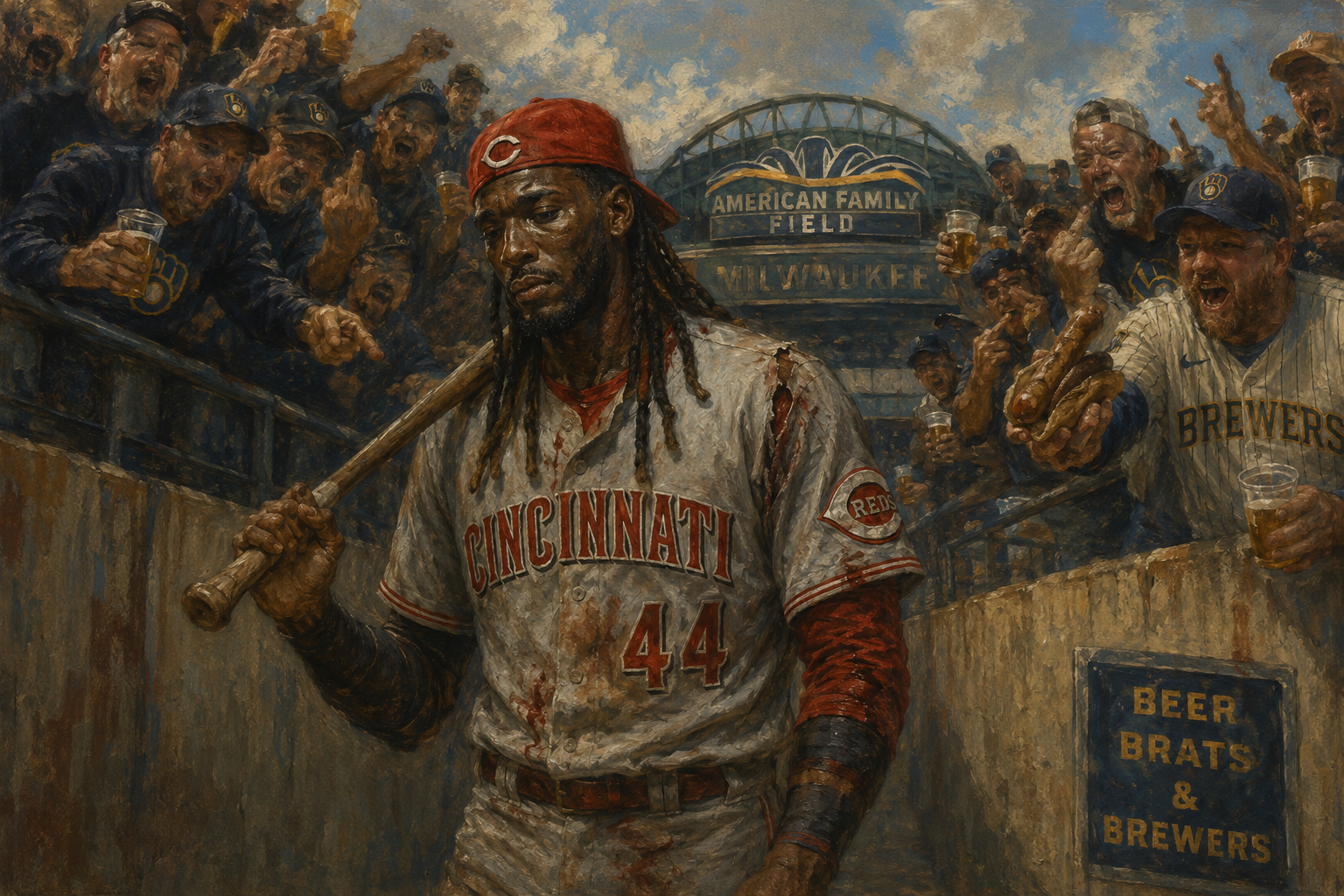
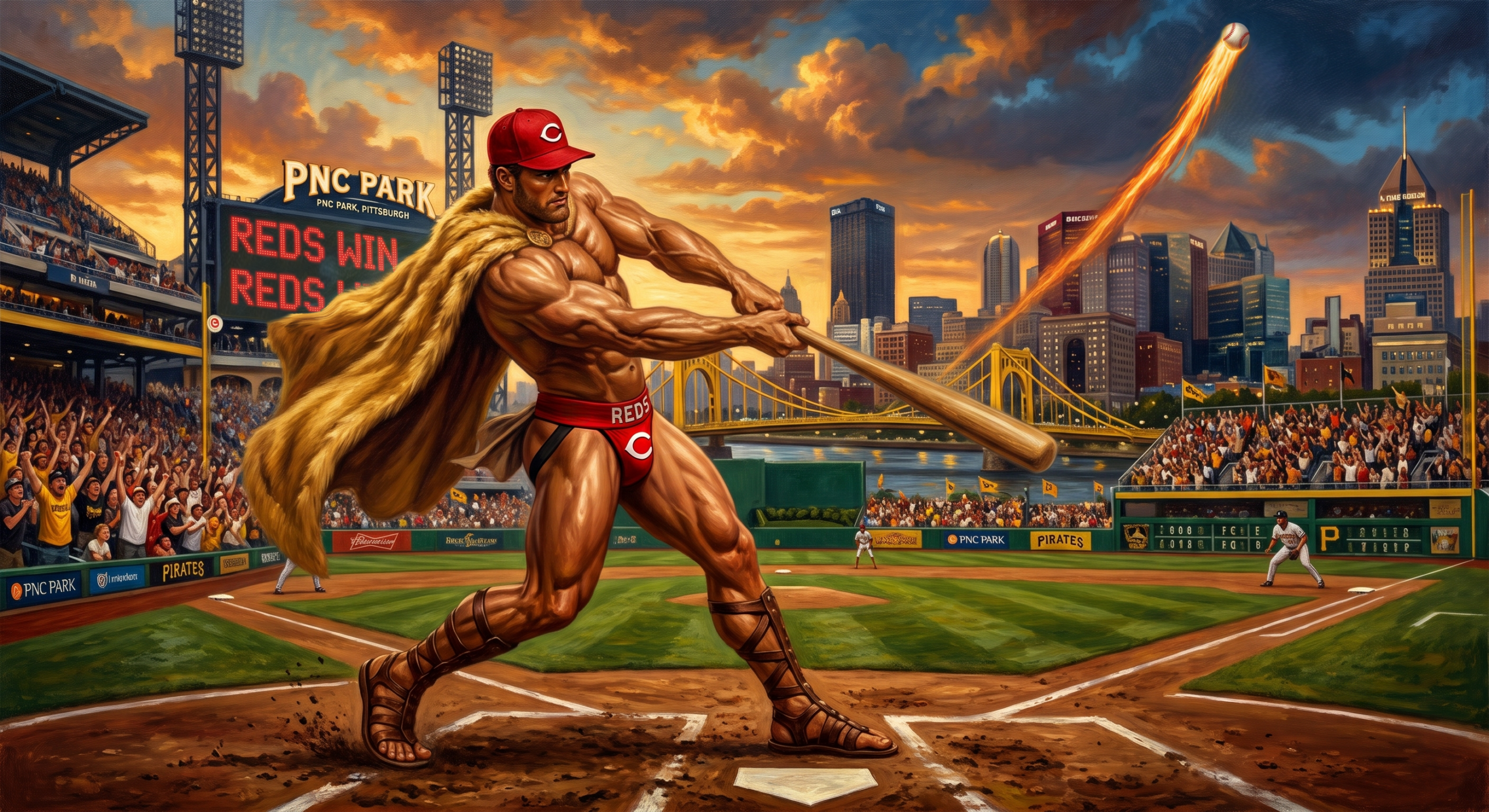
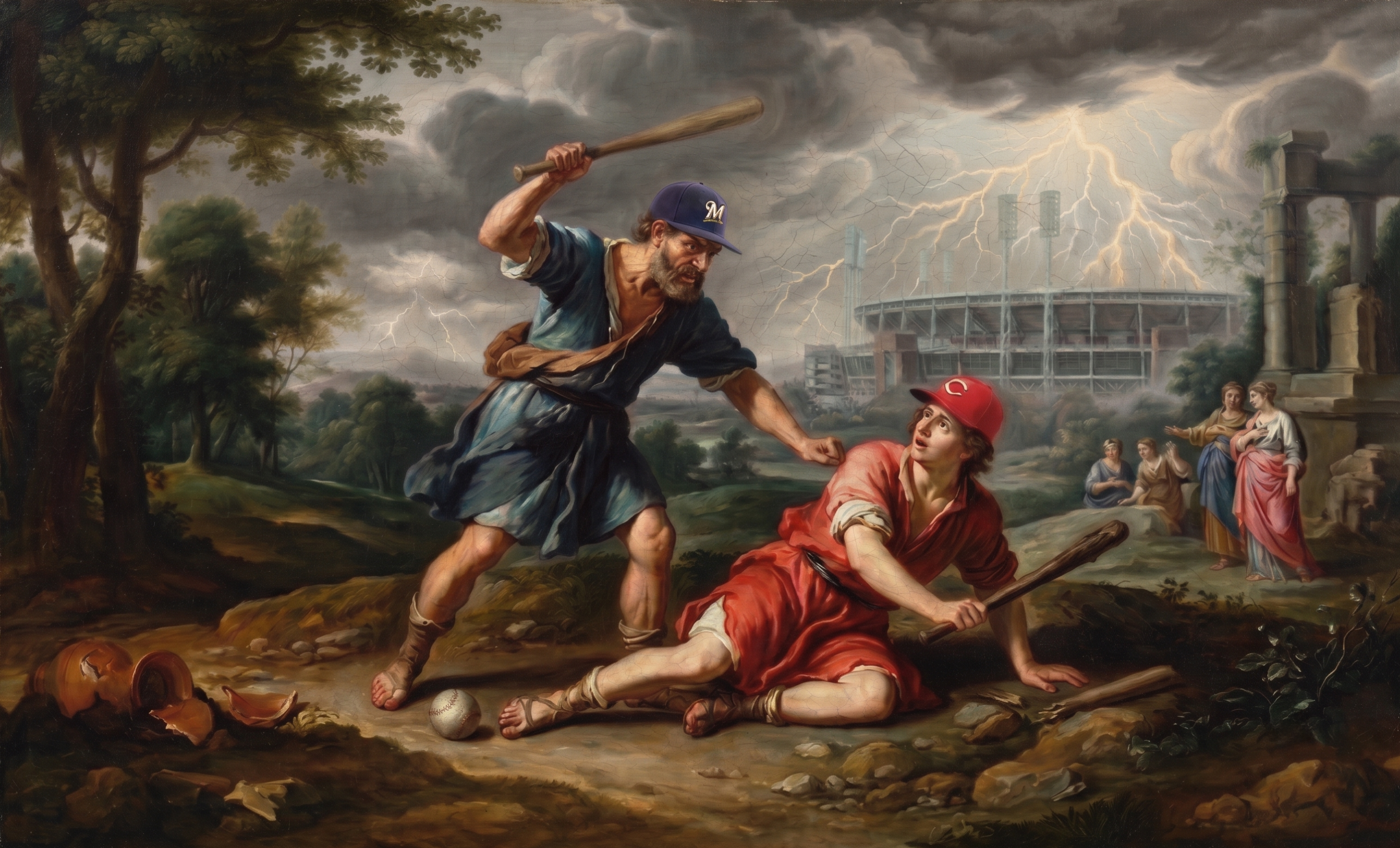
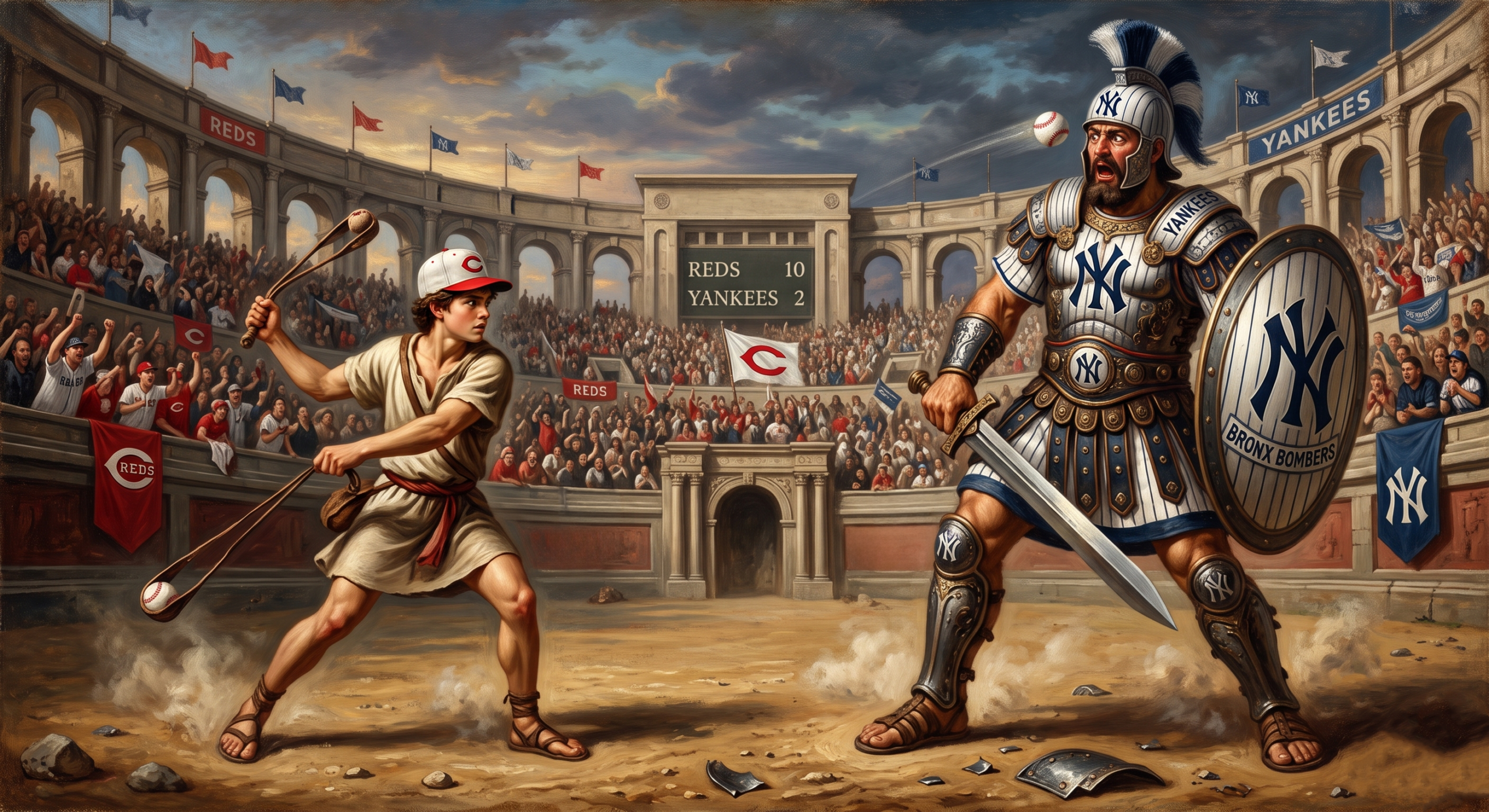
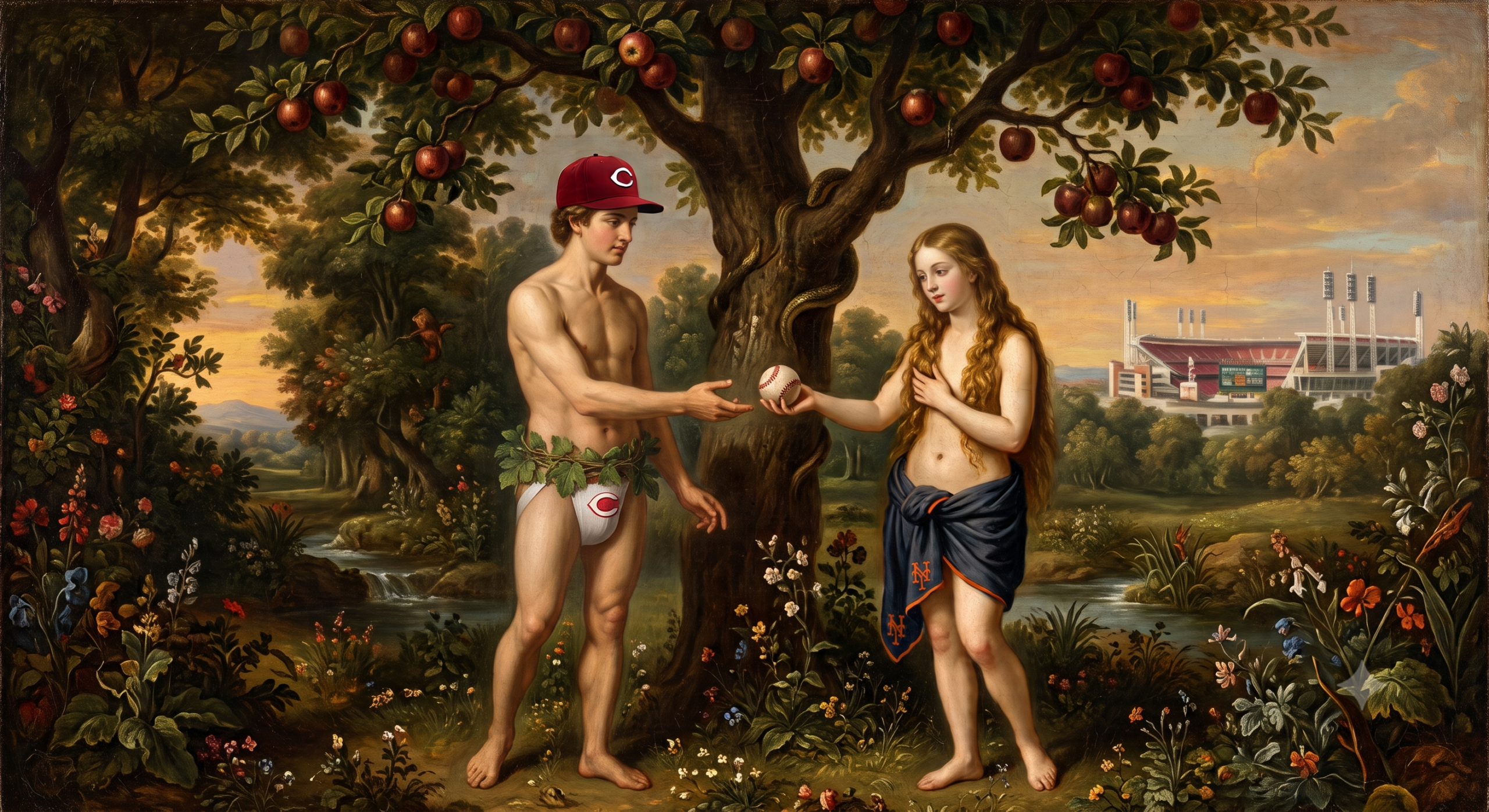
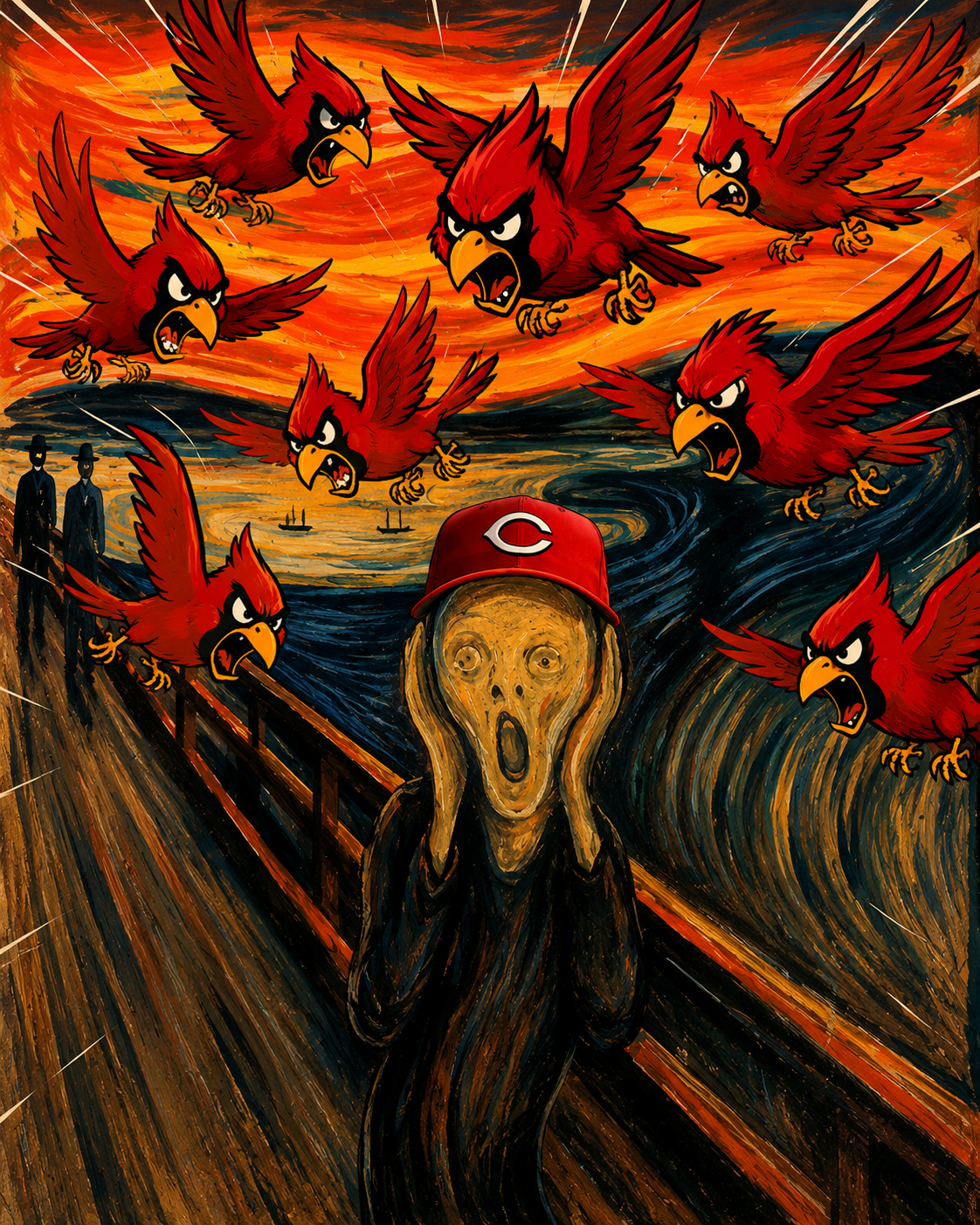
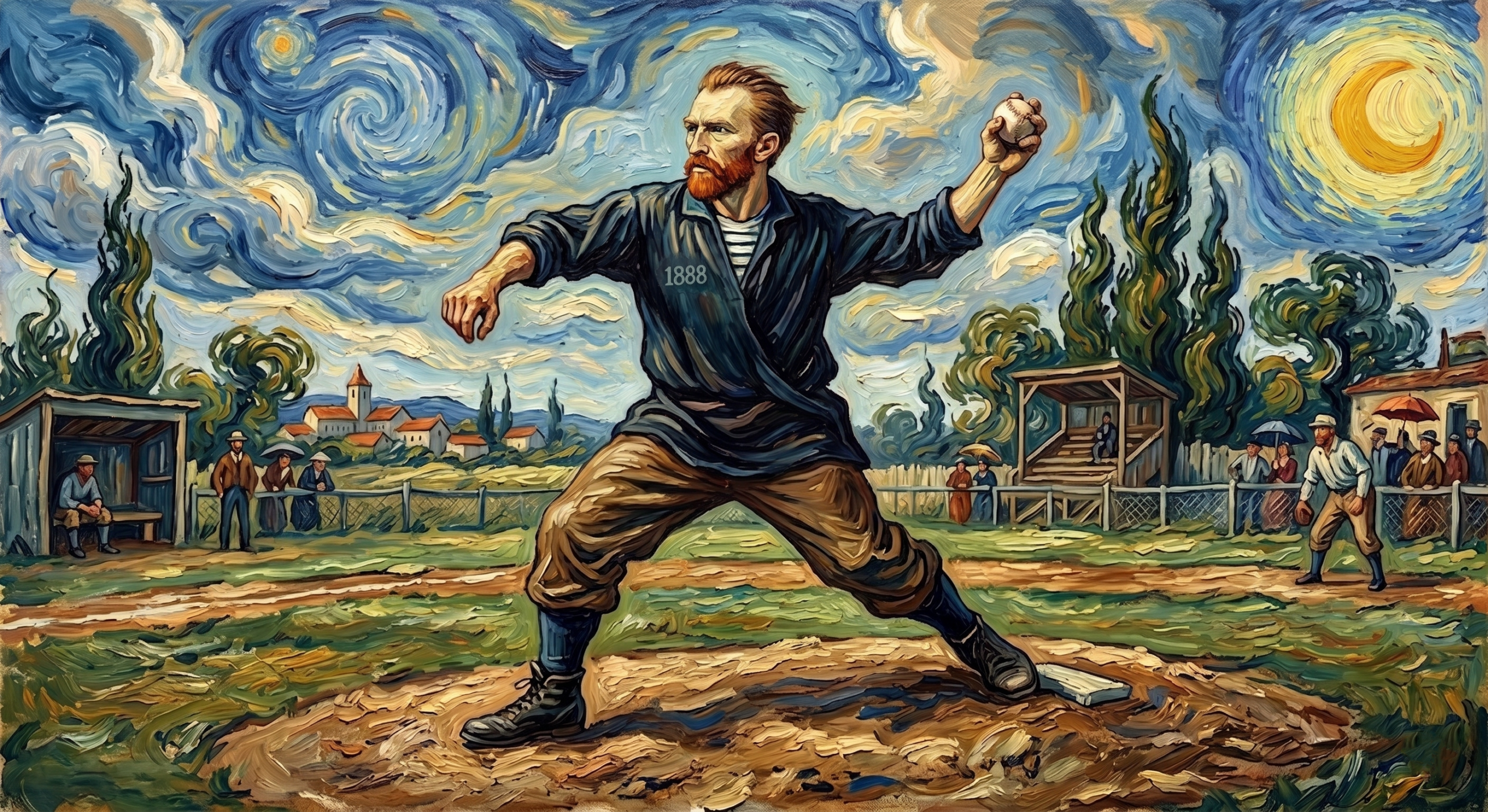
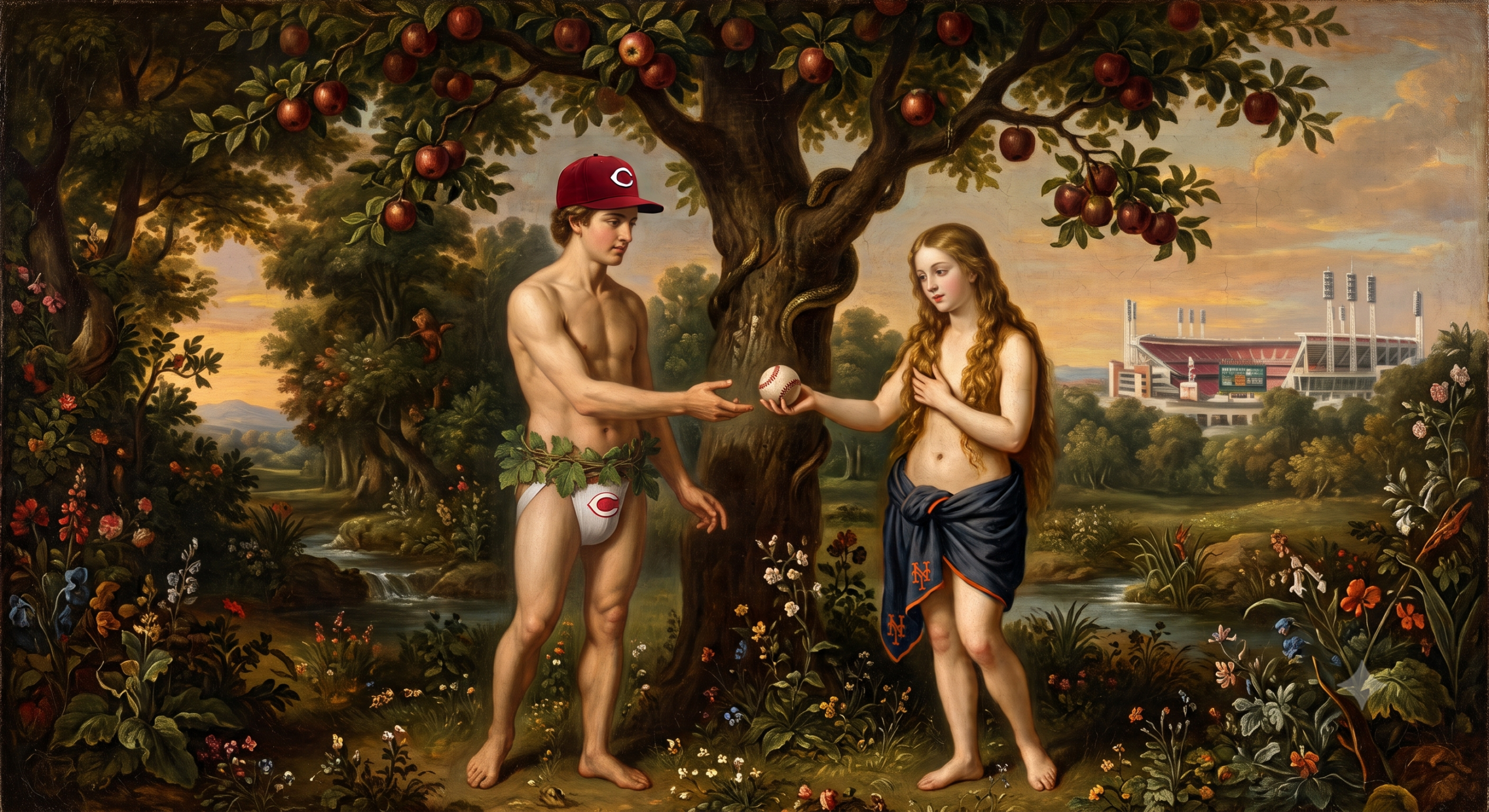
More essayist than analyst, I realize the self indulgent summer I’m commiting to. Maybe I should be committed. Maybe it’s navel gazing on steroids (my least favorite baseball era). I created my head-exploding image with A.I., and my friend Jason Wendel will be showcasing his A.I. handiwork with each series. I’m troubled by all of that, believe me.  But as a writer, I’m locked in, ready to bleed red. Don’t expect to get blown away and I’ll try not to blow my stack on losing streaks. But oh, what a wicked May it’s been to date. Let’s play ball. Click on the links above the images for my Reds Recaps.

Reds Take Two in the City of Brotherly Love


“Hello, Cleveland!” WTF, Bullpen?

A Collapse Between Blowouts as Reds Drop Series to Nats

Houston, We Got Bigger Problems Than the Astrodome’s Faked Moon Landing

Heartbreak in Wrigley: Three Walk Offs and a Rout

“Mayday, Mayday!”: Reds Swept by Pirates

“Mayday, Mayday!”: Reds Swept by Pirates

150 150 bjj-sportliterate

“Mayday, Mayday!”: Reds Swept by Pirates

by William Meiners

It’s maybe my favorite flip of the calendar. With the final half-hearted, one-third auto-generated papers to grade, the spring semester comes to a bittersweet end. Mostly bitter. And in spite of the warnings from Michigan weathermen to encourage DIY gardeners to treat their tulips like a hooded and bound Patty Hearst, early May is sweet relief for me.

Perhaps my Reds never saw it coming. With one of their better Aprils in history, the Cincinnati kids sat atop the NL Central with 20 wins, 11 losses. They won a dozen games by one or two runs — their losses mostly lopsided affairs. An improvement over the 2025 season where they lost lots of close games. In 2025, their bats went silent on April Fool’s Day in the first of three consecutive 1-0 shutouts.

Those old baseball bugaboos — frequent swings and misses, a few guys not hitting even their Little League weight — haven’t hurt the Reds too much. Heck, they were nearly 10 games north of .500 with good pitching overall, especially from the bullpen. And they showed spunk, winning games late. Bring on May and those bloodthirsty Pirates. And lo and behold the Friday night opener is on Apple TV on the first of May.

There’s not much made of May Day protests in our little town. I put off some scheduled banking and refrained from forking out anything to billionaires. The cold, winterish May pounced in like a lion throwing up bloody furballs on the carpet. And we’ve got a dog capable of that. To bear the spring cold, I built an indoor fire. Joellen, my wife, suggested an outdoor blaze and a dip in the hot tub under the evening’s full moon. She may have been dipping into her own witch’s handbook, and I half suspected naked wind sprints through the yard. All fine save for my shin splints and a disdain for running.

The Pirates made it a laugher early, touching up Reds starter Brady Singer. I opted in on the hot tub, just as the clouds hid the moon. The Bucks led 9-1 before I dried off. Saturday was even more laughable. Staked to a two-run lead before taking the mound, longhaired righthander Rhett Lowder gave up five runs in the first inning.

Lowder and reliever Connor Phillips reverted to the stuff of Little League nightmares in the second, walking seven straight batters. The Pirates scored five more runs without hitting a ball out of the infield. Oneil Cruz — good stick, makes spikes look like ice skates in centerfield sometimes — made the first and third outs of that inning (a big fear of mine in the 1970s). They added five more in the fifth to secure the humiliation. For the third time in a week, backup catcher Jose Trevino, whose “fastball” would scarcely raise a crossing guard’s eyebrow, pitched in a mop-up role. Third time! One week!

A 17-7 loss tallies the same as the one-run shortcomings from last year. On Sunday, with his club looking to salvage one win in the first Steel City trip, rookie Chase Burns did his part by pitching seven shutout innings. A couple of walks, however, from Tony Santillan, an eighth-inning strongman, set up their Cruz (not our Elly) for a two-out, game-winning single. The Reds first close loss.

Cincinnati dropped to third in the fast-starting Central, where even the basement Pirates climbed three games over even. With no rest for the shellshocked, the Reds head to Chicago to face the streaking Cubs on Monday night. I’d light a candle if I thought Jesus loved me. Maybe Joellen can explain her “Star Wars” religion to me. Anything to make the “fourth be with” the Reds in a four-game series at Wrigley.

William Meiners is the editor of Sport Literate. Among his summer 2026 plans are the documentation of 33 Reds’ series. That should be about 600 to 700 words every few days. If you don’t expect too much breakdown or analysis, outside of his own troubled head, you may not be disappointed. From losing streaks through high-water marks, he’ll follow the club, sometimes literally, from the reluctant spring of early May through the dog days of August. Then he’s off to something else.

The Douchebags of Skylands Finding Connection, One Throw at a Time

150 150 bjj-sportliterate


A band of misfits, a forest full of chains, and a lesson in how to be human.

by Scott Bandremer

Bzzzzz. Bzzz Bzzz.
I peeled open my eyes, slowly turning towards my phone. Six-thirty a.m. A Sunday morning my wife and I had sworn to sleep in after a long, chaotic week, to pretend adulthood occasionally came with rest.
I could feel it. She was already awake, peering at me over the satin berm like an artillery scout awaiting bombardment.
Bzzzzz. Bzzz Bzzz.
“It’s the Douchebags again,” she muttered with resignation.
Of course, she was right. It was always the Douchebags.

The Secret Society of Throwers

The author (front) and some douchebags.

I’m part of a club — part sport, part therapy, part traveling circus — called disc golf.

And yes, I know what you’re thinking. It’s that thing hippies do in public parks, right? The poor man’s golf. The stoner’s excuse to loiter. The weird cousin of ultimate frisbee.

Fine. You’re not wrong. But you’re not right either.

Disc golf is a bona fide sport — legit, growing fast, and quietly taking over the world’s green spaces. Nearly four million players. Sixteen thousand courses. There’s a pro tour with true international championships; sponsorships; even million-dollar endorsement deals — like Paul McBeth’s ten-year, ten-million-dollar pact with Discraft.

Watch a PDGA event on YouTube — perhaps featuring Calvin Heimburg, Paige Pierce or Kristin Lätt — and tell me it’s not beautiful. Those discs cut through the air like poetry. It’s golf without the pretense, yoga with a scoreboard.

The world can be a painful, difficult place at times. Not on the course. Here, it’s about your next perfect throw. Here, the world drops away, and you’re along for the ride.

Enter the Douchebags

The Douchebags of Skylands. That’s our club.

About 20 of us scattered through New York and New Jersey — a mix of lifers, rookies, philosophers, and degenerates who’ve somehow turned irony into identity. It began innocently enough, a couple of old timers hurling typical R-rated ribs in all directions as we played. When — POP — it struck us together, a lightning bolt of stupidity – we’d stumbled on a name for our growing band of players.

It took on a life of its own from there. People wanted in, wanted to be counted amongst the Douchebags of Skylands. There’s a group chat that never sleeps, a library of inside jokes, and a Sunday ritual that borders on religion.

By the third hole, something happens. The game envelops you as the noise of the week fades. The trees become cathedral columns. The fairway turns sacred. It all fuses into a kind of moving meditation. We become a roving band of Douchebags, synchronized and serene, navigating trees, ponds, and the ever-looming threat of OB – out of bounds.

The outside world fades. The course becomes sanctuary, an oasis for us all (and in fact, one of our favorite courses in Warwick goes by the name of Oasis).

You aim, you throw, you breathe. You curse. You laugh. Someone yells “nice!” while someone else’s disc ricochets deep into the woods. And just like that, the world makes sense again.

When the round ends, we linger in the parking lot – dusty, happy, slightly sunburned, ready to exchange our club tags with each other based on our scores. The stress has evaporated. For a few hours, we’ve been exactly where we belong.

The Cast of Douchebags

Every Douchebag member is unique, with quirks we’ve come to roast and to love.

There’s Roach, a beer-guzzling, seventy-something legend of ball busting, who’s been playing longer than some of our members have been alive. A club co-founder, he swears he’ll someday die mid-putt, right there on the green, and no one doubts it.

JByrd, a co-founder, once steered a corporate ship at a Big Four firm before sailing off for calmer waters. Known for his “aarghs” and “ayes,” this patchless-pirate maneuvers through our courses with reckless abandon. You’ll know him by his baby jogger disc carrier rolling down the fairways.

Donnie Douchebag, a rural mountain-man rebel philosopher who teaches the rest of us (especially city folk like your author) about camping, venison, and the Zen of hitting trees. His least expected special gift is remembering everyone’s birthday as my Aunt Annette was known for, which makes him both terrifying and indispensable.

Then there’s Big Mike, RAK, Sings, MJB, Rev, a couple of Jeffs, and Alicia the Champ, a former world champion who still throws like she’s chasing the crown. The roster is long, and the stories longer.

We play everywhere – Orange, Sussex, Morris, and Westchester counties. Forests, ridges, lakesides. No greens fees, no dress code, no starter telling you to tuck in your shirt.

Just trees, chains, and the faint smell of bug spray and coffee.

Not Your Typical Douchebags

Despite the name, we’re not actual douchebags. (Except maybe Brian, but that’s another story.) Our moniker is satire — a badge of ironic honor.

We are, in truth, a microcosm of inclusivity — a melting pot of age, gender, and background — teachers, welders, deli guys, entrepreneurs, retirees, a cannabis grower or two. Seventies playing alongside twenties. Trump voters and Bernie bros sharing the same beer cooler.

And the miracle? None of it matters.

Politics, religion, whatever — gone. It’s just about the game, and the flight of the disc.

When’s the last time you saw that? People who’d normally clash online laughing together in the woods? That’s what this is about. The game’s the excuse. The connection is the point. Genuine, hard-earned, and human. Beyond the throws and the laughs, the club has become something sacred: a refuge where we can share what brings us joy and what weighs us down.

There’s safety in Douchebags.

Some of us are nursing heartbreaks or layoffs or health scares. Some just need to be outside. But every week throughout the year we show up – in 95 degrees of heat, or ten below in a foot of snow. We throw. We roast each other mercilessly. We listen. And somehow, that’s enough. I live for it. I’ve been playing for decades and have no plans to stop. Screw old age.

The course is the confessional. The Douchebags are the congregation.

The Theology of Throwing Plastic

Discs and shrooms

So what does a bunch of multi-aged weirdos flinging frisbees have to do with anything larger?

In an era when “community” means arguing in the comments section, this is the antidote. The Douchebags of Skylands are proof of what’s possible when we choose connection over conflict.

For a few hours, we share one goal: make the disc fly true.

And that simple focus — 20people watching a piece of plastic spin toward a metal basket — becomes its own quiet life lesson.

You throw, you miss, you adjust. You try again. Someone laughs, someone swears, someone hits the chains. You high-five, you move on.

It’s life distilled to its cleanest form: failure, recovery, grace.

If enough of us practiced that, maybe the rest of the world would start to level out too.

Toward a Kinder Brand of Douchebaggery

I’m not saying the United Nations should settle disputes over a doubles round – though I’d pay to watch Putin miss a 10-footer — but the Douchebags of Skylands have tapped into something the world’s forgotten.

D-bag at sunset.

Connection — it’s real and at times, it’s spectacular.

No algorithms. No talking points. Just the shared pursuit of a stubborn little disc that refuses to go straight.

And when the last putt drops, the world feels a little less broken. Not perfect. Just better.

So when you hear that early-morning bzzzz — your phone lighting up with a text from friends who refuse to let you sleep in — don’t roll over. Answer it.

It might not be a summons to play, but rather, a call to action to be a little better to each other today. Will disc golf save the planet? Probably not, but it’s rocking the world of my knucklehead friends, and that’s a good starting point.

And if nothing else, a reminder that real human connection still exists. That joy can be small, round, and airborne. And that somewhere, in a forest at sunrise, a group of Douchebags is already throwing.

Because deep down, we all have a little Douchebag waiting to get out — and the truth is, the world could use a few more of us.

Scott Bandremer is a writer and lifelong disc golfer based in the New York/New Jersey metro area. He’s still trying to make par on hole 18.

The Ball Dreams of the Sky

150 150 bjj-sportliterate

A Baseball Life: Henry Schipper’s The Ball Dreams of the Sky

by William Meiners

Henry Schipper can trace his life through baseball. Like mapping the long arc of an upper-deck shot, he sailed from Little League in Detroit through a teenage stint as Babe Ruth phenom in Wisconsin to the senior softball leagues of the Golden State. Along the way, he sold beer at Wrigley Field for a couple of seasons in the mid-1970s while attending the University of Chicago. In Los Angeles, making a living as a journalist and documentarian, he followed the Angels, not the Dodgers (and the Clippers, not the Lakers) — choices he confessed to suffer for.

His first love came naturally, as Schipper had been the kid with a golden arm. A hurler of consecutive no-hitters in Wisconsin, he bicycled to and from his suburban play, mostly victorious but occasionally crestfallen, unaccompanied by any family members. And he shared no news of what transpired on the diamond with parents or sister. His book of poems, The Ball Dreams of the Sky, shortlisted for the Casey Award as Spitball Magazine’s “best baseball book” of 2025, would bring him back to his summer days in Detroit.

The collection, Schipper told me just days after the Dodgers squeaked by the Blue Jays in a heart-pounding World Series, had been on his mind for about a decade. “Then out of the blue, I had to have double bypass heart surgery,” he said. “I remember thinking, ‘Shit, I never wrote that baseball book.’”

Upon recovery, Schipper said he went about writing and rewriting the poems that could “translate life into baseball,” noting the framing that would take the reader from birth through death in a baseball context. The nuance of the language alone, like the old possibility of an endless extra-inning game, seemed limitless.

With some 50 gathered poems, a few of which follow, Schipper’s debut poetry collection is arranged under the sections of Early Innings, Middle Game, and Late Life. Of course revisiting what he first thought might be the “halcyon days” of his baseball youth, Schipper was surprised just how much trauma he drummed up.

Body and soul

The bat is physical,
inches and ounces,
swollen at the head,
all about the grip,
and hitting.

The glove like the brain,
a complex web with separate lobes,
layers of stitching,
organically poised
to catch a thought.

The ball comes to life in flight;
its essence is its potential,
like spirit it soars.

Both bat and glove dream of the ball;
the ball dreams of the sky.


If God played ball

If God played ball,
would He hit home runs
and catch them all?

would He steal signs,
or just Know?

would He prefer power
or speed, the blast
or the blur, the big bang,
or the burning whoosh?

would He take the mound against Himself?
and foul off pitch after pitch,
forever?

is that what He’s doing now?

He made the game;
it’s possible this is how
He spends His time.

would He quietly one day
turn to small ball —
advance the runner,
find the holes, express perfection
in sacrifice and team play?

would He ever slump, or pretend to,
strike out, flub one in the field,
come up short in the clutch?

of course He would,
feeling our pain, our loss,
our longing, letting the fans down.

He’d have to;
without imperfection
there is no game.

or need for Him
to wait at the gates,
and sign autographs
one at a time.

Schipper noted that the book’s title, also that last line from the “Body and soul” poem, had not been the original. “Translating the Game” had been an early challenger. Then he considered “There’s No Holocaust in Baseball” as the collection’s title poem. Though that particular label, he reasoned, would put a significant weight on the book.

His mother, from Vienna, and his father, from a Polish border town, had narrowly escaped the holocaust. They met in Palestine in 1939, huddling in the horror of nearly entire families lost to murder. Soon after, they made their way to America and Detroit.

“Because my parents were immigrants, they didn’t know anything about baseball,” said Schipper, the star of his neighborhood living in a “complicated house” where his parents, both European intellectuals, shared affection without understanding of their son’s game. “Little did they know that I was channeling all the ghosts in the house.”

But there was a catch

The stadium was packed
and I was rapt as I watched
my first game, a boy
among Gods, astonished
to see that it really existed,
this larger-than-life, this radio dream,
and I could be here, I could sit
in the heart of the diamond,
the shimmering world,
and see myself in it,
shining one day.

But there was a catch —
as I followed each play
the ball disappeared, again and again,
through the gates of a geist haus,
a spirit home, full of those
I never knew, bubbes and zeydes
from Vienna and Przemysl — eight aunts,
seven uncles, eleven cousins — Ephraim,
Siddy, Lev, Naftali. Salomea who
fell with her husband in Warsaw.
Jenta, Leah, Rivka, Chaim. Max
who made it to Shanghai where
he starved to death, along
with his kids. Erika, Arnold,
Rafat, Regina, Moses, Ida, Dobra,
Zvi, shot, gassed, burned, all of them
gazing right through me, stunned
at the lost horizon of their field of dreams.

The field I raced to every day
was just beyond the cherry tree
that I picked clean before I played,
edging out to the furthest limb,
risking all to get my share, to taste
the best, and in this delicate measure
of weight and balance and stretch
and slip, I honed the skills that would serve
in the dirt, as I measured the pitch,
measured the hit, measured the dive
and the slide and the distance between
where my story began and I now stood,
in the shifting sand of memories
I never had.

Perhaps in spite of historical family trauma, Schipper found his own lifelong love in baseball. Something beyond the escape of throwing the horsehide around the backyard. Through all that simile and metaphor his book explores romance, creativity, how so much depends on the weather (for everyone from infielders to farmers), and simply loving a game that’s rife with heartbreak.

Indeed, “Senior Softball” begins, “After all these years/do we still have to keep score? The game/is fun in so many ways/that have nothing to do with win/or lose. I used to come to be a star./Now I come to feel a star/the warm one, and to move/and mingle with others who shine,/basking in the field of play.”

With pitchers and catchers reporting for spring training in the not-so-distant future, and fans dreaming of hot stove turnarounds, The Ball Dreams of the Sky could be a hopeful St. Valentine’s Day gift for the baseball lover in your life.

Playing with words

Pen in hand, he lofted a fungo to right;
the words gathered underneath,
each one crying “mine!”

his spikes dug into syllables
of dirt, spewing letters, dollar signs,
quotation marks and exclamation points,
as he rounded the bag

he turned the pages of his wind-up,
and let the delivery write itself

the webbing of the rhyme
was old and scarred,
like fingers broken many times

in china they have a language of codes,
of blinks and bluffs that catchers
and coaches understand

the rain came down in hyperbole
and booze, and sheets of nostalgia
that rewrote the night

the poet yawned between every pitch,
foregoing perfection in uniforms of verse
don’t lose me in the sun, she cried,
and he swore he would not,
but he did

flirting with a game of words
in a field of lines, he pressed his face
inside his glove, the glove that holds
the gloves that hides — he caught himself —
and said goodbye


Managers & farmers

The faces of managers
when the season goes bad, befuddled but stoic,
like farmers with weather
they can’t understand.

They pulled the right strings the part that was theirs,
and July stood high
with the harvest to come.

When out of the blue
the Gods came to play,
with bloops, and hops,
and swinging bunts, freakish
breaks that blighted the game.

And they counted the losses
and gauged the time,
squinting, puzzled
at the edge of reproach,
but always within the code
of no blame, that’s baseball
you take whatever you get.

Like Job they bent
but did not break.
The utopian game
was thus maintained,
with the helpless gaze
of unfathoming faith.

William Meiners is the founding editor of Sport Literate.

Henry Schipper, an award-winning filmmaker in Los Angeles, has written and produced more than 125 primetime documentaries. He once held the Babe Ruth League record for consecutive no-hitters in Wisconsin. The Ball Dreams of the Sky is his first book of poems.