


Speaking of Beast Quake
https://sportliterate.org/wp-content/themes/osmosis/images/empty/thumbnail.jpg 150 150 bjj-sportliterate bjj-sportliterate https://secure.gravatar.com/avatar/592f60292ffae558017e7047d039bebe88be7eca3a999965f3a7f0501ad82d49?s=96&d=mm&r=g Speaking of Beast Quake
by William Meiners
A lot of people are putting things into historical context these days. With racist rants emanating from an authoritarian’s toilet in the White House, you might want to take some notes to address a future grandchild’s inquiry concerning your whereabouts and actions from 2016 through 2020. Indeed, writer and director David Shields likens the Trumpian era to Germany 1933.
In our mid-August conversation, I didn’t think to ask Shields about the title of his brilliant documentary…. Marshawn Lynch: A History. What sort of historical perspective could a football player just 33 years old offer? Don’t get going on Jesus now and what he achieved by 33. Yet this documentary, comprised of some 700 clips (around 10 seconds each) not only provides insight into a complicated young man, but also explores a history of protest against racial discrimination with a particular focus on Lynch’s chosen form of rebellion — silence.
Shields, a serious man of letters, is pushing the boundaries of creative nonfiction with a narration that has no narrator. True to himself, Lynch did not participate in the film. Though not for lack of trying from the filmmakers. Lynch’s group maintained a neutrality to the project, neither supporting nor discouraging the production. “Given Marshawn Lynch’s style, it would have been sort of ridiculous if he sat down for a 12-hour interview,” Shields says.
The Comedy and the Fury
It wasn’t always going to be like this. In the beginning, Shields wanted to turn Black Planet, his critically acclaimed basketball book, into a film. It’s his only book I’ve read, largely because of a blurb about its unflinching honesty by Robert Lipsyte. Covering the 1994-95 Seattle Supersonics season, Shields is anything but colorblind in Black Planet, “facing race” through myriad interactions of players, coaches, fans, and media men and their rhetorical missteps throughout a long NBA season. I told him Sport Literate was first published somewhere between chapters seven and eight of that documentary-style book.
Though the book didn’t materialize into a film, Shields says the themes of Black Planet — “race, history, media iconography, and sports morphed into the Lynch movie.” In tellings nearly 20 years apart, both stories have strong black protagonists (for a lack of a better word), both of whom are from Oakland. In the book, Shields looks intensely upon Gary Payton, the trash-talking, defensive-minded point guard of the Sonics.
“Both Payton and Lynch are very interested in violating ordinary language,” Shields says. “And I think that connects them. In their own ways, they’re both expressing a remarkable amount of comedy or fury through either silence or trash talking.”
There are plenty of laughs and tragedies in the film, often in quick succession. Lynch’s relationship with the media is sometimes jokey, other times contentious, especially as he begins providing one or two stock answers, i.e. “Thanks for asking.” As a cultural icon, Lynch becomes the punchline of Jimmy Fallon, but a contributing guest of Conan O’Brien. Graphic violence, including a Chicago cop’s murder of teenager Laquan McDonald, as well as the head trauma of football, continuously weaves in and out of the narrative.
“The last thing we wanted was the ‘voice of God’ omniscient narrator.”
Folks wondered about getting someone famous to narrate the film. Like James Earl Jones. Danny Glover, the executive producer, could have done it. But Shields says the “kaleidoscopic, freewheeling film feels congruent with who Marshawn Lynch is.”
I like this reasoning. Though I can’t help but imagine how NFL Films might handle it via baritone voiceover and the trumpeting music.
The Autumn Wind is silent
Skittling in from Oakland.
Upon Beast Quake feet, he turns Saints and Rams into sheep,
All about that action, Boss.
Beast Mode in High Definition
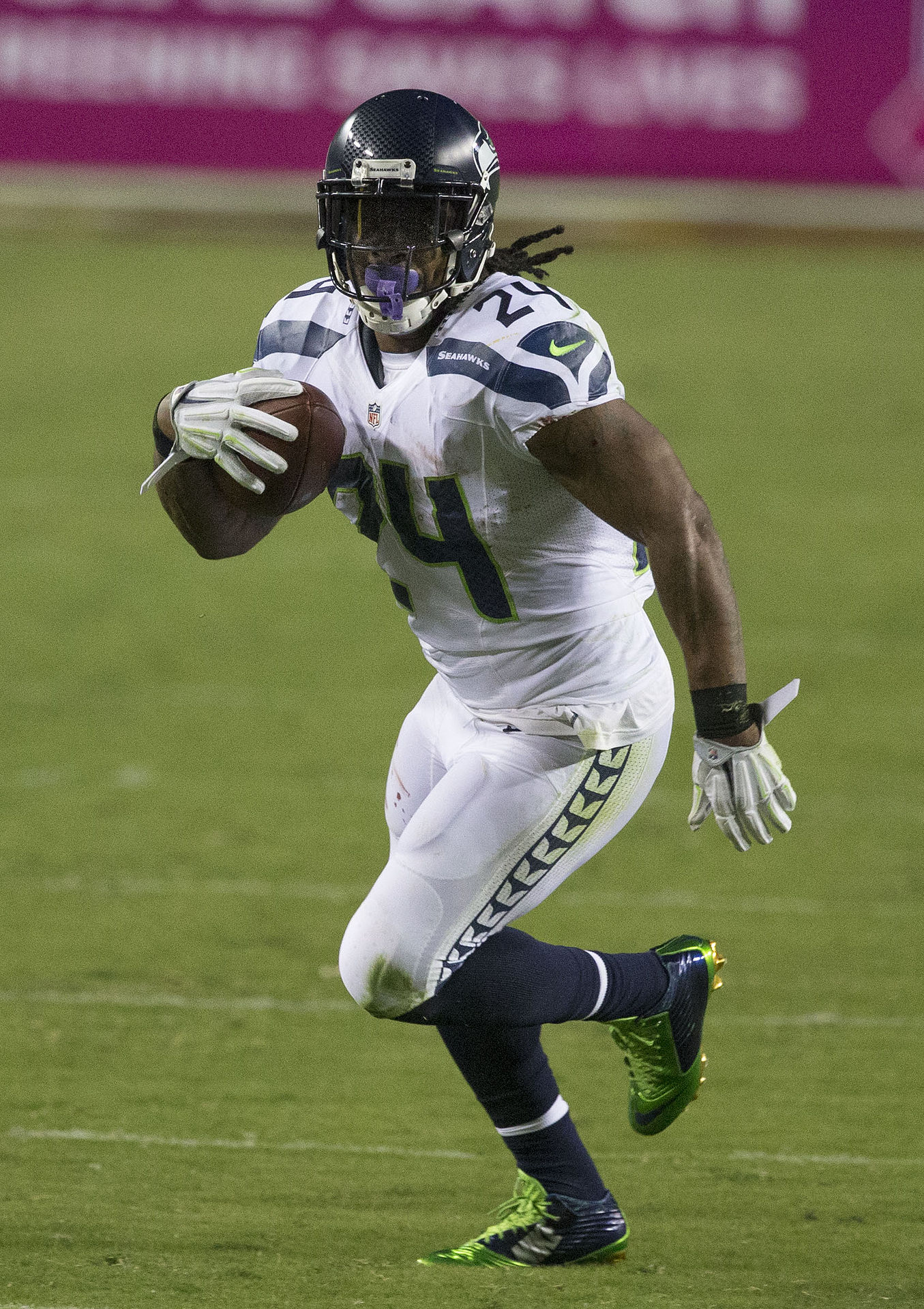
Additionally, they never wanted the production to feel like a television show, or (God forbid) a three-hour NFL broadcast with the vanilla commentary of Joe Buck or Thom Brennaman, or anyone else whose dad got him the job. “That turned into a different mantra, which was to try to make the movie feel like the most kinetic Marshawn Lynch run,” Shields says. “It should be like Beast Quake… it turns, it twists, it surprises, stutter steps, reverses and repeats. It’s like a seven-second, 70-yard run.”
I remember where I watched Beast Quake — Lynch’s playoff pinball run through what seemed like a dozen New Orleans Saints. If my grandchildren should ever ask, I can tell them precisely. On January 8, 2011, I was in the bar of the Hooters Casino in Las Vegas. My friend and his friend, a banker and chiropractor, respectively, spent about six hours (two NFL playoff games) at the same craps table. I checked in with them periodically and drank alone. My live-in girlfriend, at home with the pre-existing condition of her three children, would be pregnant by St. Valentine’s Day. Our son James, born exactly 10 months after Beast Quake, brought forth the possibilities of my grandchild’s question.
Go ask Alice
Shields says the East Bay writer Alice Walker provided some cautionary advice for white folks embarking on a discussion of race. When asked what can white men do, she said: “They can sit down and listen for the next 350 years.”
Taken to heart, Shields says, “We tried, to the best of our abilities, to listen to Marshawn talk, or not talk. Especially as a white filmmaker, I don’t want to tell the audience what to think.”
Though thousands of people in multi-racial audiences have by now overwhelmingly enjoyed the film that’s also received some glowing reviews. Still is there something specific Shields would like white people to take away from the movie?
He says it has to do with the unremitting legacy of slavery, repression, and (I think) government-sanctioned violence against black people. Wearing his feelings on his own nerve endings, Lynch, Shields believes, “is trying to convey that history is real. If you feel it, then he can feel you. And if you don’t, then he’s not up for it. Much of what he’s doing is expressing the rage he experiences as a black man in America, especially a Trumpian America.”
To me, it seems, there’s an expanding lack of empathy in Trumpian times. Shields agrees, citing the profound tribalism in this great divide and the president’s uncanny ability to unleash a reptilian-like response in his base supporters. By sheer contrast to the “most powerful man in the world,” Lynch is an “extremely empathetic, loving, and imaginative person,” Shields says. “He’s also hugely aware of Trump’s awfulness. So if you think about it, Lynch could not be more presidential. If you want to talk about a beast, or beast mode, it’s Trump.”
Much Ado About Shyness?
It’s a question often put to Shields. “Are you over-reading someone who may just not like to talk?” But Shields pushes back. Through the work of his foundation and a commitment to his Oakland community, Lynch is no wall flower. And he has a lot to say when he wants to say it.
Early in the movie, when a younger Lynch, still in high school, has a microphone thrust upon him with a demand that he ask for advice, he responds, “I ain’t got no questions.” In perhaps his last words of the film, he says, “Run through a motherfucker’s face.” That confident, beast mode mentality, may speak to his preference for action over commentary. In another clip, where he looks to be getting a pedicure beside some white guy, Lynch laments the fact that people might complain if he talks too much. So why would they even want any insipid sport cliches?
“The more I study it, the more I feel like Marshawn is a very intentional person,” Shields says. “He’s very eloquent, very lyrical, very funny.”
In the tradition of the African-American trickster, Lynch, who says Jeff Hostetler is his all-time favorite Raider, simply does not like to play by the rules of a corrupt game. Think Muhammad Ali and how hard it was for most white writers, aside from people like Lipsyte, to box him in racially as either a “good Negro” or scary one.
“There’s a sense in which American sports media are trying to get black athletes to be vectors on the grid of American capitalism,” Shields says. “Lynch, to his great credit, says, ‘No, I’m not going to speak to your corporate capitalistic rhetoric.’ In a strange way, he’s speaking truth to power by being silent. ‘If you want to pay me a million dollars to sell Pepsi, okay, we can talk about that. Maybe I’ll do a funny commercial. But there’s no frickin’ way I’m going to give you your American sports media cliches and not be paid.’ So in a way, I would say Lynch is a savvy American capitalist.”
And that’s some tricky, complicated stuff, no matter how you slice it. If you want my two cents (and it’s about all I’ve got), I’d give Marshawn Lynch: A History two thumbs up for a rollicking ride and all its potential to make you stop and think. And to echo Snoop Dogg (and my favorite clip) maybe one middle finger to anyone who thinks highly paid athletes need to conform to the norms of a racist society.
William Meiners is the founding editor of Sport Literate.
David Shields is the internationally bestselling author of 22 books, including Reality Hunger (named one of the best books of 2010 by more than thirty publications), The Thing About Life Is That One Day You’ll Be Dead (New York Times bestseller), Black Planet (finalist for the National Book Critics Circle Award), and Other People: Takes & Mistakes (NYTBREditors’ Choice). The film adaptation of I Think You’re Totally Wrong: A Quarrel was released by First Pond Entertainment in 2017. Nobody Hates Trump More Than Trump: An Intervention was published in 2018; The Trouble With Men: Reflections on Sex, Love, Marriage, Porn, and Power is forthcoming in March 2019. A recipient of Guggenheim and NEA fellowships and a senior contributing editor of Conjunctions, Shields has published essays and stories in the New York Times Magazine, Harper’s, Esquire, Yale Review, Salon, Slate, A Public Space, McSweeney’s, and Believer. His work has been translated into two dozen languages.