

• A Literary Magazine | Honest Reflections on Life's Leisurely Diversions

Posts By :

bjj-sportliterate

The Personal is Political as Memoir

150 150 bjj-sportliterate

The Personal is Political as Memoir

A Review of Caster Semenya’s The Race to Be Myself

by Scott F. Parker

In another world, Caster Semenya’s memoir might have told the archetypal story of an athlete working hard with her considerable natural talent to overcome obstacles and achieve success. Needless to say, Semenya did just that in the course of setting numerous records and winning three world championships and two Olympic gold medals at 800 meters.

The Race to Be Myself book cover

But in this world, Semenya’s memoir, like her career, gets totally subsumed by gender controversy. For all her accomplishments on the track, Semenya is far better known for her disputed status as a woman. “To put it simply” Semenya writes, “on the outside I am female, I have a vagina, but I do not have a uterus.” This fact was revealed by a gender test given in response to suspicions about Semenya’s race results. “I found out, along with the rest of the world, that I did not have a uterus or fallopian tubes. The newspaper reported I had undescended testicles that were the source of my higher-than-normal levels of testosterone.” The official diagnosis was a variant of DSD (difference in sex development) condition known as 46XY, which is to say Semenya has male chromosomes.

Despite this seemingly undeniable fact, Semenya devotes much of The Race to Be Myself to asserting her status as a woman. Take two typical passages: “I know I look like a man. I know I sound like a man and maybe even walk like a man and dress like one, too. But I’m not a man.” and “I want everyone to understand that despite my condition, even though I am built differently than other women, I am a woman.” The claim lands squarely on Semenya’s sense of identity. She was raised as a girl, accepted as a girl, and understood herself as a girl and then as a woman, and therefore takes herself to be a woman, regardless of what anyone else says: “To be honest, I didn’t care then, and I don’t care now what the medical findings are.”

Even the most sympathetic readers will notice that this emphasis on identification, no matter how understandable, avoids the central question, which is not how we define woman as such but how we define woman in track and field. The definition itself is relevant because women are protected from having to compete against men due to their relative physical disadvantages. A better analogy than to say LeBron James’s genes give him an unfair advantage over his competitors but we don’t ban him from the NBA would be to say that we have weight divisions in boxing to give more people a chance to compete. Following this analogy, Semenya simply has the misfortune of belonging to a class too small to field its own division within the sport. If this is unfair to Semenya — and it is — wouldn’t it be similarly unfair to the other athletes to let her race against women?

If you’d rather gain access to Semenya’s experiences of the extraordinary events of her life than engage such arguments, The Race to Be Myself feels mostly like a missed opportunity. As she writes, “it is hard to think of another athlete at the elite level who has endured as much scrutiny and psychological abuse from sports’ governing bodies, other competitors, and the media as I have.” Yet the book largely neglects the emotional toll that this experience placed on her in favor of defensive posturing. The greatest exception to this tendency comes in the book’s strongest chapter, “Nothing,” which depicts the low period in Semenya’s life after her private medical records were made public. “How do you explain what it feels like to have been recategorized as a human being? That one day you were a normal person living your life, and the next day you were seen as abnormal?” Yes, how do you explain that? I would love to find out.

Scott F. Parker is the author of Run for Your Life: A Manifesto and The Joy of Running qua Running, among other books. His writing has appeared in Runner’s World, Running Times, Tin House, Philosophy Now, the Believer, and other publications. He teaches at Montana State University and is the nonfiction editor for Kelson Books.

The Being and the Doing

150 150 bjj-sportliterate

The Being and the Doing

A Review of Brendan Leonard’s I H♡TE RUNNING and You Can Too

by Scott F. Parker

Maybe I should consider it a sign. I was walking by a table of books at a church fundraiser when the word running caught my eye. Stopping, I read the full title, I H♡TE RUNNING and You Can Too: How to Get Started, Keep Going, and Make Sense of an Irrational Passion. It looked, from premise to design, a little cute for my tastes. But one term in the subtitle intrigued me: irrational passion. It is one of the motivating concerns of this column to make sense of precisely that. Plus, the book was $1, and it would go to the church.

I Hate Running book cover

It didn’t take me long to realize that, assumptions be damned, Brendan Leonard is my kind of running writer: “This is not a how-to book or a memoir of a very fast person who has stood on podiums at the finish lines of races. It will not tell you how to train for a race, how to eat during, before, or after running and/or racing, or what kind of shoes to buy or clothes to wear, or what kind of stretches to do before or after running.” Pausing briefly to remember that some fast people write great memoirs, what I really want to say here is Amen. When it comes to reading about running, give me the intangibles every time.

But Leonard is being slightly ironic in his disclaimer. I H♡TE RUNNING most definitely is a how-to book; it’s just not about how to run a certain way or toward a certain outcome. It’s more elemental than that — it’s actually about how to be a runner. To wit:

Isn’t it more complicated than that? Not really. As Leonard explains, “At some point, every person was running zero miles per week.” Like Lao Tzu before him, Leonard recognizes wisdom disguised as the perfectly obvious: the way to get from zero to more than zero is to start. It’s impossible to argue against such clear insights. But the point isn’t to nod your head, it’s to take to heart.

Leonard challenges our conceptions of what it means to run so that we will be liberated to run. Here he is quoting Bart Yasso, the former chief running officer of Runner’s World: “I often hear someone say, ‘I’m not a real runner.’ We are all runners; some just run faster than others. I have never met a fake runner.” If you’re inclined toward ordinary language philosophy, you’ll see right away what Yasso and Leonard are up to. So many of us are insecure about our status as runners. Are we real runners? But we don’t stop think to about the implied contrast of real in that question. Do we mean that we are slow runners? That we are occasional runners? That we haven’t ever run marathon? Maybe we are slow, maybe we don’t run every day, maybe we max out at three miles. But these are just three ways of modifying what we are: runners.

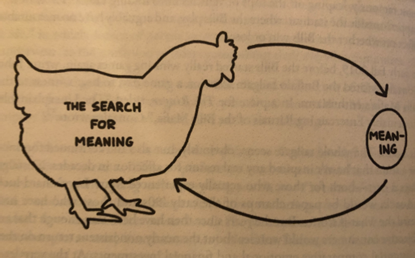
This might start out as semantic, but one of Leonard’s key psychological insights is that it quickly becomes ontological. Noticing what words mean and using them precisely can produce a change in our self-conception. And that change in self-conception can propagate quickly in behavior. If I am a runner… I run. Or here is one of Leonard’s helpful charts:

The question then becomes, Why be a runner? Why run?

To this, Leonard offers several answers. There is the undeniable: “Either you think doing hard things is worth it to some extent, or you don’t.” The inspirational, by way of Alex Lowe: “‘The best climber in the world is the one who’s having the most fun.’ I think that ethos can apply to anything we do, including running.” The realistic: “Yes, I hate it most of the time, but maybe once during every run, I have a few seconds, or a minute or two, where I find myself thinking, ‘You know, this isn’t so bad.’” Different runners will lean into different reasons. And perhaps reasons is the wrong concept to apply here. We run because running is in our nature. We can but don’t need to tell a story about how it got in our nature. It’s enough just to notice that it’s there. If you do, the rest follows:


Scott F. Parker is the author of Run for Your Life: A Manifesto and The Joy of Running qua Running, among other books. His writing has appeared in Runner’s World, Running Times, Tin House, Philosophy Now, the Believer, and other publications. He teaches at Montana State University and is the nonfiction editor for Kelson Books.
On Balance

150 150 bjj-sportliterate

On Balance

A Review of Mylo Choy’s Middle Distance

by Scott F. Parker

At the same time, during high school, that Mylo Choy learned about running the most efficient line when cutting in from an outside lane during an 800m race, they “became interested in expressing more with less” in their drawings. This minimalist aesthetic maintains in Choy’s graphic memoir, Middle Distance, which is as sparse in its narrative as it is in its illustrations.

Middle Distance book cover

The book, then, is not unlike its subject — running. In the same way that the simplicity of running is the source of its depth, Middle Distance’s simple style creates the space for the rich experience of reading it. There is a whole felt world beneath the surface of this one runner’s outline of a story.

This is not to suggest that Choy’s work is vague or impersonal. To the contrary, the particular details of the style and story are crucial to its success. Choy chooses not to linger on their Buddhist upbringing or their nonbinary identity, but these aspects of the author’s life uniquely contextualize the role running plays in it and support Carl Rogers’s claim that “What is most personal is most general.”

Choy started running in sixth grade when their gym teacher sent the class out for a state-mandated timed mile. Choy’s response was immediate: “I felt free. A new way to be in my own world.” From this day on, running would be a source of meaning and stability in their life. “When I ran,” they write, “I could process my feelings without words, and without anyone else. It gave me the feeling of power in my own life.”

Of course, running doesn’t go only well for Choy. Training for the New York City Marathon, they get injured and are forced to give up running for what turns out to be years before working their way through a long, slow rehab that eventually culminates in their completing the NYC Marathon.

But this is not a story of mind over matter, or the conquering will of the heroic athlete. This is a subtler book than that. It’s about listening to what is and learning how to trust the world and expressing oneself through authentic acts. This period of struggle when they are not running is profound for Choy. They, like many runners, are not the same person when they are not running. And their return to running doesn’t return them to the person they used to be. Running the NYC Marathon leads Choy, instead, to a mature perspective and a mature sense of self that recalls the Buddhism of their childhood. “I never lost my love for running. That love taught me to look for a middle way.”

Choy’s running, finally, is quiet, balanced, receptive, and wise. As is their book.

Scott F. Parker is the author of Run for Your Life: A Manifesto and The Joy of Running qua Running, among other books. His writing has appeared in Runner’s World, Running Times, Tin House, Philosophy Now, the Believer, and other publications. He teaches at Montana State University and is the nonfiction editor for Kelson Books.

Remembering Michael Steinberg

150 150 bjj-sportliterate

Remembering Michael Steinberg

by William Meiners

Michael Steinberg (1940-2019) was one of a few established writers that found Sport Literate in its earliest days. Even as we were trying to figure ourselves out. His essay, “Elegy for Ebbets,” earned him (and SL) a nod in Best American Essays — our first of many.

After I moved to Michigan in 2013, I got to know him personally, and he became a friend mentor. I last saw Mike (that’s him in his New York high school pitching days) in mid-October 2019 in Lansing. I dropped off a box of Elegy for Ebbets, his final essay collection that we published. He signed a few copies to early buyers, and we talked some playoff baseball, which he would have had trouble seeing due to his upcoming eye surgery. I didn’t know I wouldn’t see him again. He died at home in December, a metastasized cancer newly discovered in his body. Of course, I wish our October goodbye could have been more meaningful.

Mike wrote a lot about baseball. But these essays are just a short lead off first base because he always looked at something bigger. That final collection includes four new essays alongside three previously published gems that all earned BAE nods. All capture a life around baseball. He writes about finally quitting fastpitch softball (to the betterment of his marriage) in his mid-forties, recapturing the focus from his high school pitching days to become a memoirist in his fifties, and, in an angst-filled story about throwing out the first pitch at a Michigan State game, he’s pondering his own mortality, then in his sixties.

In “LA Breakdown,” which you can read here, Mike offers an unflinching look at his freshman year at UCLA. Many writers knew the man Mike became… the attentive professor who wrote alongside his students, the award-winning writer, and a groundbreaking editor in the field of creative nonfiction. But in Los Angeles, in 1958, he was just an 18-year-old kid who couldn’t get out of his own way. Not until the transplanted New Yorker found familiar ground on a softball field, shagging flies and tossing the horsehide around, coaching up his fraternity brothers, and losing himself in the game he loved.

William Meiners is the founding editor of Sport Literate.


Game: A Sport Literate Anthology

150 150 bjj-sportliterate

Game: A Sport Literate Anthology

Years in the making (literally), Game: A Sport Literate Anthology, features 25 of our favorite essays from our first 25 years (1995-2020). Arranged alphabetically by sport, Jay Lesandrini leads off with his baseball short, “Waiting on Deck.” Mark Pearson’s wrestling piece, “The Short History of an Ear,” wraps up the collection. Coincidentally, both those essays were published in our “15th Anniversary Issue” in 2010.

In between our lead-off hitter and reflective wrestler, you’ll find the work of Anthony D’Aries, Justina Elias, Lucy Ferriss, Benedict Giamo, Linnie Greene, Jeffrey Hammond, Michael J. Hess, William Huhn, Mark Anthony Jarman, Michael Kula, William Loizeaux, Rachel Luria, Lance Mason, Michael McColly, Allessandra Nolan, Virginia Ottley Craighill, Liz Prato, Cinthia Ritchie, Bill Roorbach, Frank Soos, Robert Wallace, and Mark Wukas. It’s full of several of our “Best Americans,” along with their good humor, occassional heartbreak, and really wonderful writing.

To get some of the best of our best all within a 228 page collection, you can order the book for $24.95, plus $5 for shipping and handling. Pick it up through PayPal below.


Should that link not work, send us a message at billsportliterate@gmail.com and we’ll figure it out. Or go old school, sending a check, made payable to Sport Literate, to our Michigan home base: 1422 Meadow Street; Mount Pleasant, MI 48858. Or go new school and Venmo… @William-Meiners-3.

Five for Five

150 150 bjj-sportliterate

Five for Five

by Scott Palmieri

Somewhere near the middle of a row in the middle of my eighth-grade homeroom, not far from the end of middle school, I await morning announcements, which begin with the end of the Pledge of Allegiance. I hate every day here. But I can’t wait for this one to start, my last chance to emerge from the endless middle.

Part of me is still in yesterday, our last baseball game of the season, only our third win, when I have five hits, my last a bloop that drops well enough behind the second baseman, far enough from the right fielder. A cheap hit but a clean hit. No other middle schooler in the world is five for five.

We rumble back on the bus, change in the locker room, and I start my walk home, past the blacktop behind the school, between the track and the soccer field, dreaming of my imminent fame. I can already hear the next morning’s words muffling through the stiff tan weave of the speaker, fastened near the classroom clock, the voice of Mrs. Radinsky saying to the world of West Hollow Middle School, “Scott Palmieri had five hits.”

I need this more than ever. I am failing math. And in science, a kid in a Guns N’ Roses t-shirt pokes my back, wanting the answers to our daily quiz. I am only a little better at science than he is. English is better, but I make the dubious choice of writing a book report on Fred DeCordova, longtime producer of the Tonight Show. No other middle schooler in the world has done this. But this will not boost me up the social ladder, nor will the revelation from my elderly teacher, who wears a bright auburn wig, that she also loves Johnny Carson. Social Studies reminds me that my problems will not qualify for its syllabus.

I cross our vacant field to the space I played shortstop all spring. The big diamond, the real diamond, 60 feet and six inches from mound to home, 90 feet from base to base, the long throw from the middle of the infield, a burden I am just strong enough to bear. The song “Cycles” plays through my Walkman headphones because my father raised me not just on baseball but Frank Sinatra. No other middle schooler in the world hears:

Life is like the seasons
After winter comes the spring,
So I’ll keep this smile a while
And see what tomorrow brings.

I soar past the melancholy tenor because, as the song implies, even middle school days can be good, even here, tangled in hormones in the middle of Long Island, where strip malls bracket everything, even the first home of Walt Whitman, who spoke with affection about baseball in its earliest days, his farmhouse not far from my baseball field, which borders a cabbage farm that stretches like rows in a long homeroom. Up two long hilly streets, I turn into my driveway and submerge into my house.

I am neither the oldest nor the youngest of nine children. We are nine, but we are not all baseball. We are Irish-Italian but also a family of adoption. So we are South Korean, and we are Puerto Rican, in the middle of a grand transition. Unlike Whitman, I do not yet celebrate our shared atoms. I am 14 and selfish. I cower and cringe from the gaze of neighbors and the parishioners who gawk at our differences when we enter Mass, always a few minutes late, and shuffle down the middle aisle.

Maybe five hits can help me overcome the clarinet, the choice that doomed me to the cluster between flutes and trumpets, a good distance from the kid in the Megadeth t-shirt who plays electric guitar, his wild hair bouncing atop the bandstand beside the percussionists, who sport feint mustaches and joke about girls and getting to second base. Among the meek woodwinds, I gawk at the lone oboe, puckering my mouth around the splintering reed.

Maybe five hits can ease my black and white yearbook picture: a pale, braces-laden smile, drably parted dark hair, my eyes tired from staying up late to watch Johnny Carson, all squared alongside the rococo 1980s ambitions of hair spray. Or protect me from the likes of Rocco Scarpoli, who once volleyed my snarky comment with his large hand, shoving my head into a cafeteria table. I promptly rose and stared in his direction, and then promptly sat back down, when a friend from elementary school, who still cared enough, shook his head and winced as if to say, “He will kill you, man.”

On the baseball field, everyone can like me, even our chain-smoking pitcher, whose name I can’t remember and whose photo I don’t find in the yearbook, who laughs at my snarky comments because he hates middle school, too. He survives by doing the wrong things while I do the opposite. When our third baseman, Michael Gipp, yells out in disgust, “C’mon guys!” after I make an error, frustrated at our series of errors amidst a series of losses, the smoker tells Gipp to go fuck himself, flashing a smile at me.

But now it’s all up to Mr. Reiser, our hapless manager, who made up for his lack of coaching with a wealth of apathy. Though no matter how bad it got, no matter how limited the instruction, the special education teacher smiled and called out our names with each at-bat, sitting flat footed on the long, low bench behind the chain-link fence, his arms crossed in his short sleeve button-down and blue jeans. For us, his meager stipend was earned with one job: handing Mrs. Radinsky the highlights, when names and athletic feats, though we had few, soared through every room and hallway across three grades.

The announcements begin. The spring production of Grease will be this weekend. Sandy will be played by the angelic Jessica Pepe. The spring dance tickets are available, too. I will attend neither. I will rent Mel Brooks films from Mega Movies, near the Walt Whitman Shopping Mall, where on the walls, fronting J.C. Penny’s and Buster Brown Shoes, are imprinted lines from “Song of Myself.”

I have heard what the talkers were talking, the talk of the begin-
ning and the end,
But I do not talk of the beginning or the end

Since my mother raised me on poetry, maybe my five hits can make me believe that “there will never be any more perfection than there is now.” Maybe I can salvage myself from the sinking shyness that stopped me from spinning the bottle, that dropped me from birthday party lists, that made me drift lonesome through the jangled locker spaces of the crowded halls.

Mrs. Radinsky’s sports recap begins. Don’t just say my name in a list among others. Tell them all I had five hits. Please, Mrs. Radinsky. Please, Mr. Reiser.

Then Mrs. Radinsky says it. She says it better than I ever could have hoped.

“Scott Palmieri went five for five.” She lands on each number. Five for Five. She gives me my own sentence, not a mere mention in the middle. Everyone knows that yesterday, I was extraordinary. In another room, Jessica Pepe must wonder who I am. Heads turn in my direction. Eyebrows rise, mouths open.

But Mrs. Radinsky must go on. The heads turn back. The announcements end as has middle school baseball. For the rest of the day, no one cares about five for five. Math class does not. The same for the Guns N’ Roses kid expecting the right answers and the one sporting Megadeth, who jams by himself in the band room, before class starts, creating, what must be for him, something beautiful, with no chance of Mrs. Radinsky telling the world.

I will get an A on the book report, walk home with Sinatra, and, by the next September, attend a high school where no one knows me, a new start, like Whitman, who left his Long Island hometown. Baseball will help send me to college, where I will study English, cycles of leaving home and returning to my family, whom I will rightly find extraordinary.

Tonight, my wife, a school nurse, tells me that today she found a girl sitting in a middle school hallway, back pressed against the wall, her face in her hands, sobbing.

“Why won’t anyone be nice to me? No matter how hard I try?”

I wish I could give the child my five hits and then 500 more, let her have my morning announcement, tell her that these words have been for her, though the truth is that this was already written and dedicated to my chain-smoking pitcher, whom I’d like to find again, finally thank for being kind.

Scott Palmieri is a professor of English at Johnson & Wales University in Providence, Rhode Island. His writing has been published in Sport Literate, Aethlon, Hobart, The Leaflet, The Alembic, and The Result Is What You See Today: Poems About Running. He played baseball at Providence College and continues his love of the sport through writing, coaching Little League, and playing, as long as his legs will allow, in a senior men’s league. He lives in Wakefield, Rhode Island, with his wife and three children, his biggest fans.

Concrete Charlie and The Golden Boy

150 150 bjj-sportliterate

Concrete Charlie and The Golden Boy

by Hal Ackerman

The crash sounded like a train wreck. Cheers caught in the throats of 63,000 fans. Frank Gifford who had just caught a pass, lay flat on his back, motionless. Chuck Bednarik, the Eagles linebacker who had laid the hit on him, pulsed his closed fist skyward in triumph. Fans who were there and millions who saw the iconic photograph mistook the gesture for savage glee. Gifford would later defend it as a perfectly clean tackle, and Bednarik’s explanation of the gesture was not about the damage he’d inflicted but elation that his team had clinched the game and the division championship.

I had turned 18 on that November afternoon of 1960. My dad and I were seated in a VIP section among the players’ wives, courtesy of Joseph Sheehan, a sportswriter for the New York Times and a client of my dad’s. The New York Football Giants played their home games back then at Yankee Stadium. As diehard Brooklyn Dodger fans, even three years after their desertion to some city on the west coast, we had never set foot (or backside) in any other ballpark than Ebbets Field. Certainly not the home of the despised New York Yankees. So the Bronx was foreign territory.

Our drive from suburban Long Island took longer than we’d expected. All the parking lots close to the stadium were filled. We drove around the unfamiliar streets, circling further from the gates. My father was 46 and had already suffered two heart attacks: warning shots across the bow. He could not walk far. We pulled up to a lot that had a thick iron chain pulled across the entrance. The guy in charge was maybe 19, lean, Valvoline hair slicked back, wearing a blue work shirt with a pack of Camels in one pocket, a wad of bills rolled in the other. He waved his arms across his chest. “Sorry bub,” he said. “All filled.”

It was funny hearing my father called “bub.” He was not a “bub” kind of guy. A CPA. Mild mannered, prematurely grey. Pleated trousers and dress shirts even on weekends. He rolled down his window and leaned out to talk to the guy. I guessed he was going to slip the guy a five spot. Instead, in a real quiet voice so I wouldn’t hear, he said, “I have a weak heart.”

I heard the shame and apology in his voice but all I felt was angry. I hated his weakness. I didn’t want us to get in because of pity. The guy unlatched the chain and we left the car. I walked deliberately faster than he could on the way to the stadium, then pretended not to realize I’d gotten way ahead of him and made a big ceremony of slowing down for him. It was an unexpectedly warm day, in the low fifties. I don’t want to see his distress. I don’t want to inherit his faulty manufacture. It was not until I was nearly 60, when a urologist who had just read the results of my prostate biopsy, leaned across his desk and said to me, “Well. Mister Ackerman, you’ve got a good bit a of cancer there,” that I understood the terror my father woke up to every day, knowing that the rope suspending the ten ton safe that dangles over every one of us from the day we’re born had been snapped and the safe was plummeting.

Philly won the game 17-10. The sun had gone down, and the temperature had dropped by late afternoon. My father looked tired. I took the keys from him and told him to wait out of the wind while I went for the car. I felt like a World War II scout behind enemy lines. I felt my heartbeat skipping and feared that his malady had found me. I breathed easier when I found the lot. I had never driven his car except once when he was in the hospital and I’d snuck it out for a ride around our neighborhood. Traffic was brutal. The streets were unfamiliar. Trucks and taxis with grown up men driving them blasted their horns at me as I made my uncertain way back. What if I never found him? With relief I turned onto the street in the right direction. I stayed where I was and opened the passenger side door for him. “Get in, bub.” He gave me a look that said, “Don’t be a wise guy,” but he got in and let me drive.

My back found a space in the indentation worn by his back. I followed the signs in the gathering dusk and made it onto the Throgs Neck Bridge. The steady thrum over the mesh roadway was hypnotic. His eyes fluttered and he drifted to sleep, like I used to do in the back seat, to the familiar secure murmur of adults talking. I put the radio on softly to the classical station. I kept the car at a steady speed and changed lanes very slowly so not to wake him.

The third attack got him. He was dead two years later. Bednarik lived to age 90. “Concrete Charlie” was the last man to play full games both ways — offense and defense. Gifford sat out the rest of 1960 and all of ’61, then played five solid seasons, did Monday Night Football, married Kathy Lee, and died at 85. Their names would remain linked in folklore like Ralph Branca and Bobby Thompson, Ali and Frazier, Magic and Bird. Me? I lived to remember it all. The crash, the stadium falling into stunned silence, the ride home with the Alfred Deller Consort performing a Bach Cantata, and a perfect moment earlier in that game when 265-pound Jim Katcavage (huge for that time) smeared the Eagles quarterback for a loss, and his hundred pound wife leapt out of her seat and shouted at the top of her voice, KILL HIM, KAT!”

Hal Ackerman’s short fiction has appeared in New Millennium, The Pinch, Southeast Review, The Idaho Review, and elsewhere. “Sweet Day,” read by the late Robert Forster is available at Harper Collins. “The Dancer Horse” was nominated for a Pushcart Prize and is available on Audible, read by Adrian Pasdar. “Bob Dylan and Me” appears in Visiting Bob, among 100 poets writing about Dylan. He has published two “Soft boiled” murder mysteries in a detective series about an aging counter-culture P.I His One-Man play, Testosterone: How Prostate Cancer Made a Man of Me (renamed Prick) won the William Saroyan Award for Drama and was named Best Play at the 2012 New York Solo Festival. The 15th anniversary edition of his book, Write Screenplays That Sell…The Ackerman Way is now available.

OF A MORAL LEGACY

150 150 bjj-sportliterate

OF A MORAL LEGACY
A Review of Kara Goucher’s The Longest Race

by Scott F. Parker

By the time Kara Goucher’s memoir landed on my front porch, the big news had already broken. In The Longest Race, Goucher describes being sexually assaulted by her former coach Alberto Salazar and reveals that it was her accusations that eventually led to Salazar’s lifetime ban from professional coaching. (After his doping suspension is served, he will be eligible to coach high school and college athletes).

If you’ve been following this story for the past several years, this revelation does not come as a total surprise. Goucher and her husband, Adam, also a former member of Salazar’s Oregon Nike Project (NOP), worked with the FBI and the USATF for years at great personal cost to protect the integrity of track and field (such as it is) from Salazar’s amoral and possibly immoral approach to biological tinkering. Their success came when the U.S. Anti-Doping Agency banned Salazar for four years (upheld on appeal) for possession of testosterone, tampering with the doping control process, and for complicity in the administration of a prohibited method. In the course of that investigation, Goucher mentioned two sexual assaults that Salazar committed against her. This accusation sparked an investigation from SafeSport, which eventually implemented Salazar’s lifetime ban (also upheld on appeal).

The Longest Race represents Goucher’s most comprehensive statement on the sagas that have ensnarled her life since she first became involved with Salazar and is a riveting read on those merits alone. But aside from the details of the two monumental scandals, The Longest Race’s success stems equally from its depiction of the human being at the center of them. The self-portrait of Goucher at NOP is of a woman beset by self-doubt and dependence in the face of the powerful, charismatic, and domineering Salazar. One lowpoint is illustrative. Goucher, who as a young child lost her father to a car accident involving a drunk driver, is being driven through Portland’s notoriously twisty West Hills by a drunk Salazar and is too cowered by him and his role in her life to object, despite the profound inner torment her silence causes her. It is such emotional transparency that provides the book with so much feeling. And when Goucher does summon the courage to start speaking out against Salazar’s repeated transgressions, we know what a triumph it is for her.

Goucher finding her voice, despite the pressure and incentives not to, is the real story here. The book’s refrain consists of variations of “I was also fearful of speaking up”; “I worried about saying anything at all”; “Why didn’t I say anything?”; “I felt choked, deafened by my own silence”—a refrain that is ultimately replaced by “I realized, my power wasn’t in my legs. It was in my voice.” One way to understand this transformation is that Goucher was accustomed to subordinating herself to Salazar and might have gone on doing so indefinitely if it were a matter only of her own suffering but that she understood herself to have responsibilities to her sport and her community that compelled her to disrupt the status quo. Which is to say, claiming her voice was a byproduct of Goucher’s pursuit of the Good. Understood this way, Goucher’s heroism is as moral as it is personal—but either way it is heroism.

None of which even touches on the standard tribulations of life as an athlete in the strange world of professional running, all of which are present in Goucher’s story, including the capriciousness of career-sustaining sponsors, the unhealthy incentive structures that promote injury, the role of luck in a career, the prevalence of eating disorders, the joy-sucking pressure to succeed, the industry-standard hardships faced by mothers, and the egregious conduct of Nike, which violated USATF rules to unfairly advantage its athletes and then used its influence (it seems) to ensure that the cheating would not be penalized.

FIt’s a mess of a sport and one that not many elite athletes seem to get out of with their integrity intact. That Goucher has is testament to her judiciousness as well as her courage. She has been sober and circumspect, even kind, in her accusations when she might have been reckless and reactionary. Her example serves not only future runners but anyone who is reluctant to claim their own voice. Goucher may not have wanted to tell this story, but this is the story she has, this is the life she has lived. And it is this—Goucher’s complete self-acceptance, regrets and all—that most impresses me in The Longest Race. I come to this book a great admirer of Goucher and leave it the same. No one represents the sport better.

Scott F. Parker is the author of Run for Your Life: A Manifesto and The Joy of Running qua Running, among other books. His writing has appeared in Runner’s World, Running Times, Tin House, Philosophy Now, the Believer, and other publications. He teaches at Montana State University and is the nonfiction editor for Kelson Books.
On the Run with Scott F. Parker

150 150 bjj-sportliterate

On the Run with Scott F. Parker

Scott F. Parker “on the run.”

Running Book Reviews from an SL Veteran

Scott F. Parker has been a quadruple threat for our small press publication for several years now, contributing poetry, essays, literary journalism, even a video essay. Now, with running book reviews, he’s offering some critical insight into writings on a sport that is close to his own beating heart and blistering feet. Check out the following from “On the Run With Scott Parker.”


TENDA WEMA NENDO ZAKO (Do what is right and go your way)

150 150 bjj-sportliterate

TENDA WEMA NENDO ZAKO[1]

A review of Sarah Gearhart’s We Share the Sun

by Scott F. Parker

[1] Do what is right and go your way.

As long as I’ve been writing about running, I have been extolling the virtues of running for the sake of running. If you’ve come across my writing before, you’ve likely seen me discouraging the focus on results, miles, training plans, and watches; you’ve maybe known me to encourage you to attend, instead, to the quality of your experience as you move your body through space and when you detect joy in the process allow yourself to freely move toward it.

Well, We Share the Sun: The Incredible Journey of Kenya’s Legendary Running Coach Patrick Sang and the Fastest Runners on Earth is not that. Sarah Gearhart introduces readers to runners who have dedicated their lives to succeeding at the far reaches of human possibility. Running in this world is very much about winning, with self-actualization falling much farther down the list of one’s priorities. Sang’s runners “‘come into the sport to make a living,’ he says. That is the driving force: to fight poverty.”

And yet Sang is hardly a typical winning-is-the-only-thing coach. Far from it, he comes across in Gearhart’s portrayal as a modern-day Stoic more concerned with character than success. His gnomic utterances could easily place him in the company of Marcus Aurelius. Consider that, for Sang, “character is everything,” where character means, in part, controlling what you can control. “What I’ve learned in life, and it started way back when I was young, is do your best. There’s nothing else.” If you do your best, after all, the results are just the results, nothing to feel overly good or overly bad about. And if you can’t something cannot be controlled, what sense is there in worrying about it? “If there’s no answer to anything that’s complicated, just leave it. Why should I struggle?”

As one of Sang’s athletes, Eliud Kipchoge, the consensus greatest runner of all time, said in explaining to a journalist how Sang gets the best out of his runners, “And above all, how to make that athlete a human being. In our camp, we want the best athletes. At the same time, we want to be human beings.”

So while economic realities might account for the plethora of eager Kenyan runners, by the time they find themselves in Sang’s company, something like self-actualization begins to come to the fore. This is demonstrated by the fact that, “For years, Sang has permitted locals in Kaptagat to attend his trainings.” Can you imagine, in this country, being welcome to join Des Linden’s workout (as she once joined Sang’s group)?

Running isn’t just about international results and prize money, for Sang. It’s about finding out who we are deep in ourselves. “‘Whenever I run, I always pray. I always confess. I correct myself. Whatever I’d done wrong. I get the right answers. I find myself apologizing,’ he says. Sang doesn’t let on any specifics, just that running affords a space for him to ‘get all sorts of solutions.’” There’s something ephemeral to Sang in We Share the Sun. Maybe it’s the language barrier, maybe it’s the limited access Gearhart had to him, or maybe it’s his propensity to ask questions rather than answer them: “‘Who are you?’ is the root question he wants each person he coaches to consider. ‘If you take athletics out of a human being, what is left?’ he says.” Whatever it is, the elusiveness makes for a compelling figure. I come away from Gearhart’s book curious to know more about Sang yet somehow also grateful not to know more but to be left with the curiosity itself.

Prior to coaching, Sang competed for Kenya in the steeplechase, winning silver at the Barcelona Olympics. For much of his professional career, he coached himself. “Self-coaching is just being aware of yourself. If you do too much, listen to your body. If you do less, listen to your body. Evaluate yourself after competition. You tend to sort of mold your way into the business of coaching.”

He comes by coaching naturally, then, and is seemingly an ideal fit for the job. The only hitch seems to be that Kenya has been hit with a spate of doping violations in recent years, including some for Sang’s athletes. Most disturbingly, one of Kipchoge’s training partners, Philemon Kacheran Lokedi, received a three-year ban for testing positive for exogenous testosterone. Gearhart’s book would have gone to press before the Lokedi suspension, but she might have dug into this difficult reality instead of simply celebrating Sang, easy as he is to celebrate. Even assuming Sang isn’t implicated in Lodeki’s case, it reveals the limits of his influence. Character, Sang would be the first to say, cannot be granted, it can only be earned.

Scott F. Parker is the author of Run for Your Life: A Manifesto and The Joy of Running qua Running, among other books. His writing has appeared in Runner’s World, Running Times, Tin House, Philosophy Now, the Believer, and other publications. He teaches at Montana State University and is the nonfiction editor for Kelson Books.